Silver carries a quiet power in Muslim culture. Many people assume it holds mystical properties, that wearing it on certain days draws blessings or that it functions as a spiritual shield in ways the Qur’an never actually describes. The truth is both simpler and more profound. Silver in Islam is deeply meaningful, but its significance flows from specific, well-defined sources: Islamic law, Qur’anic imagery, and prophetic tradition. This article walks through each of those sources clearly, separating what is authentically grounded from what is cultural overlay.
Table of Contents
- Silver as wealth and spiritual responsibility
- Silver in Qur’anic imagery and eschatology
- Permitted adornment versus unsupported symbolism
- Misconceptions and cultural overlays: Silver symbolism beyond Qur’an and Sunnah
- Why authentic evidence matters more than cultural symbolism
- Discover authentic Islamic adornment and giving
- Frequently asked questions
Key Takeaways
| Point | Details |
|---|---|
| Silver signifies responsible wealth | In Islam, silver is a material of value linked to zakat and spiritual accountability, not just luxury. |
| Paradise imagery includes silver | Qur’anic descriptions of Paradise feature silver vessels, symbolizing purity and divine reward. |
| Adornment is permitted, not magical | Wearing silver jewelry is lawful, but claims of extra spiritual benefit lack authentic evidence. |
| Avoid unsupported symbolism | Islamic guidance advises steering clear of folk or mystical meanings not grounded in scripture. |
Silver as wealth and spiritual responsibility
Silver, known in Arabic as fiḍḍah, holds a foundational place in Islamic law. It is not just a decorative metal. It is recognized as a form of genuine wealth, and that recognition comes with real spiritual and legal obligations.
One of the most important of those obligations is zakat, the obligatory almsgiving that forms one of the Five Pillars of Islam. Zakat is not optional charity. It is a structured act of worship, and silver is directly subject to it. According to Islamic jurisprudence, zakat on silver becomes obligatory when a person’s silver holdings reach the nisab threshold, which is approximately 595 grams of silver, and when that amount has been held for one full lunar year (hawl). The rate is 2.5% of the total silver value.
This is significant because it means owning silver in Islam is not spiritually neutral. It creates accountability. The moment your silver crosses the nisab threshold, you have a religious duty to calculate and give.
Here is a quick overview of how silver zakat works in practice:
| Condition | Requirement |
|---|---|
| Minimum amount (nisab) | ~595 grams of silver |
| Holding period (hawl) | One full lunar year |
| Zakat rate | 2.5% of total value |
| Applies to | Coins, bars, jewelry used as investment |
| Does not apply to | Personal adornment jewelry (in many scholarly opinions) |
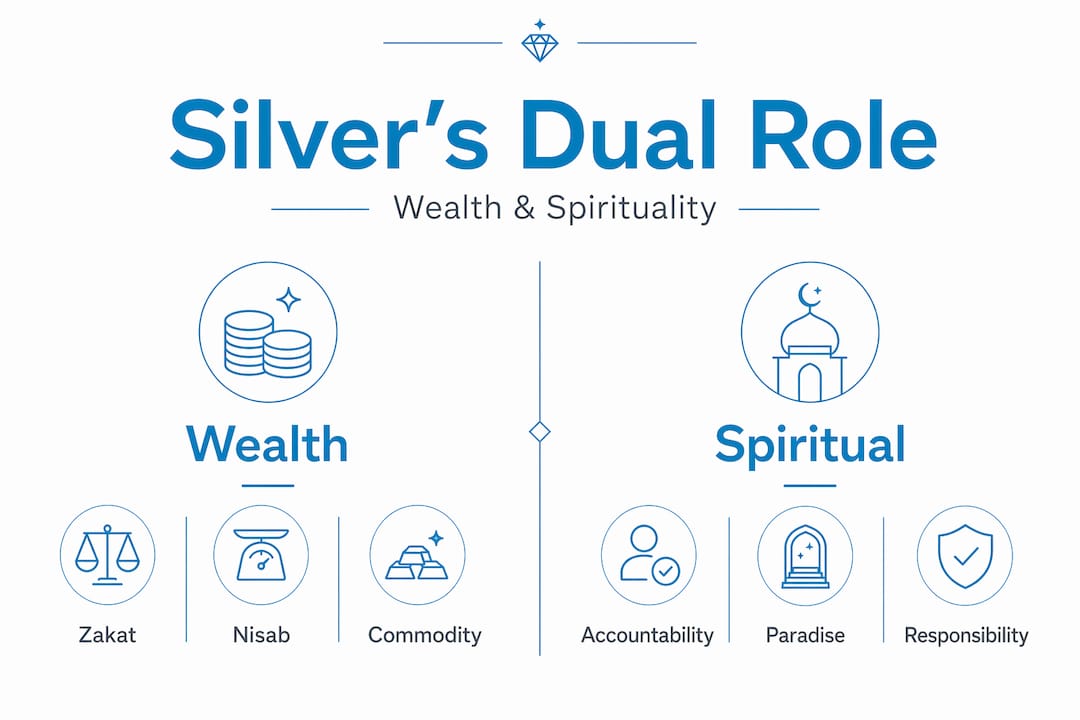
It is worth noting that scholars differ on whether silver jewelry worn regularly for adornment is subject to zakat. Many Hanafi scholars include it, while Shafi’i and Maliki scholars often exempt it. This is a nuance worth discussing with a qualified scholar based on your situation.
Key spiritual dimensions tied to silver as wealth include:
- Purification of wealth: Paying zakat on silver is an act of tazkiyah, a purification that removes spiritual attachment to material possessions.
- Accountability before Allah: Holding silver above the nisab without paying zakat is treated as a serious matter in Islamic texts.
- Community responsibility: Zakat on silver redistributes wealth to those in need, making your silver a tool of social justice.
- Intentionality: The obligation connects everyday financial decisions to a larger framework of worship and gratitude.
Pro Tip: If you are unsure whether your silver jewelry counts toward your zakat calculation, consult a local Islamic scholar or a reputable zakat organization. The ruling can vary depending on how the jewelry is used and which school of jurisprudence you follow.
The practical and spiritual dimensions here are inseparable. Silver is not just a commodity in Islam. It is a trust, and how you manage that trust reflects your relationship with Allah.
Silver in Qur’anic imagery and eschatology
Beyond its earthly function, silver holds a special place in Islamic eschatology, which is the study of the afterlife and the final realities described in Islamic texts. Specifically, silver appears in the Qur’an as part of the imagery of Jannah, Paradise.
Surah Al-Insan (76:15) describes the rewards awaiting the righteous in Paradise:
“And they will be served with vessels of silver and cups of crystal.” (Qur’an 76:15)
This is not a passing detail. According to Ibn Kathir’s tafsir, the silver vessels of Paradise are part of a broader picture of honor and divine generosity. The righteous are served, not serving. The vessels are described as gleaming, pure, and perfectly proportioned. This imagery communicates something important: in the Qur’anic worldview, silver is associated with nobility, reward, and purity in their highest forms.
This eschatological use of silver creates a meaningful contrast with its earthly role:
| Context | Role of silver | Spiritual message |
|---|---|---|
| Earthly life | Wealth subject to zakat | Accountability and purification |
| Paradise (Jannah) | Vessels and cups for the righteous | Divine reward and honor |
| Prophetic tradition | Permitted adornment (rings) | Modesty and permitted beauty |
| Cultural overlays | Mystical protection, luck | Not grounded in authentic sources |
The Qur’anic use of silver in Paradise imagery is deliberate. It takes something familiar from human experience, a precious metal associated with beauty and value, and elevates it into a symbol of divine generosity. The silver of this world is temporary and subject to obligation. The silver of the next world is a gift from Allah to those who were patient, grateful, and righteous.
This is a powerful spiritual framework. It means that when you look at silver, you can hold two realities at once: the responsibility it carries in this life and the reward it represents in the next. That dual meaning is entirely grounded in Qur’anic text, and it gives silver a depth that no cultural myth could match.
It is also worth noting that the Qur’anic imagery of silver in Paradise is not isolated. Surah Al-Insan goes on to describe gardens, flowing water, fine garments, and a sense of profound peace. Silver is part of a complete vision of divine reward, not a standalone symbol. Understanding it in that context makes the meaning richer and more accurate.
Permitted adornment versus unsupported symbolism
This leads to the question: does silver carry extra spiritual weight in everyday actions, or is its role strictly defined?
The answer from Islamic scholarship is clear. Wearing silver is permitted. The Prophet Muhammad (peace be upon him) wore a silver ring, and this is well-documented in authentic hadith. That prophetic example establishes that silver adornment is lawful for men and women within certain guidelines. For men, silver rings are generally permitted while gold is not, based on prophetic narrations.
However, scholarly guidance on silver rings makes something equally clear: there is no authentic evidence that wearing a silver ring on a specific day, in a specific month like Rajab, or with a specific intention of gaining extra closeness to Allah carries any religious virtue. The practice of assigning special spiritual power to silver based on timing or folk tradition is not supported by the Qur’an or authentic Sunnah.
Here is a practical breakdown of what is and is not grounded in Islamic sources:
- Wearing a silver ring as adornment: Permitted and consistent with prophetic practice.
- Wearing silver with the intention of modesty and simplicity: Aligned with Islamic values of avoiding excess.
- Believing silver protects you from evil because of its material properties: Not supported by any authentic text.
- Wearing silver on specific days for extra barakah (blessing): No authentic evidence; scholars flag this as potential bid’ah (innovation).
- Gifting silver jewelry engraved with Qur’anic verses: Permissible and meaningful when the verse is treated with proper respect.
Pro Tip: The spiritual value of any Islamic adornment comes from what it reminds you of, not from the material itself. A ring engraved with Ayatul Kursi carries meaning because of the verse, not because it is silver or gold-plated.
The concept of bid’ah, or religious innovation, is important here. In Islamic jurisprudence, introducing a new religious practice that has no basis in the Qur’an or Sunnah is considered a serious matter. This does not mean all cultural practices are forbidden. It means that when you assign religious virtue to something, that claim needs to be grounded in authentic evidence. Silver jewelry is beautiful and permissible. Claiming it brings you closer to Allah simply by wearing it, without any textual basis, crosses into unsupported territory.
Misconceptions and cultural overlays: Silver symbolism beyond Qur’an and Sunnah
With the legal and spiritual limits clarified, it is important to address where misconceptions originate and how to tell authentic symbolism from cultural overlays.
Many popular ideas about silver in Islamic culture come from sources outside the Qur’an and Sunnah. Some come from folk traditions passed down through generations. Others come from psychological color symbolism, where silver is associated with clarity and intuition in Western frameworks that have no connection to Islamic thought. Still others come from dream interpretation traditions that, while present in Islamic culture, are not always reliable guides to symbolic meaning.
Common misconceptions worth addressing include:
- Silver protects against the evil eye or jinn: Protection from harm in Islam comes through specific Qur’anic supplications and practices, not through the material properties of silver.
- Wearing silver in Rajab or Sha’ban brings special blessings: This claim has no authentic basis and is considered an innovation.
- Silver has a “pure” energy that cleanses the wearer spiritually: This is a concept borrowed from metaphysical traditions, not from Islamic theology.
- Dreaming of silver means a specific religious message: Dream interpretation in Islam is a complex field, and assigning fixed meanings to symbols like silver is not a reliable practice without scholarly grounding.
“Hold firmly to what is established in the Qur’an and Sunnah, and be cautious of what has no basis in them.” (Paraphrased principle from classical Islamic scholarship)
The mainstream Islamic scholarly position limits silver’s symbolic meaning to three well-defined areas: its role as wealth subject to zakat, its permissibility as adornment following prophetic example, and its appearance as a symbol of divine reward in Qur’anic descriptions of Paradise. Everything beyond those three areas requires careful scrutiny.
This does not mean cultural traditions around silver are worthless. Many of them reflect genuine love for beauty, community, and spiritual aspiration. But there is a difference between a cultural practice that enriches life and a religious claim that assigns spiritual virtue without evidence. Recognizing that difference is an act of intellectual honesty and religious integrity.
Why authentic evidence matters more than cultural symbolism
We want to share something that goes beyond the facts laid out above. At CĀIRO Jewellery, we think about this question a lot, because we make pieces that carry Qur’anic verses and Islamic symbols. And we have noticed something: the most meaningful jewelry is not meaningful because of its material. It is meaningful because of what it points to.
When someone wears an Ayatul Kursi ring, the power is not in the silver plating. The power is in the verse itself, in the reminder it creates, in the intention behind wearing it. The material is a vessel. The meaning is the message.
This is exactly what the Qur’anic imagery of silver in Paradise teaches us. Those silver vessels in Jannah are not valuable because silver is inherently magical. They are valuable because they represent Allah’s generosity to those who were faithful. The meaning comes from the source, not the substance.
We think this is a healthier and more honest relationship with Islamic symbolism. When you ground your understanding of silver in Qur’anic text and prophetic tradition, you get something far more stable than folk belief. You get a framework that connects your daily choices, your wealth, your adornment, your gifts to a coherent spiritual vision. That coherence is what gives Islamic practice its depth.
Cultural overlays are not always harmful. Sometimes they carry genuine wisdom or community memory. But when they start replacing textual evidence, or when people begin believing that silver itself has power independent of Allah’s will, the tradition loses its grounding. The antidote is not skepticism. It is knowledge. The more you understand what the Qur’an and Sunnah actually say about silver, the more clearly you can appreciate its real significance and let go of the rest.
Discover authentic Islamic adornment and giving
If this exploration of silver’s meaning in Islam has resonated with you, you might be looking for jewelry that reflects that same intentionality.
At CĀIRO Jewellery, every piece is designed around Qur’anic verses and Islamic symbols that carry real, textually grounded meaning. The Ayatul Kursi Ring is one of our most beloved pieces, engraved with the most powerful verse in the Qur’an and crafted to be worn as a daily reminder of Allah’s protection and greatness. Whether you are buying for yourself or for someone you would make dua for, our pieces are made to carry meaning that lasts. Every order also contributes to our ShareTheMeal partnership, donating meals to those in need, because authentic Islamic giving does not stop at adornment.
Frequently asked questions
Does silver have a specific spiritual virtue in Islam?
Silver symbolizes wealth, purity, and divine reward in specific Qur’anic and prophetic contexts, but no special religious virtue is attached to silver adornment beyond what is clearly defined in the Qur’an and Sunnah.
How is silver tied to zakat in Islamic law?
Silver is subject to zakat when it reaches the nisab threshold of approximately 595 grams and has been held for one full lunar year, signifying both financial responsibility and spiritual purification.
Are there myths about silver bringing barakah in Islamic culture?
Yes, and scholars are clear that seeking barakah from silver without any basis in the Qur’an or Sunnah is considered an innovation and is discouraged in mainstream Islamic scholarship.
What role does silver play in Paradise according to the Qur’an?
The Qur’an describes silver vessels in Paradise as part of the reward for the righteous, symbolizing divine honor, generosity, and the highest form of purity in the afterlife.