Most people look at a piece of jewelry and see something decorative. Something that catches light, completes an outfit, or signals a sense of style. But for many Muslims, a piece of jewelry worn close to the skin carries something far more significant. It carries intention, remembrance, and a quiet, constant connection to faith. Spiritual jewelry refers to pieces chosen for symbolic or devotional intent, worn as a reminder of beliefs rather than purely for appearance. This guide explores what that really means in an Islamic context, from the types of pieces that matter most to how to choose or gift them with genuine understanding.
Table of Contents
- What does ‘spiritual jewelry’ really mean?
- Key types of Islamic spiritual jewelry
- How spiritual jewelry functions: Remembrance and intention
- Gifting spiritual jewelry: What to consider
- Misconceptions to avoid about spiritual jewelry
- A deeper perspective: Why meaning is personal and what most guides miss
- Find meaningful Islamic jewelry at CAIRO
- Frequently asked questions
Key Takeaways
| Point | Details |
|---|---|
| Meaning beyond style | Spiritual jewelry in Islam serves as a reminder of faith and intention, not just a fashion statement. |
| Variety and etiquette | Islamic spiritual jewelry includes items like tasbih, Qur’anic pendant necklaces, and symbol charms, often with etiquette for handling. |
| Function over superstition | These items are practical aids for focus and remembrance, not magical objects. |
| Gift thoughtfully | When gifting spiritual jewelry, consider etiquette, the recipient’s beliefs, and the meanings attached to the piece. |
| Intention is key | The true power of spiritual jewelry comes from your purpose and remembrance, not the material or design. |
What does ‘spiritual jewelry’ really mean?
When we talk about spiritual jewelry, we’re not describing a vague aesthetic trend. We’re describing something purposeful. A piece becomes spiritual not because of the material it’s made from, but because of what it represents to the person wearing it and the intention they bring to it.
For Muslims, this concept is deeply rooted in the practice of dhikr, which means remembrance of Allah. A piece of jewelry inscribed with a Qur’anic verse or worn during moments of reflection serves as a physical anchor for that remembrance. It’s not superstition. It’s mindfulness made tangible.
The distinction matters because it separates spiritual jewelry from decorative jewelry in a very clear way. You can wear a beautiful necklace without any spiritual intent and it remains decoration. The moment you wear it as a reminder of your faith, as something that draws your thoughts back to gratitude or trust in Allah, it becomes something else entirely.
What actually qualifies as spiritual in an Islamic context?
- Jewelry inscribed with Qur’anic verses, such as Ayatul Kursi or Surah Al-Fatiha
- Tasbih or misbaha beads used for counting dhikr
- Pieces carrying Islamic symbols tied to remembrance or identity
- Items gifted with the sincere intention of blessing the recipient
In an Islamic context, wearable spiritual jewelry often overlaps with dhikr practices, linking physical objects directly to acts of worship and remembrance. This overlap is what gives these pieces their depth.
Psychologically, the connection makes sense too. Jewelry functions as identity-expression and association-building, meaning what we choose to wear shapes how we see ourselves and what we consistently think about. When you wear something tied to your faith, it can gently redirect your focus throughout the day.
| Type of piece | Primary purpose | Who it’s for |
|---|---|---|
| Tasbih/misbaha beads | Counting repetitions in dhikr | Active practitioners |
| Qur’anic verse pendant | Visual reminder of faith | Everyday wearers |
| Symbol-based jewelry | Identity expression and belonging | Those expressing Islamic values publicly |
| Verse-inscribed bracelet | Constant physical reminder close to the body | Those seeking grounding during daily life |
A quick note on meaning: A piece of jewelry doesn’t become spiritually meaningful because it’s expensive or elaborately designed. Meaning is created by the wearer, through intention, consistent use, and sincere faith.
Key types of Islamic spiritual jewelry
Understanding what makes jewelry spiritual is one layer of the picture. The next is knowing what kinds of pieces are actually most relevant and meaningful in an Islamic context. Each type serves a slightly different purpose, and choosing the right one depends on what you or the recipient actually needs.
1. Tasbih and misbaha beads
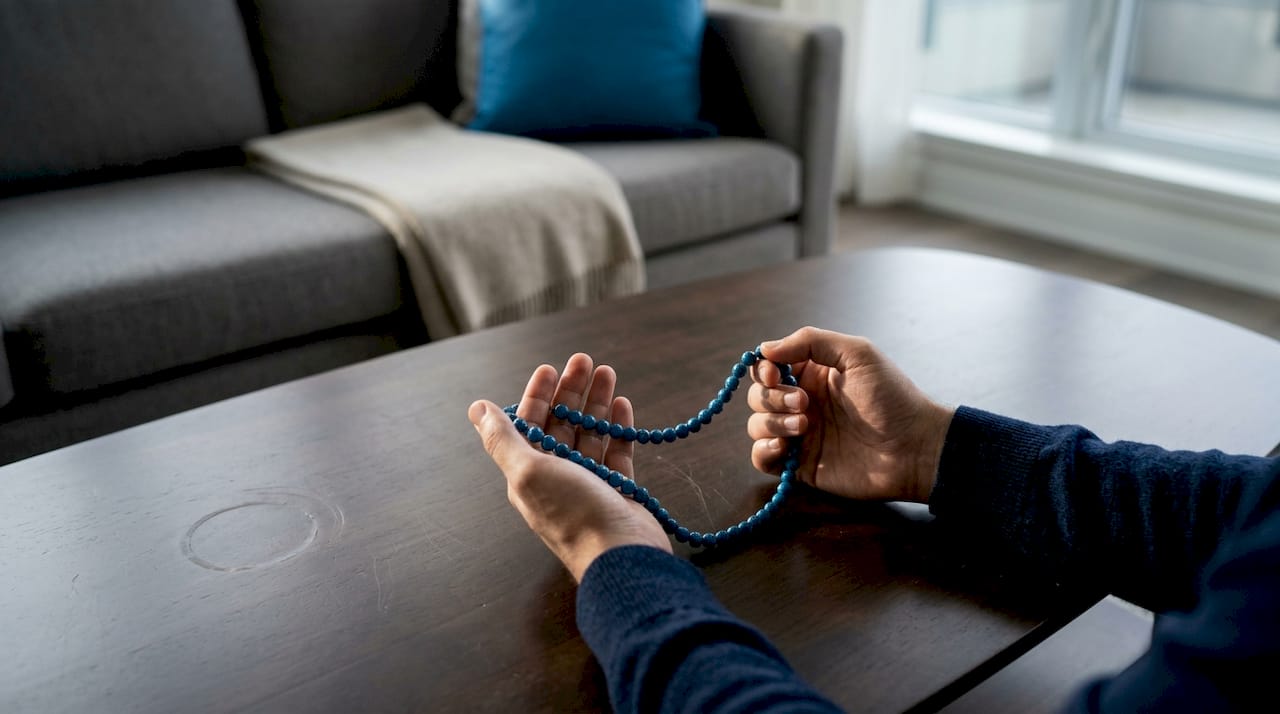
Tasbih beads are used as tactile counting aids for dhikr in Islamic practice, traditionally comprising 33 or 99 beads. Moving your fingers from bead to bead while repeating phrases like Subhanallah, Alhamdulillah, or Allahu Akbar creates a meditative rhythm. Some people carry misbaha in their pocket or wrapped around their wrist throughout the day. The physical sensation of the beads helps maintain focus, particularly during moments when the mind wants to wander.
2. Necklaces with Qur’anic inscriptions
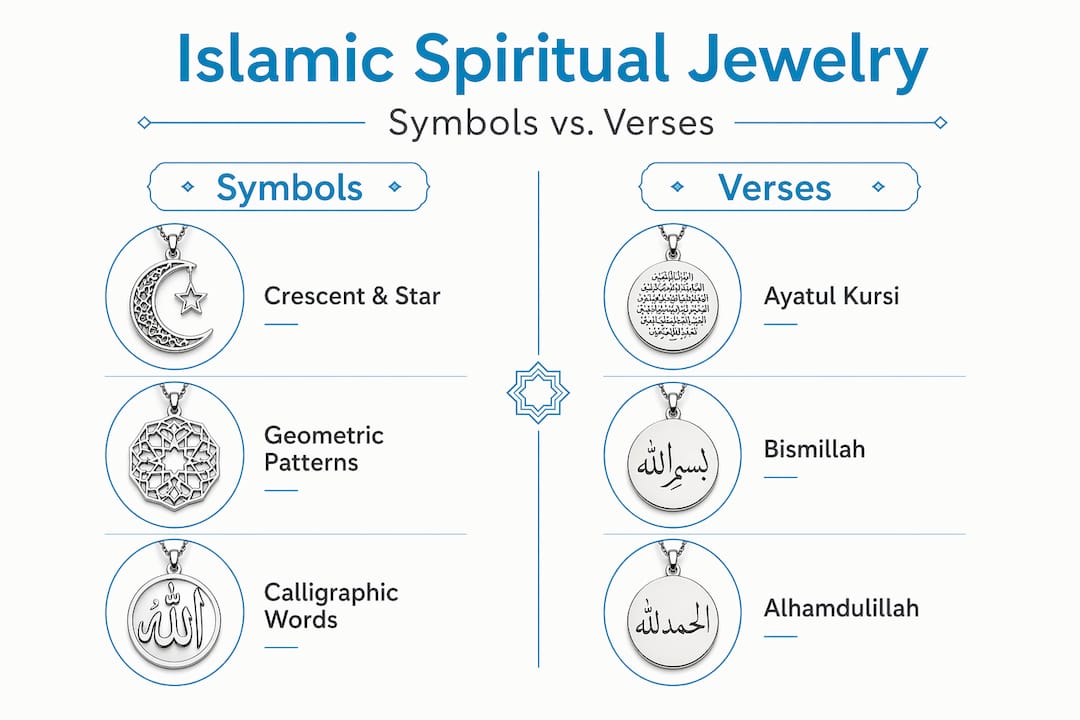
Perhaps the most recognizable form of spiritual jewelry for Muslims, these pieces carry verses from the Qur’an, often etched onto a small pendant in Arabic calligraphy. Ayatul Kursi (2:255) is one of the most commonly used verses, known for its powerful message about Allah’s sovereignty and protection. Wearing this verse close to your chest isn’t about magical protection but about keeping that reminder always near, so that when you glance down or touch the pendant, your heart turns back to what matters.
3. Symbol-based pieces
These might include the Crescent and Star, geometric Islamic patterns, or phrases like Bismillah or Alhamdulillah rendered in minimalist calligraphy. These pieces often serve an identity function as much as a spiritual one. They quietly announce your faith to the world and reinforce a sense of belonging to a global ummah. For Muslims living in Western countries especially, wearing symbols of Islamic identity can feel deeply affirming.
4. Verse-inscribed bracelets
A bracelet keeps the word of Allah literally on your wrist. That physical proximity makes it one of the most intimate forms of spiritual jewelry. When you raise your hands in prayer, when you reach out to help someone, when you feel anxious and look down at your hands, the verse is there. Pieces like an Ayatul Kursi bracelet carry that particular kind of closeness.
Etiquette to be aware of:
- Pieces with Qur’anic text should be removed before entering the restroom
- It is advisable to remove them during wudu (ablution) to maintain proper respect
- Store them carefully, ideally wrapped or placed in a clean space
- Do not place them on the floor or in locations where they might be stepped on
Pro Tip: If you’re buying a Qur’anic jewelry piece for yourself or someone else, look for stainless steel or gold-plated versions that are durable and waterproof. This makes following etiquette easier since you can remove and replace the piece quickly without worrying about damage.
How spiritual jewelry functions: Remembrance and intention
There’s an important distinction that’s worth being clear about. Islamic spiritual jewelry does not function through magical properties. It does not protect you simply because it exists on your body. It is a tool, and like any tool, its value depends entirely on how you use it.
The concept of niyyah (intention) is central to Islamic practice. Every act, whether prayer, charity, or even eating, begins with intention. The same logic applies to wearing spiritual jewelry. If you put on an Ayatul Kursi necklace absentmindedly because it looks nice, you lose much of its deeper purpose. But if you put it on with the conscious thought that you want it to remind you of Allah’s protection and sovereignty throughout your day, it becomes something that consistently pulls your attention back to faith.
Tasbih practice relates to dhikr; meaning comes from the phrase repeated and the focus the counting beads provide. This is a useful framework for understanding all spiritual jewelry. The object itself is neutral. It’s the intention, the habit, and the consistency of remembrance that give it life.
How spiritual jewelry supports daily faith:
- It provides a physical prompt for remembrance, especially during stressful moments
- It creates a habitual connection between touching or seeing the piece and turning thoughts toward Allah
- It can serve as a quiet act of dawah (inviting others to learn about Islam) when people ask about its meaning
- It grounds identity during moments when faith may feel distant or tested
- It reminds you of blessings, particularly when the verse inscribed speaks directly to comfort or protection
“And He is with you wherever you are.” (Qur’an 57:4) — Wearing a verse as a reminder is simply holding this truth a little closer.
The emotional and spiritual effect of consistently touching or viewing something tied to your faith cannot be understated. Think about how often your hands move during a normal day. A bracelet on your wrist is in your field of vision constantly. That kind of passive, repeated exposure to sacred text quietly shapes your thinking in ways you may not even consciously notice.
Gifting spiritual jewelry: What to consider
Spiritual jewelry is one of the most meaningful gifts you can give to a fellow Muslim. It says something that most material gifts cannot: I thought about your faith and your soul, not just your preferences. But thoughtful gifting requires a little more care than picking something beautiful.
Before you choose a piece, consider these questions:
- Is the recipient someone who is comfortable wearing Qur’anic text publicly? Not everyone feels ready for that visibility, and that’s completely valid.
- Does the verse or symbol you’re choosing resonate with something specific in their life right now? A necklace with the phrase “With hardship comes ease” (Qur’an 94:5) can be extraordinarily meaningful for someone going through difficulty.
- Have you thought about etiquette around Qur’anic text? Sharing a note about how to handle the piece respectfully is a kind and thoughtful addition to the gift.
- Does the style suit them? Faith-based jewelry still needs to feel like them visually. A delicate gold-plated necklace hits differently than a bold silver bracelet, so consider their everyday style.
Gift nuance for Muslim buyers matters when a piece includes Qur’anic text, because both the design and the handling etiquette become part of the gift experience. A small note explaining the verse and how to care for the piece adds another layer of sincerity.
For broader gifting ideas beyond jewelry, a thoughtful spiritual gift guide can help you pair a meaningful piece with other items that reflect care for the recipient’s faith and well-being.
Pro Tip: When gifting, write a short personal message explaining why you chose that particular verse or symbol. The recipient’s understanding of your intention turns a beautiful object into a lasting memory.
Misconceptions to avoid about spiritual jewelry
There is a real risk of misunderstanding what spiritual jewelry is and is not. Some of this confusion comes from the broader wellness industry, which often uses language about “energy,” “vibrations,” and “protective powers” in ways that don’t align with Islamic theology.
Many spiritual energy claims about jewelry differ from established religious practice; Islamic remembrance tools are aids for focus, not magic. This is an important distinction. Wearing Ayatul Kursi does not make you bulletproof. It does not ward off evil through some inherent force contained in the metal. What it can do is remind you to seek protection through du’a (supplication), which is where real spiritual power lies in Islamic understanding.
Common misconceptions and the truth behind them:
- “Wearing this verse will protect me automatically.” Protection comes from Allah. The verse reminds you to ask for and trust in that protection.
- “The more expensive the piece, the more spiritual power it has.” Meaning is entirely independent of price. A simple stainless steel bracelet worn with sincere intention outweighs a gold ring worn without thought.
- “All Islamic symbols mean the same thing to every Muslim.” Context, culture, and personal history all shape how a symbol is received. What feels deeply meaningful to one person may feel neutral to another.
- “You can wear Qur’anic jewelry anywhere without any special consideration.” The written word of Allah deserves respect, which means following the handling etiquette outlined earlier.
- “Spiritual jewelry replaces prayer or worship.” It doesn’t. It supports and complements your practice by keeping your mind oriented toward faith during the spaces between formal worship.
Being clear about these distinctions helps you approach spiritual jewelry with both authenticity and reverence, which is exactly the spirit in which it should be worn or given.
A deeper perspective: Why meaning is personal and what most guides miss
Here’s something most articles about spiritual jewelry won’t say: there is no universal formula for what a piece will mean to you. Two people can wear identical Ayatul Kursi bracelets and have completely different experiences. For one person, it becomes a daily anchor that genuinely shifts how they move through the world. For another, it sits on the wrist and eventually becomes background noise.
The difference has nothing to do with the jewelry and everything to do with what the wearer brings to it. How often do they actually pause and reflect on the verse? Do they know its meaning deeply enough for it to speak to them in difficult moments? Did they receive it from someone whose love they feel every time they look at it?
This is why we’d encourage you to go beyond the market description when choosing or wearing a spiritual piece. Read the verse it carries. Sit with its meaning. Understand why Ayatul Kursi, for example, has been recited by Muslims for centuries as a means of drawing close to the truth of Allah’s power and protection. When you know why a verse matters, the piece that carries it transforms.
There is also something worth saying about the gifting dimension. The most powerful spiritual gifts are not necessarily the most elaborate ones. They are the ones where the giver clearly considered the recipient’s heart, their struggles, their faith journey. Giving someone a necklace that says “With hardship comes ease” when you know they’re going through a difficult season is not just a gift. It’s a declaration of love and solidarity, rooted in Qur’anic truth.
Intention always outweighs the object. That’s not a limitation of spiritual jewelry. It’s the whole point.
Find meaningful Islamic jewelry at CAIRO
If this guide has inspired you to explore spiritual jewelry for yourself or someone you care about, we would love for you to discover what we’ve created at CĀIRO Jewellery.
Our Ayatul Kursi jewelry collection brings one of the most beloved verses in the Qur’an into beautifully crafted, everyday pieces. Whether you’re drawn to a bracelet you’ll feel on your wrist throughout the day or a necklace worn close to your heart, each piece is designed to carry genuine meaning. We also offer Hardship Comes Ease pieces for those moments when someone you love needs a reminder rooted in Qur’anic truth. Every order also contributes meals through our ShareTheMeal collaboration, because a meaningful gift should do good beyond the person receiving it.
Frequently asked questions
What makes jewelry truly ‘spiritual’ in Islam?
Jewelry becomes spiritual when worn with the intention to remember Allah, inspire devotion, or express faith rather than for decoration alone. Spiritual jewelry is chosen for symbolic or devotional intent, with meaning created through purpose and consistent use.
Is wearing Qur’an verses as jewelry respectful?
Yes, it is respectful when proper etiquette is observed, including removing the piece in restrooms and storing it carefully. Jewelry with Qur’anic text carries handling etiquette considerations that are part of honoring the sacred nature of the verse.
Are Islamic spiritual items like tasbih beads magic?
No. Tasbih serves as an aid for dhikr, helping the wearer count repetitions and maintain focus during remembrance. These items support worship but hold no magical power on their own.
Can spiritual jewelry make a good gift?
Absolutely, when chosen with thought for the recipient’s beliefs, their current circumstances, and proper etiquette around religious texts. Gift nuance is especially important when Qur’anic text is involved, making a personal note about the verse’s meaning a meaningful addition to the gift.