Many Muslim individuals want jewellery that genuinely reflects their faith, but the line between a meaningful spiritual reminder and a forbidden amulet can feel unclear. Islamic jewellery meaningful supplication pairing is not just about aesthetics. It requires understanding Islamic rulings, proper intention (niyyah), and how specific pieces connect to the supplications you recite. This guide cuts through the confusion and gives you a clear, respectful framework for choosing, wearing, and gifting jewellery that honors your faith rather than compromising it.
Table of Contents
- Understanding Islamic jewellery and meaningful supplications
- Preparing to choose jewellery: materials, intentions, and traditions
- Executing meaningful pairing: jewellery pieces with supplications
- Verifying authenticity and avoiding common mistakes
- The unseen power of intention in Islamic jewellery pairing
- Explore meaningful Islamic jewellery at CAIRO
- Frequently asked questions
Key Takeaways
| Point | Details |
|---|---|
| Meaningful pairing | Pair Islamic jewellery with appropriate supplications to enrich your daily spiritual practice effectively. |
| Choose materials wisely | Select silver rings and authentic Yemeni Aqeeq stones in line with Islamic traditions and rulings. |
| Intention is essential | The true spiritual benefit stems from sincere intention and faith rather than the physical jewellery itself. |
| Avoid amulets | Do not treat jewellery with Quranic verses as talismans; seek protection through recitation and prayer. |
| Verify authenticity | Ensure your Aqeeq stones and other pieces are genuine to maintain the jewellery’s spiritual and traditional value. |
Understanding Islamic jewellery and meaningful supplications
To build this understanding, let’s first explore what Islamic jewellery represents and how supplications integrate with these pieces.
Islamic jewellery is not decorative alone. Each type carries a distinct spiritual context rooted in tradition and purpose.
- Rings are among the oldest forms of Islamic adornment. The Prophet Muhammad (PBUH) wore a silver ring, and this practice established a Sunnah that continues today. Rings set with Aqeeq (carnelian) stones are particularly associated with barakah, meaning divine blessing.
- Necklaces and pendants engraved with Quranic verses serve as visual reminders of Allah’s words. The most common verse featured is Ayatul Kursi (Quran 2:255), the Throne Verse, which speaks of Allah’s absolute sovereignty and protection.
- Tasbih prayer beads are used for dhikr (remembrance of Allah) and help count repetitions of phrases like SubhanAllah (Glory be to Allah) and Alhamdulillah (Praise be to Allah).
Ayatul Kursi appears on approximately 80% of protective Islamic jewelry pieces like necklaces and rings, serving as a daily reminder for protection when recited after each of the five daily prayers. This is a critical distinction: the verse reminds you to recite it. The protection comes from the recitation and your sincere connection to Allah, not from the metal or stone itself.
Supplications (du’as) complement meaningful Islamic jewelry by reinforcing intention during wear. When you put on an Ayatul Kursi necklace and then recite the verse, the jewellery acts as a prompt, not a power source. This is the correct spiritual relationship between symbolic Islamic accessories and prayer. Explore our Muslim jewellery stacking guide for ideas on combining pieces while keeping this intention intact.
Preparing to choose jewellery: materials, intentions, and traditions
With this preparation, you will be ready to select jewellery that honors Islamic practices and supports meaningful supplications.
Before you purchase or gift any piece, there are three things to get right: material, placement, and intention.
Material rulings matter. Gold is forbidden for men in Islam, while silver rings are permitted and preferred, following the Prophet’s Sunnah. Women face no such restriction and may wear gold freely. If you are buying Islamic prayer jewelry for a man, always confirm the base metal. Many modern pieces use stainless steel with silver or gold plating, which scholars generally consider permissible since the base is not gold.
Aqeeq stones carry Sunnah significance. Aqeeq carnelian rings, especially the Yemeni red variety, are worn by men on the right hand little or ring finger following the Sunnah of Prophet Muhammad (PBUH), with prices ranging from $20 to $200 as of 2026. The stone itself is not magical. Its significance is tied to the Sunnah practice and the wearer’s sincere intention.
Intention (niyyah) is everything. A piece of jewellery has no power independent of Allah. Wearing it as a reminder to recite a verse or make du’a is sound. Wearing it believing the object itself protects you crosses into problematic territory.

| Material | Permissibility for men | Permissibility for women | Spiritual association |
|---|---|---|---|
| Silver | Permitted and Sunnah | Permitted | Purity, Prophetic tradition |
| Gold | Forbidden | Permitted | Adornment, blessing |
| Stainless steel | Generally permitted | Permitted | Durability, modern practice |
| Aqeeq (carnelian) | Sunnah-inspired | Permitted | Barakah, protection through faith |
| Quranic engravings | Permitted as reminder | Permitted as reminder | Spiritual mindfulness |
Explore more about silver in Islam and its deep spiritual symbolism before making your selection.
Pro Tip: When gifting jewellery for supplication, include a handwritten note with the relevant du’a or verse written out. It reinforces the correct intention from the moment the recipient opens the gift.
Executing meaningful pairing: jewellery pieces with supplications
Let’s now apply these pairing methods through clear action steps to enrich your daily spiritual routine.
Pairing jewellery with supplications is a practice of mindfulness, not ritual magic. Here is how to do it correctly and consistently.
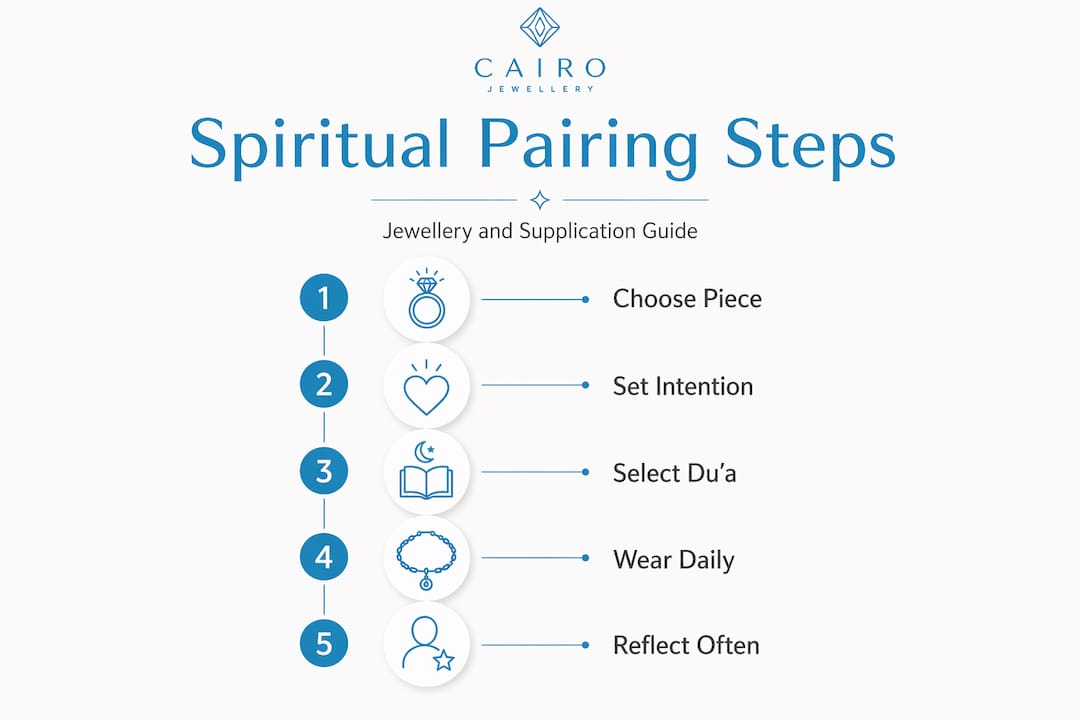
Step-by-step guide to mindful jewellery pairing:
- Set your intention before putting on any piece. Say Bismillah (In the name of Allah) and remind yourself the item is a reminder, not a source of protection in itself.
- Pair your Ayatul Kursi necklace or ring with its verse. After each of the five daily prayers, recite Ayatul Kursi in full. The jewellery engraved with the verse keeps this practice visible throughout your day.
- Wear an Aqeeq ring on the right hand little or ring finger. As you put it on, make du’a for barakah and good character. The physical act of placing it on the correct finger connects you to the Prophetic tradition.
- Use tasbih prayer beads after salah. Tasbih beads typically have 33, 99, or 34 beads for dhikr counting phrases like SubhanAllah 33 times, used post-prayer for remembrance rather than formal salah. Hold the beads, count your phrases, and let the physical object anchor your focus.
- Close with a personal du’a. After your dhikr, make sincere supplication for whatever you need. This is where the spiritual benefit is fully realized.
Pairing dos and don’ts:
- Do use jewellery as a visual prompt to recite the verse or phrase it represents
- Do choose pieces that reflect your personal spiritual reminders, whether that is Ayatul Kursi, a phrase of gratitude, or a symbol of hope
- Do gift supplication jewelry sets with an explanation of the verse or du’a attached
- Don’t treat any piece as a talisman that independently wards off harm
- Don’t believe the jewellery needs to be worn continuously to maintain protection
- Don’t neglect the recitation and rely solely on the physical presence of the item
Pro Tip: If you are shopping for modern Muslim jewelry online, look for brands that explain the spiritual meaning behind each piece. A brand that educates you on correct intention is one that respects your faith, not just your purchase.
Verifying authenticity and avoiding common mistakes
After selecting and pairing your jewellery thoughtfully, it is equally important to verify authenticity and steer clear of improper practices.
Two types of authenticity matter here: the authenticity of the stone or material, and the authenticity of your practice.
Verifying Aqeeq stones. The market is flooded with fake Yemeni Aqeeq. Authentic stones have a deep red color and no bubbles inside, which indicate a genuine stone rather than dyed glass or resin. Hold the stone up to light. Real carnelian shows natural banding and translucency without the uniform appearance of fakes.
Understanding scholarly guidance on Quranic verse jewellery. This is where many Muslims need clarity. Scholars at IslamToday.net note that wearing Quranic verses on jewelry was not practiced by the Companions of the Prophet and should be approached with caution to avoid confusion with shirk (associating partners with Allah), even though wearing such pieces does not itself constitute polytheism.
The stronger scholarly position comes from the Permanent Committee for Research and Verdicts:
“He who wears an amulet, may Allah not help him.” The Permanent Committee states that amulets containing Quranic words are unlawful according to hadith, and that recitation is the correct means of seeking protection, not wearing.
This does not mean all Quranic jewellery is forbidden outright. It means your intention and understanding must be clear. You wear the piece as a reminder to recite. The moment you believe the object itself protects you, you have crossed a line. For additional scholarly views on Quranic verse jewelry, consulting trusted Islamic scholars remains the best approach.
Common mistakes to avoid:
- Treating pairing Islamic amulets as a substitute for sincere du’a and salah
- Purchasing fake stones without verifying authenticity
- Gifting jewellery without explaining the correct intention to the recipient
- Misunderstanding scholarly rulings and either dismissing all Islamic jewellery or treating it as magical
- Wearing pieces to bathrooms or impure places where Quranic text should not be taken
For more guidance on building a respectful collection, our stackable Muslim jewellery guide covers how to layer pieces without compromising their spiritual significance.
The unseen power of intention in Islamic jewellery pairing
Here is what most articles on this topic miss entirely: the conversation about Islamic jewellery meaningful supplication pairing almost always focuses on the object. The ring. The necklace. The stone. But the real question is what is happening inside you when you wear it.
Many people come to Islamic jewellery after a period of difficulty. They want something that feels like protection, like closeness to Allah, like a tangible expression of faith during a time when faith feels fragile. That is a deeply human impulse. And it is not wrong. What matters is where you place the source of that protection.
Islamic tradition is unambiguous: all blessings come from Allah, not from the stone or the metal. The Aqeeq ring does not carry barakah the way a battery carries charge. It carries meaning because you carry intention. When you look at it and remember to say SubhanAllah, or when you touch your Ayatul Kursi necklace and recite the verse before a difficult meeting, the jewellery has done its job. It has pointed you back to Allah.
“Wear Aqeeq with good intention and faith that all blessings come from Allah, not the stone itself.”
This reframe changes everything about how you shop, how you gift, and how you wear. A piece of meaningful jewellery layering becomes a daily spiritual practice rather than a fashion choice with religious aesthetics. A gift becomes a du’a made physical. You are not giving someone a lucky charm. You are giving them a reminder to turn to Allah.
The Muslims who get the most from significant Islamic charms and customized Islamic pendants are not the ones who believe the objects are powerful. They are the ones who use the objects to remember who is.
Pro Tip: Pair your jewellery with a specific du’a you want to make more consistently. Every time you see or touch the piece, that du’a comes to mind. Over weeks, the habit forms. That is the real spiritual technology of Islamic jewellery.
Explore meaningful Islamic jewellery at CAIRO
Now that you understand how to choose and pair meaningful Islamic jewellery, CAIRO’s selections can help you bring that knowledge into your daily life.
At CAIRO Jewellery, every piece is designed with spiritual meaning at its center. Whether you are looking for a personal reminder or a gift for someone you would make du’a for, the Ayatul Kursi collection features necklaces and rings crafted to serve as daily spiritual anchors, not decorative objects.
If you want to build a purposeful spiritual stack, the Complete the Look collection brings together complementary pieces designed to be worn together with intention. Each order also contributes meals through CAIRO’s ShareTheMeal collaboration, so your purchase carries meaning beyond the jewellery itself. This is the kind of gift that means something.
Frequently asked questions
Is it permissible to wear jewelry engraved with Quranic verses?
Wearing jewelry with Quranic verses is generally discouraged by scholars to avoid confusion with prohibited amulets; protection is sought primarily through sincere recitation rather than wearing the verse.
What finger should a man wear an Aqeeq ring on according to Sunnah?
Men traditionally wear an Aqeeq ring on the right hand little or ring finger following the Sunnah of Prophet Muhammad (PBUH), with the right hand being the preferred choice.
Are Tasbih prayer beads required for performing dhikr?
Tasbih beads are a helpful tool for counting dhikr repetitions but are not required for dhikr; many Muslims count on their fingers or simply recite the phrases without counting aids.
How can I verify the authenticity of a Yemeni Aqeeq stone?
Authentic Yemeni Aqeeq stones are identified by a deep rich red color and the absence of bubbles or uniform appearance, both of which indicate the fakes commonly sold in markets today.