Jewelry in Muslim culture carries a weight that goes far beyond aesthetics. For millions of Muslims worldwide, a piece of jewelry is a declaration of faith, a memory of ancestry, and a quiet act of worship worn close to the skin. The role of jewelry in Muslim identity is often misunderstood from the outside — reduced to fashion or dismissed as purely decorative. But when you look closely, you find something far richer: a tradition shaped by Quranic guidance, regional craftsmanship, spiritual symbolism, and deeply personal stories passed from one generation to the next.
Table of Contents
- Key Takeaways
- The role of jewelry in Muslim identity across history
- Spiritual symbols and sacred inscriptions in Islamic jewelry
- Gender roles and religious guidelines around jewelry
- How jewelry carries personal and emotional meaning
- Choosing and wearing jewelry that honors your identity
- My perspective on jewelry as spiritual storytelling
- Jewelry that carries your faith forward
- FAQ
Key Takeaways
| Point | Details |
|---|---|
| Jewelry reflects faith, not just style | In Muslim culture, pieces often carry Quranic verses and spiritual symbols that serve as daily reminders of Allah. |
| Regional traditions vary widely | From Ottoman filigree to Amazigh silverwork, Islamic jewelry reflects diverse cultural heritages within a shared faith. |
| Religious guidelines shape choices | Islamic jurisprudence distinguishes clearly between what men and women may wear, grounding jewelry in intention and modesty. |
| Heirlooms preserve family and faith | Passed-down pieces act as living archives of family history, especially within diasporic Muslim communities. |
| Mindful wearing strengthens identity | Choosing jewelry with intention — whether for du’a, dhikr, or gifting — deepens its spiritual and emotional meaning. |
The role of jewelry in Muslim identity across history
To understand what jewelry means to Muslims today, you need to look back. Across Islamic civilization, jewelry was never simply ornamentation. It functioned simultaneously as a social marker, a spiritual symbol, and a form of cultural memory.
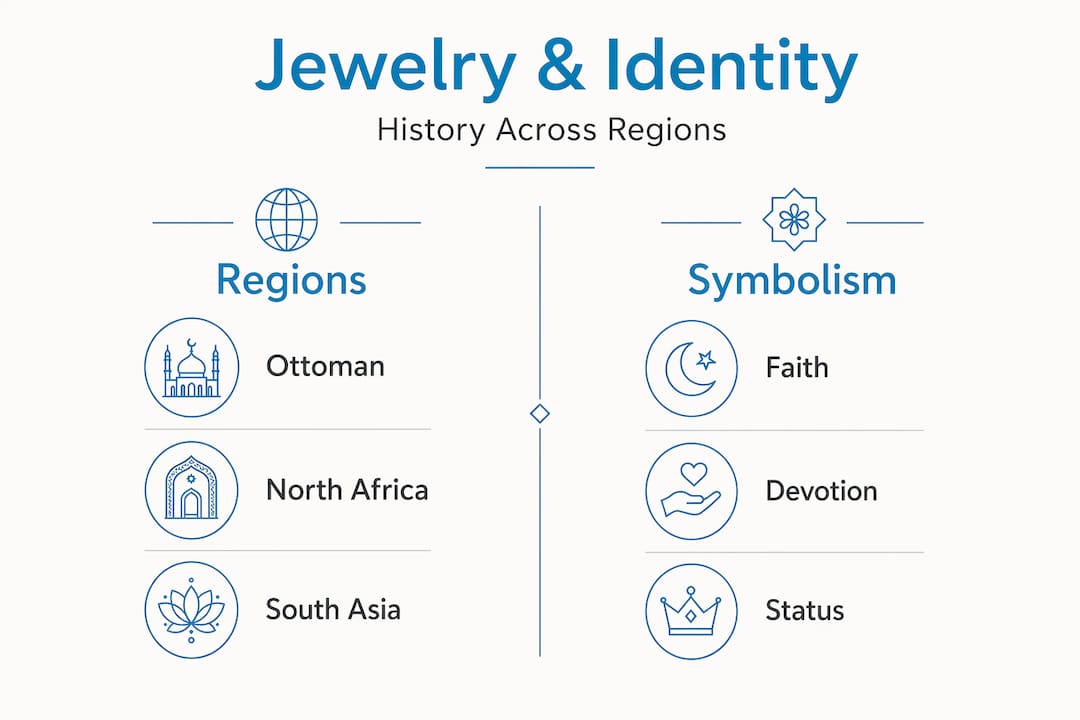
During the Ottoman era, filigree goldsmithing reached extraordinary levels of refinement. Artisans across Istanbul, Cairo, and Damascus created intricate pieces that communicated rank, devotion, and regional belonging all at once. In North Africa, Amazigh communities developed their own distinct silverworking traditions, producing heavy geometric talismans that encoded tribal identity and spiritual protection. The Khamsa and triangle motifs used across Moroccan jewelry, for example, conveyed meanings related to fertility, protection, and divine eternity — meanings that were understood communally without a single word being spoken.
What makes Islamic jewelry history particularly layered is its cross-cultural character. Jewish silversmiths in Morocco, for instance, played a foundational role in the development of Amazigh and Arab adornment traditions, creating pieces for Muslim clients over centuries of close coexistence. This kind of cultural exchange is woven into the objects themselves, making many traditional pieces impossible to fully understand without knowing the communities that shaped them.
Heirloom jewelry occupies a special place in this history. In cultures where written records were not always accessible, a grandmother’s silver bracelet or a mother’s wedding necklace became a living archive. The piece remembered what words sometimes could not. Heritage-inspired Islamic jewelry is seeing strong market growth today precisely because that hunger for cultural continuity is intensifying, not fading, among younger Muslim generations.
| Region | Traditional style | Key symbolism |
|---|---|---|
| Ottoman Empire | Filigree goldsmithing | Rank, devotion, imperial identity |
| North Africa (Amazigh) | Heavy geometric silverwork | Protection, tribal belonging, fertility |
| South Asia (Mughal) | Kundan and meenakari | Royalty, spiritual devotion |
| Arabian Peninsula | Embossed gold | Wealth, marital status, family honor |
Spiritual symbols and sacred inscriptions in Islamic jewelry
The symbolism of Islamic jewelry is not decorative by accident. Every motif, material, and inscription points toward something beyond itself.
Arabic calligraphy is perhaps the most direct expression of this. Common motifs include the 99 Names of Allah and Quranic verses engraved on rings, pendants, and bracelets as daily spiritual reminders. Wearing Ayatul Kursi, for example, is understood by many Muslims as a form of protection and remembrance — the verse held physically close to the body as a constant presence, not merely a decoration.
Geometric patterns carry equally deep meaning. Islamic geometric design is rooted in the principle that divine order and beauty reflect Allah’s creation. The infinite repeating patterns seen across Islamic art and architecture translate into jewelry as symbols of balance, unity, and the infinite nature of Allah. Wearing them is, in a quiet way, a form of dhikr.
Material choice matters too. Silver has a distinct spiritual significance in Islam. The Prophet Muhammad (peace be upon him) wore a silver ring, and silver is widely associated with purity, humility, and modesty. You can explore the full spiritual meaning of silver in Islamic tradition to understand why so many traditional Muslim jewelry styles favor it over other metals.
Pro Tip: When selecting a piece with a Quranic inscription, take time to learn the meaning of that specific verse or name. Wearing a piece you understand transforms it from an accessory into a personal act of remembrance.
| Symbol | Spiritual meaning | Common form |
|---|---|---|
| Ayatul Kursi | Divine protection and power of Allah | Rings, necklaces, bracelets |
| 99 Names of Allah | Remembrance, reflection on divine attributes | Pendants, bangles |
| Geometric patterns | Divine order, infinity, unity | Earrings, bangles, rings |
| Hamsa (Khamsa) | Protection, warding off harm | Necklaces, charms |
| Crescent and star | Islamic heritage and faith | Pendants, bracelets |
Gender roles and religious guidelines around jewelry
Islamic jurisprudence addresses jewelry with precision and intentionality, and understanding the rulings helps you wear your pieces with clarity and confidence.
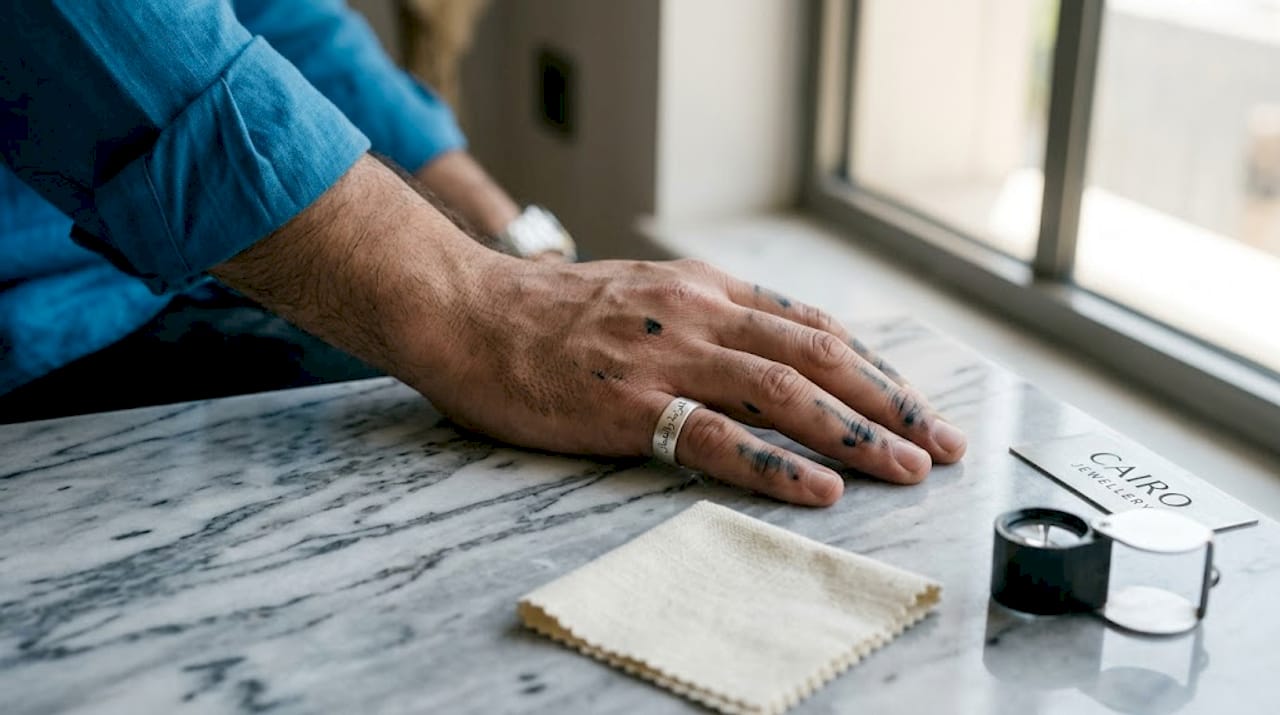
For men, the guidelines are specific. Men are permitted only a single silver ring weighing less than 4.375 grams. Gold is not permissible for men to wear, and multiple rings or ornamental bracelets fall outside what is prescribed. This is not a restriction for its own sake. It reflects the prophetic tradition of simplicity and modesty in male adornment.
For women, the framework is considerably wider. Gold, silver, and costume jewelry are all permissible within the boundaries of modesty. The central principle is not whether you wear jewelry, but whether the wearing of it draws inappropriate attention, especially before non-mahram men. Islam views adornment as a reflection of divine artistry when practiced without arrogance or distraction from worship. The tension to hold is not between faith and beauty, but between adornment and ego.
Here is how these principles typically shape jewelry choices in Muslim communities:
- Intention first. The niyyah behind wearing a piece matters. A woman wearing gold to honor a celebration differs from wearing it to display wealth or invite comparison.
- Context determines display. Jewelry that is appropriate in a private or family setting may be best kept covered in public, in alignment with broader modesty norms.
- Material boundaries for men. Men choosing to wear jewelry should stick to silver, specifically a single ring, and avoid pieces that mimic feminine ornamentation.
- Life-stage considerations. During the 'iddah period following divorce or the death of a spouse, women observe specific restrictions on adornment as part of a broader observance of mourning and restraint.
Pro Tip: If you’re unsure whether a particular piece aligns with your madhab’s guidelines, consult a trusted scholar. Clarity of intention always makes wearing jewelry more spiritually grounded.
How jewelry carries personal and emotional meaning
Beyond the theological and historical, there is something deeply personal about the jewelry Muslims choose to wear. A piece passed down from a grandmother who made hijrah, a ring bought in Makkah during Hajj, a necklace gifted by a parent before their final illness — these objects hold entire lives within them.
Heirloom jewelry acts as a tactile mnemonic that prompts prayer, mindfulness, and family remembrance. When you touch a ring that belonged to someone you loved, you are not just remembering them — you are engaging your faith. The object becomes a prompt for du’a, for gratitude, for connection to something that transcends the present moment.
For Muslims living in diaspora, this function becomes even more pronounced. When your cultural community is spread across continents and your language of faith is not the dominant one in your country, jewelry becomes a visible, portable form of belonging. Symbols like the Hamsa and Arabic calligraphy reinforce shared narratives and communal identity across geographic distance. They say, without words: I know who I am, and I know where I come from.
“Jewelry in drama is not decoration. It is visual storytelling.” — Nahed El-Karmody
This insight applies just as powerfully to real life. The jewelry you wear tells your story, your faith, your family, and your community, even in rooms where you are the only Muslim present. That is not a small thing. That is a form of quiet testimony.
Choosing and wearing jewelry that honors your identity
Knowing the history and symbolism of Islamic jewelry is one thing. Applying that knowledge to what you actually wear is another. Here is how to approach it with intention:
- Start with meaning, not appearance. Before choosing a piece, ask what it represents and whether that meaning aligns with your faith and cultural background. A piece with Ayatul Kursi or a name of Allah carries spiritual responsibility alongside beauty.
- Consider your cultural heritage. If your family comes from a Moroccan, Turkish, South Asian, or West African background, there are distinct jewelry traditions worth exploring. Wearing pieces connected to your heritage adds a layer of authenticity that generic fashion jewelry cannot offer.
- Choose artisans and brands with integrity. Ethical artisan craftsmanship preserves techniques like Ottoman filigree and Moroccan enameling. Supporting these makers keeps traditions alive and creates pieces with real cultural weight. For those navigating online purchases, understanding how to shop safely protects you from inauthentic products.
- Care for your pieces properly. Heirloom and artisan jewelry deserves thoughtful maintenance. Store silver pieces away from moisture and polish gently to preserve engravings. Quranic inscriptions especially should be treated with reverence.
- Think about gifting with intention. Ramadan, Eid, Hajj milestones, and new births are all meaningful occasions for jewelry gifts. Choose pieces that speak to the recipient’s faith story rather than simply their aesthetic preferences.
Pro Tip: If you want to layer multiple pieces without losing coherence, focus on a shared motif or material. A silver Ayatul Kursi ring paired with a silver bracelet bearing a Quranic verse creates unity without crowding. See the layering guide for Muslim jewelry for practical ideas.
My perspective on jewelry as spiritual storytelling
I’ve spent years watching how Muslims navigate their identity through the things they wear, and jewelry consistently carries more emotional freight than almost any other object. What strikes me most is not the grand heirloom pieces locked in family safes, but the small ones worn daily — a silver ring a student chose before university, a necklace a young mother bought herself after her first Ramadan alone in a new country.
What I’ve learned is that the role of jewelry in Muslim identity is rarely planned. It accumulates. Someone receives a piece at a significant moment, wears it through formative experiences, and gradually it becomes inseparable from who they are. The piece starts to mean something not because it was designed to, but because life happened while wearing it.
I think the real challenge for Muslims today is resisting the pull to treat Islamic jewelry as branding. There is a difference between wearing a Quranic verse because it grounds you in prayer and wearing it because it signals group membership. Both happen. But the first is what the tradition actually points toward: adornment as worship, not as performance.
My encouragement to you is this: choose pieces that make you think of Allah when you touch them. That is the oldest and most honest reason any Muslim ever wore jewelry in the first place.
— Elias
Jewelry that carries your faith forward
At Cairojewellery, every piece is designed around a single question: does this mean something? The brand’s Ayatul Kursi collection brings together rings, necklaces, and bracelets engraved with one of the most beloved verses in the Quran, crafted in stainless steel with gold and silver plating for everyday wear. These are not statement pieces designed to impress. They are quiet companions for your faith, made to be worn with intention and given to someone you would make du’a for.
Whether you are exploring your heritage for the first time or looking for a gift that reflects genuine spiritual care, Cairojewellery offers pieces that carry real meaning. Worldwide shipping, thoughtfully crafted designs, and a commitment to both beauty and purpose. Explore the full collection and find the piece that speaks to where you are in your faith right now.
FAQ
What is the role of jewelry in Muslim identity?
Jewelry in Muslim identity serves as a spiritual reminder, cultural marker, and personal narrative. Pieces engraved with Quranic verses or Islamic symbols connect wearers to their faith, heritage, and community on a daily basis.
Can Muslim men wear gold jewelry?
No. Islamic jurisprudence restricts men to wearing a single silver ring weighing less than 4.375 grams. Gold is not permissible for Muslim men to wear.
What symbols are most meaningful in Islamic jewelry?
The most significant symbols include Ayatul Kursi, the 99 Names of Allah, the Hamsa, and geometric patterns representing divine order. Arabic calligraphy and Quranic verses are among the most widely used motifs across Muslim cultures.
How does heirloom jewelry connect to Muslim faith?
Heirloom pieces act as physical reminders of family history and faith milestones, prompting du’a and dhikr when touched or worn. They preserve cultural and spiritual memory across generations, particularly in diasporic communities.
What should I look for when buying Islamic jewelry as a gift?
Choose a piece with a meaningful inscription or symbol that reflects the recipient’s faith. Consider the occasion, whether Eid, Ramadan, or a life milestone, and prioritize pieces from makers who treat Quranic inscriptions with the respect they deserve.