Adornment is one of the most misunderstood topics in Islamic practice. Many assume it is forbidden outright, something to be avoided in the name of modesty. But what does adornment mean in Islamic law actually points to a much more nuanced truth. Islamic law permits adornment within clear, compassionate limits, and understanding those limits can change how you think about faith-based jewelry, personal expression, and what it means to carry your values on your body. This guide covers the rules, the cultural significance, and the practical wisdom that helps Muslim consumers make choices they feel good about.
Table of Contents
- The meaning and permissibility of adornment in Islamic law
- Key Islamic restrictions and distinctions concerning adornment
- Cultural and marital dimensions of adornment in Islam
- Navigating adornment and modesty: practical advice and expert guidance
- A fresh perspective: why Islamic adornment is about dignity, not deprivation
- Explore faith-based jewelry that honors Islamic adornment values
- Frequently asked questions
Key Takeaways
| Point | Details |
|---|---|
| Adornment is permitted | Islamic law permits adornment but restricts public display to non-mahram men for women. |
| Specific restrictions exist | Men must avoid silk and cross-gender adornments, and Ihram requires stricter rules. |
| Intent and place matter | Purposeful display is forbidden, but accidental exposure is tolerated; knowing adornment places helps modesty. |
| Adornment strengthens relationships | Women are encouraged to beautify for their husbands within Shariah limits to enhance marital bonds. |
| Faithful shopping tips | Choosing jewelry that aligns with Islamic principles supports modesty and spiritual identity. |
The meaning and permissibility of adornment in Islamic law
The Arabic word for adornment is zinah, and it appears directly in the Quran. In Surah An-Nur (24:31), Allah instructs believing women not to display their zinah except to specific people. That single instruction tells us something important: adornment is assumed, expected even. The restriction is not on having it, but on whom you display it to.
At its foundation, Islamic jurisprudence treats adornment as a natural human inclination. Allah is beautiful and loves beauty, as noted in hadith literature. The key principle is not prohibition but proportionality. Adornment becomes a concern when it crosses from personal dignity into public provocation, arrogance, or distraction from worship.
Adornment is permitted in private settings and among close family. The primary boundary is public display to non-mahram men, meaning men who are not related to a woman in a way that makes marriage permanently forbidden, such as a father, brother, or husband. Within the home, among mahrams, there are generally no restrictions on jewelry, clothing, or beautification.
Here is what Islamic law generally permits and encourages:
- Wearing gold jewelry for women in most scholarly positions
- Silver rings for men, following the prophetic sunnah
- Henna, kohl, and other traditional beautification practices
- Decorating the home and personal space with beauty
- Wearing modern Muslim jewelry that carries meaningful Islamic symbols
The meaning of adornment in Islam, at its core, is beauty lived with intention.
Key Islamic restrictions and distinctions concerning adornment
Having grasped the general permissions, let’s explore specific Islamic restrictions and customs around adornment.
Not all forms of adornment are treated equally. Islamic law draws careful lines based on gender, material, and context. Understanding those lines is not about finding loopholes. It is about understanding what values those rules are protecting.

Gender-specific restrictions are among the clearest in Islamic jurisprudence. Men are prohibited from wearing silk and from adopting adornments traditionally associated with women. Cross-gender imitation, known as tashabbuh, is considered a major sin in multiple hadith narrations. This applies both ways. Women imitating distinctly male dress in a way that deliberately erases gender identity is also frowned upon.
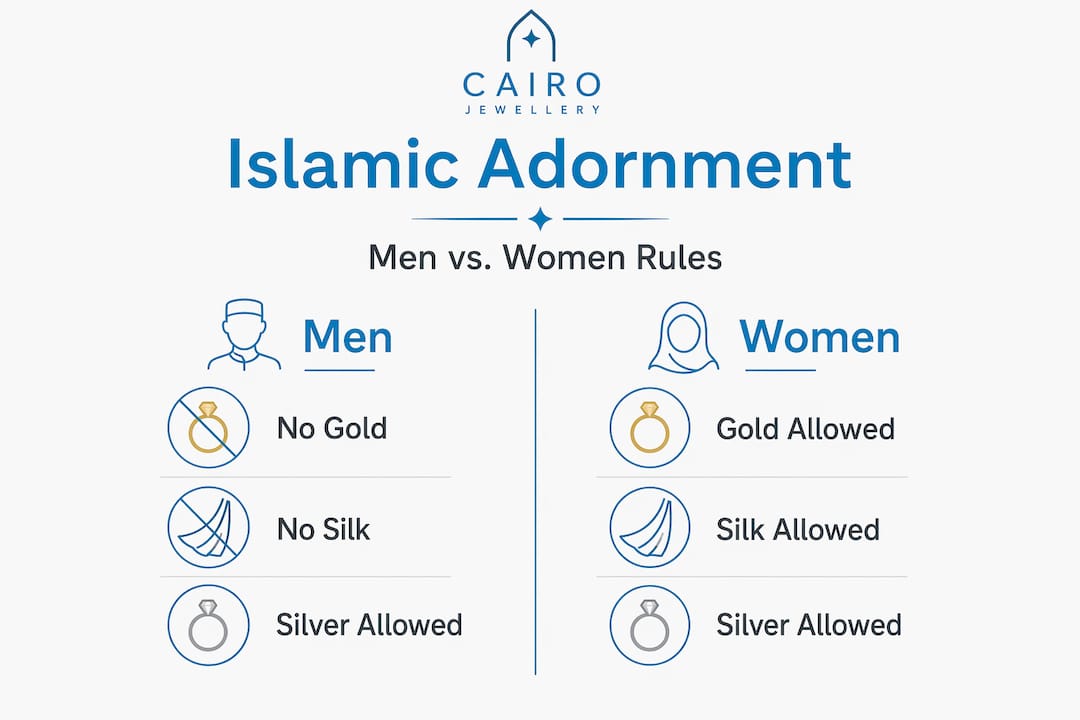
Here is a quick comparison of what is generally permitted versus restricted:
| Category | Men | Women |
|---|---|---|
| Gold jewelry | Not permitted (most scholars) | Permitted |
| Silver jewelry | Permitted (especially rings) | Permitted |
| Silk fabric | Not permitted | Permitted |
| Henna | Generally discouraged | Encouraged |
| Kohl (eyeliner) | Permitted for Sunnah use | Permitted |
The state of Ihram introduces a separate layer of restrictions. Ihram is the sacred state pilgrims enter when performing Hajj or Umrah. During this time, adornment is significantly restricted for both men and women. Women, notably, cannot cover their faces with a niqab during Ihram, even though covering the face may be their normal practice. If a woman does cover her face during Ihram out of necessity, she must pay a fidyah, which is an expiation that takes one of three forms: fasting, feeding the poor, or sacrificing an animal. This shows how seriously Islamic law takes the integrity of worship states, even when it means temporarily adjusting normal modesty practices.
Pro Tip: If you wear faith-based jewelry regularly, consider removing pieces that contain Qur’anic inscriptions before entering states of ritual impurity, or placing them in a pocket or bag as a sign of respect for the sacred words they carry. Many scholars recommend this as a mark of reverence.
There is also a nuanced conversation around silver symbolism in Islam and why silver holds a special place compared to gold for men, rooted directly in prophetic practice.
Additional restrictions to be aware of include:
- Wearing adornments out of arrogance or to flaunt wealth is condemned
- Excessively loud or attention-seeking adornment in worship spaces is discouraged
- Adornment that imitates non-Muslim religious symbols should be avoided
Cultural and marital dimensions of adornment in Islam
Beyond rules, adornment carries deep cultural and relational meanings worth understanding.
One of the most overlooked dimensions of the Islamic perspective on decoration is how strongly Islam encourages beautification within marriage. This is not a footnote in Islamic jurisprudence. It is a substantial principle. A wife adorning herself for her husband is considered a virtuous act, and Islam encourages this as a way to strengthen the marital bond and fulfill the rights of a spouse.
This framing shifts adornment from something purely aesthetic into something spiritually purposeful. You are not just wearing jewelry. You are expressing care for your relationship, honoring a covenant, and fulfilling an act that has religious weight behind it.
“The goal of modesty is maintaining dignity and character, not the deprivation of appearance.”
That distinction is worth sitting with. Modesty in Islamic law is never about making yourself less. It is about directing beauty intentionally. Public modesty protects a woman’s dignity from being reduced to her appearance. Private adornment within the home celebrates that same beauty in a space where it belongs.
The cultural meaning of adornment in Islam also reflects community identity. Certain pieces, a ring engraved with Ayatul Kursi, a necklace bearing a Qur’anic verse, carry identity markers that say something about who you are and what you believe. These are not decorative in the shallow sense. They are declarations.
Key principles around marital and cultural adornment include:
- Beautifying for one’s spouse is a recognized act of worship and care
- Adornment that expresses faith is distinct from adornment that seeks attention
- Community contexts (mosques, gatherings) call for more restrained choices than private settings
- Jewelry can serve as a dhikr reminder, keeping Allah’s words close throughout the day
If you want to explore how pieces can be worn together thoughtfully and modestly, the Muslim jewellery layering guide offers practical ideas that reflect these values.
Navigating adornment and modesty: practical advice and expert guidance
To apply these principles, here are expert tips on balancing adornment and modesty in daily and communal life.
One concept that often gets missed in conversations about adornment rules in Islam is the distinction Islamic scholars make between the adornment itself and the places of adornment. A bracelet is an adornment object. The wrist is a place of adornment. The ruling on covering applies to the places, not just the objects. So a woman covering her wrists with long sleeves is covering a place of adornment, even if the bracelet itself is hidden underneath.
This matters because it shapes how you think about modesty in practice. It is not about cataloging every piece of jewelry you own. It is about understanding which parts of the body require covering in which contexts, and choosing clothing accordingly.
Here is a practical framework for daily decisions:
- Identify the context. Are you at home, in a mixed public space, at a women-only gathering, or in a place of worship? Each context carries a different standard.
- Consider your intent. Wearing a piece because it brings you closer to Allah is different from wearing it to attract admiring looks. Scholars note that intent shapes the ruling in gray areas.
- Cover the places, not just the objects. Focus on ensuring the body parts associated with adornment are appropriately covered for the setting.
- Give yourself grace for unintended moments. If a bracelet slips visible or a necklace shows unexpectedly, unintended display is treated differently in jurisprudence than deliberate exposure. You are not sinning because of a wardrobe moment.
- Adjust for worship spaces. In mosques or during prayer, simpler, quieter adornment is preferred. This is about spiritual focus, not strict prohibition.
Pro Tip: When choosing faith-based jewelry for everyday wear, look for pieces that carry meaning quietly. A ring engraved with a Qur’anic verse is always present as a reminder without announcing itself loudly. That is the spirit of adornment in Islamic law: beauty with purpose, not performance. A halal jewelry shopping guide can help you make choices that align with both your faith and your aesthetic.
A fresh perspective: why Islamic adornment is about dignity, not deprivation
With these foundational insights, let’s step back and reconsider Islamic adornment from a fresh, practical viewpoint.
Here is something the mainstream conversation almost always gets wrong: the rules around adornment in Islamic law are not a ceiling. They are a foundation. They do not exist to make Muslim women (or men) less beautiful or less expressive. They exist to protect the weight of beauty. To ensure it lands in the right spaces, with the right people, for the right reasons.
When you understand adornment in Islam this way, faith-based jewelry stops being a compromise and starts being a statement. Every piece you choose deliberately, because it carries a verse, a symbol, or a value you believe in, is an act of intention. That is far more powerful than wearing something purely because it looks good.
We have seen this firsthand in how people connect with pieces engraved with Ayatul Kursi or inscribed with Qur’anic reminders. The jewelry does not just decorate the body. It keeps something close. It is the difference between fashion and wearable dhikr, remembrance you carry without even thinking about it.
There is also a practical wisdom in the adornment rules that does not get enough credit. By distinguishing between private and public display, Islamic law creates a framework where beauty is personal rather than performative. You are not dressing for the street. You are dressing for yourself, for your spouse, for the people who truly know you. That is a genuinely dignified way to live.
The challenge, honestly, is that modern fashion culture pushes in the opposite direction. It rewards visibility, volume, and spectacle. Choosing faithful jewelry styling that is meaningful rather than maximalist takes a quiet kind of confidence. But that confidence, rooted in knowing why you wear what you wear, is exactly what Islamic adornment is designed to cultivate.
Explore faith-based jewelry that honors Islamic adornment values
Now that you understand Islamic adornment, discover jewelry that respects these values while enhancing your personal style.
At CĀIRO Jewellery, every piece is designed with this understanding at its heart. Whether you are looking for something to wear as a daily reminder or searching for a gift for someone you would make dua for, the collections reflect what adornment in Islam is truly about: beauty, meaning, and intention held together.

The Ayatul Kursi collection brings the most powerful verse of the Quran into wearable form, available as a bracelet, necklace, or ring in gold-plated and silver-plated stainless steel. For those wanting to build a complete, cohesive look that still honors modesty principles, the Complete The Look collection offers curated combinations that work together beautifully. Explore everything at the CĀIRO Jewellery store and find pieces that carry your faith with you, quietly and with dignity.
Frequently asked questions
Is it allowed for women to wear jewelry in public according to Islamic law?
Yes, women can wear jewelry, but they must conceal adornments from non-mahram men to maintain modesty, meaning intentional public display to unrelated men is restricted while private wear is fully permitted.
What types of adornment are men forbidden from wearing in Islam?
Men are prohibited from silk and from wearing cross-gender adornments like earrings traditionally associated with women, as these forms of imitation are considered major sins in Islamic jurisprudence.
Are there special adornment rules during the sacred state of Ihram?
Yes, during Ihram adornment restrictions increase significantly; women cannot wear niqab over the face and must pay a fidyah (expiation through fasting, feeding the poor, or sacrifice) if they violate this rule.
Can women remove their hijab in front of close relatives?
Yes, women may show adornments to mahram relatives, including husbands, fathers, brothers, and sons, without violating modesty rules, as Islamic law explicitly permits this within family settings.
How should women manage unintended exposure of jewelry in public?
An unintended display of jewelry, like a bracelet slipping visible, is treated differently in Islamic jurisprudence than deliberate exposure and is generally considered permissible when it is genuinely accidental and not attention-seeking.