Islamic geometric design is not merely decoration. It is a visual language that has carried spiritual meaning, mathematical rigor, and cultural identity for over a thousand years. Many people assume Islamic art simply avoids all imagery, full stop. The reality is more profound: geometry stepped in where figuration stepped back, and what emerged was one of the most sophisticated artistic traditions in human history. This guide walks you through what is Islamic geometric design, where it came from, what it means spiritually, and how you can begin engaging with it yourself.
Table of Contents
- The origins and history of Islamic geometric design
- Core motifs and mathematical principles behind Islamic geometric patterns
- Spiritual significance and symbolism in Islamic geometric design
- Getting started: tools and steps to create Islamic geometric designs
- Islamic geometric design in modern culture and everyday inspiration
- Why Islamic geometric design is more than decoration: a reflection on faith, math, and artistry
- Explore authentic Islamic geometric designs with CĀIRO Jewellery
- Frequently asked questions
Key Takeaways
| Point | Details |
|---|---|
| Origins rooted in history | Islamic geometric design emerged by the 8th century, evolving through rich cultural and mathematical exchanges. |
| Mathematical foundation | Patterns use circles and polygons constructed precisely with compass and ruler, forming stars and tessellations. |
| Spiritual symbolism | Designs symbolize Allah’s unity, infinity, and divine order through symmetry and repetition. |
| Crafting essentials | Beginners need basic tools and start with simple shapes before advancing to complex patterns. |
| Living tradition | Islamic geometric design influences modern art, architecture, and jewellery, connecting past and present. |
The origins and history of Islamic geometric design
Islamic geometric design carries roots that stretch back to the earliest centuries of Islam. As early as the 8th century, geometric pattern traditions were already taking shape during the Umayyad dynasty, drawing from an extraordinary exchange of mathematical and artistic knowledge across expanding Islamic territories.
Early Muslim artists did not work in isolation. They absorbed and transformed Greek mathematical geometry, Roman decorative traditions, and Persian architectural ornament, then fused these influences into something entirely new and distinctly Islamic. The result was an art form built on circles, lines, and interlocking polygonal shapes that could cover a surface entirely without a single human or animal figure in sight.
The prohibition on depicting living beings in religious contexts was not a limitation. It was, in a way, a creative directive. Geometry became the primary decorative language for mosques, palaces, manuscripts, and objects of everyday use.
Key developments across history include:
- Umayyad period (661–750 CE): Early geometric motifs appear in architectural decoration, blending regional influences.
- Abbasid Golden Age (8th–13th century): Mathematical scholarship flourished, and geometric precision entered art at a deeper level.
- Al-Andalus (Muslim Spain): The Alhambra palace in Granada became one of the highest expressions of Islamic geometry, featuring intricate star patterns across entire walls and ceilings.
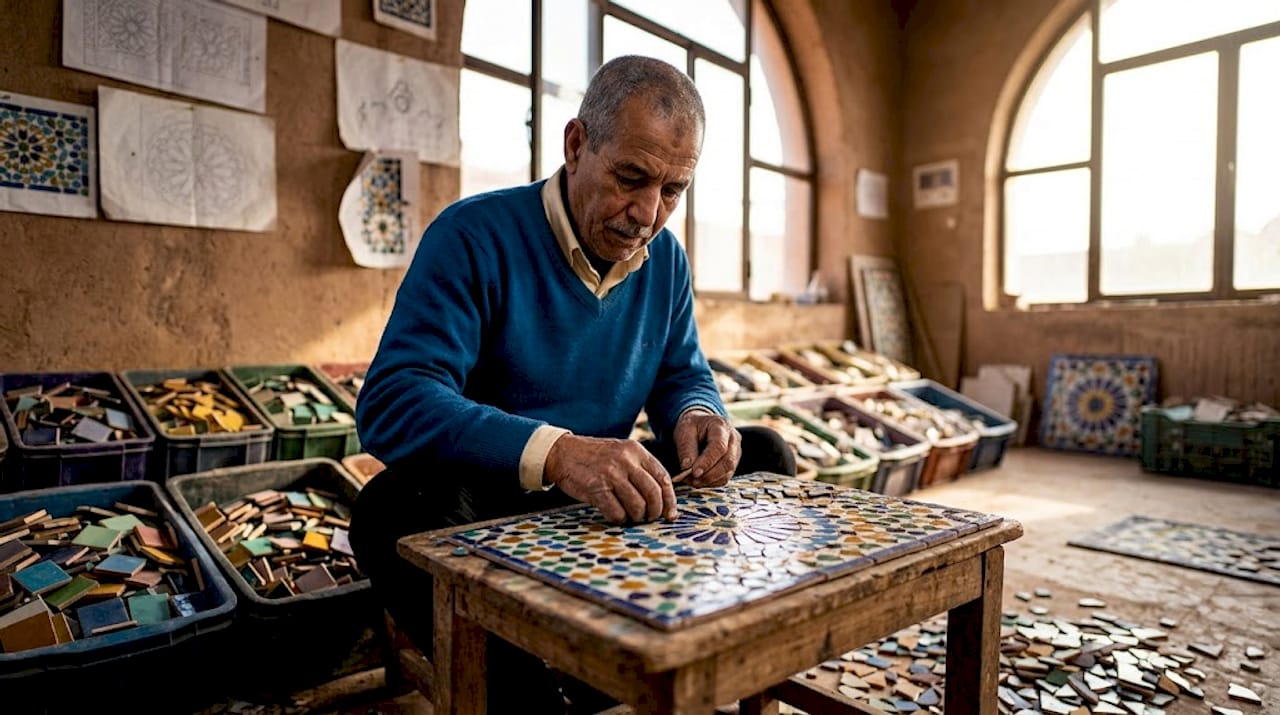
- Moroccan zellige: Hand-cut ceramic tilework using geometric compositions, a tradition still practiced today in Fez and Marrakech.
- Persian and Ottoman periods: Patterns reached extraordinary complexity, with 10-fold and 12-fold star compositions requiring advanced geometric knowledge.
What makes this history remarkable is its continuity. Moroccan craftsmen today cut and arrange zellige tiles using techniques passed down for centuries. The art is alive, not archived.
Core motifs and mathematical principles behind Islamic geometric patterns
At the heart of Islamic geometric patterns lies a beautifully disciplined method. Every design is built from mathematically defined shapes, circles, polygons, and star motifs, constructed using a compass and ruler with precise symmetry. This is not intuitive doodling. It is structured geometry.
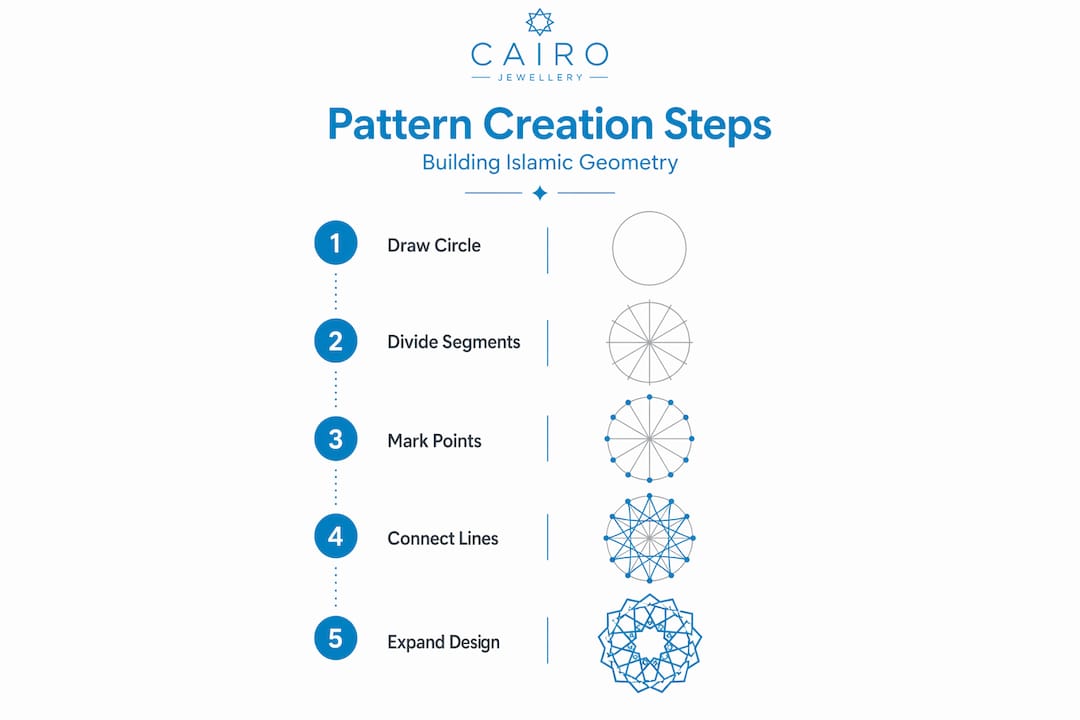
The process begins with a circle. That circle is divided into equal segments, and those division points become the anchors for everything that follows. Common pattern families are built from circle divisions into 6, 8, 10, 12, or 16 equal parts, each producing a distinct family of stars and polygons.
Here is how the main shape families break down:
| Division | Star type | Common name | Found in |
|---|---|---|---|
| 6-fold | Hexagram | Star of David variant | Persian tilework, mosaic floors |
| 8-fold | Octagram | Eight-pointed star | Ottoman, Central Asian art |
| 10-fold | Decagram | Ten-pointed star | Andalusian architecture |
| 12-fold | Dodecagram | Twelve-pointed star | Moroccan zellige, Persian domes |
The key principle that makes these patterns so visually powerful is tessellation. Tessellating patterns repeat infinitely across a surface without gaps or overlaps, following strict symmetry rules. You can extend a well-constructed pattern forever in any direction, and it will always hold together.
Building an Islamic geometric design from scratch follows a logical sequence:
- Draw a base circle and divide its circumference into equal parts using a compass.
- Connect the division points using straight lines to form star shapes or polygons.
- Extend those shapes outward, interlocking them with neighboring units.
- Identify and repeat the smallest repeating unit (the tile) to build the full pattern.
- Add secondary and tertiary lines within the gaps to achieve layered complexity.
You can also explore how Islamic geometric design appears in jewelry today, where geometric motifs from these ancient traditions are translated into wearable, meaningful forms.
Pro Tip: When learning to create Islamic patterns, start with the 6-fold or 8-fold family before tackling 10-fold or 12-fold designs. The math is simpler, and your eye will calibrate to the proportions faster.
Spiritual significance and symbolism in Islamic geometric design
The features of Islamic geometry are inseparable from their spiritual intent. These patterns are not abstract in the sense of being meaningless. They are abstract in the sense of pointing beyond themselves, toward something that cannot be drawn directly.
Geometric design reflects spiritual meanings including unity, divine order, and infinity, using symmetry and repetition to represent God’s oneness, known in Arabic as Tawhid, and His boundlessness. Every decision in the design carries weight.
Here is what the major motifs symbolize:
- The circle: Represents eternity and divine completeness. It has no beginning and no end, reflecting Allah’s eternal nature.
- The star: Symbolizes divine light and guidance radiating outward in all directions.
- Polygons: Express balance and cosmic harmony, the order underlying all of creation.
- Tessellation and repetition: Evoke infinity. A pattern that can extend without limit reflects a Creator without limit.
- Interlacing lines: Suggest the interconnectedness of all things in creation, nothing existing in isolation.
“The patterns are meditations on the infinite nature of Allah, drawing the observer closer to the divine essence.”
This is why stepping into a mosque filled with geometric ornament can feel spiritually different from entering a decorated building in another tradition. The patterns are not there to impress. They are there to orient. They direct the mind away from the particular and toward the universal. The significance of geometric shapes in Islam goes far deeper than aesthetics.
Getting started: tools and steps to create Islamic geometric designs
Learning how to create Islamic geometric art is genuinely accessible, even for someone with no formal art training. Beginners typically start with a pencil, ruler, and compass, constructing foundational polygon families before moving into complex star and rosette compositions.
Here is what you need to get started:
Essential tools:
- A good compass with a tightening screw (loose compasses produce inaccurate circles)
- A clear ruler, at least 30 cm
- A sharp pencil (0.5mm mechanical pencil works well)
- A large eraser
- Grid or blank white paper, preferably heavier weight
Step-by-step construction for a basic 8-pointed star:
- Draw a circle with your compass at the desired size.
- Without changing the compass width, mark 8 equidistant points around the circumference. You can do this by first finding 4 points at 90-degree intervals, then bisecting each arc.
- Connect every other point to form a square, then rotate and connect the remaining points to form a second square overlapping the first.
- The overlapping squares create an 8-pointed star at the center.
- Extend the edges of both squares outward to neighboring unit circles to begin building the tessellating grid.
- Repeat the unit, and the pattern will lock together seamlessly across the page.
Pro Tip: Accuracy in measurements is everything. Even a small compass error compounds across the grid and breaks the pattern’s symmetry. Physical tools beat freehand sketching for consistency every single time.
Once you have the basics down, look at how modern Muslim jewelry inspired by geometric art translates these very shapes into pieces you can carry with you every day.
Islamic geometric design in modern culture and everyday inspiration
Islamic geometric design did not remain locked in mosque walls or historical archives. It influences architecture, fashion, jewelry, and digital art, demonstrating that its appeal and spiritual resonance are as strong today as they were in the 9th century.
Here is where you will find it today:
- Architecture: Contemporary mosques worldwide incorporate geometric tiling and patterned facades that echo historic precedents. The Hassan II Mosque in Casablanca is one of the most breathtaking modern examples.
- Fashion and haute couture: Designers from Muslim-majority countries and global fashion houses regularly draw on geometric ornament for textile prints, embroidery, and structural pattern work.
- Digital art: Programmers and artists now use algorithms to generate fractal-style patterns rooted in Islamic geometric logic, producing infinite, meditative visual work.
- Jewelry: Geometric motifs from Islamic tradition appear in rings, necklaces, and bracelets where the spiritual symbolism becomes personal and portable.
- Interior design: Geometric tiles, lattice screens, and carved plaster panels bring the visual language of Islamic art into homes globally.
The continued relevance of Islamic geometric patterns is not nostalgia. It is a living connection between historical faith expression and contemporary Muslim identity. If you are interested in how symbolism travels from architecture into jewelry, the conversation is richer than most people expect. You can also explore how layering geometric pieces creates a personal visual language inspired by this centuries-old tradition.
Why Islamic geometric design is more than decoration: a reflection on faith, math, and artistry
Most people encounter Islamic geometric patterns and see beauty. That is a good start. But stopping there misses what makes this tradition genuinely remarkable.
Islamic geometric patterns are a contemplative visual language where symmetry and repetition communicate divine order and unity. They are far beyond ornamentation. We believe this distinction matters deeply.
Here is the truth that gets overlooked: these patterns required the same intellectual discipline as mathematics, astronomy, and philosophy. The craftsmen who laid the Alhambra’s tilework were not simply skilled with their hands. They were operating with geometric knowledge that would not appear in European mathematical texts for centuries. Creating a correct 10-fold tessellation is not something you accomplish through artistic instinct. It demands rigorous, systematic thinking.
“The patterns are not decoration applied to objects. They are the objects’ reason for existing.”
That framing changes everything. When you look at Islamic geometric design as the object’s purpose rather than its finish, you start to understand why it appears in spaces of worship, learning, and gathering. The pattern is doing spiritual work. Its repetition is a kind of dhikr, a continual remembrance encoded in form.
Tawhid, the oneness of Allah, cannot be depicted directly. But it can be expressed through patterns that are self-similar at every scale, balanced in every direction, and extendable without limit. That is not coincidence. That is theology expressed through mathematics.
We also think there is a personal invitation here. Engaging with these patterns, whether by drawing them, studying them, or wearing them, connects you to a tradition of believers who sought to make the invisible visible through discipline and devotion. That connection is available to anyone willing to look closely.
Explore authentic Islamic geometric designs with CĀIRO Jewellery
Now that you have explored the history, mathematics, and spiritual depth of this art form, consider how you can carry a piece of it with you. At CĀIRO Jewellery, we design pieces inspired by Islamic symbolism and sacred motifs, bringing the meaning of this tradition into everyday wear. Whether you are honoring your own faith or gifting someone you would make dua for, there is something here that holds genuine significance.

Our Ayatul Kursi Collection blends Qur’anic calligraphy with geometric design principles, creating pieces that feel both spiritually rooted and beautifully made. Each piece is crafted in stainless steel with gold or silver plating, designed to last. Browse the full range, including stackable and layered styles, through our Complete the Look collection. This is the kind of jewellery that means something the first time you put it on, and every time after.
Frequently asked questions
What is Islamic geometric design and why is it important?
Islamic geometric design is a form of art using mathematically defined shapes like circles and polygons to create decorative patterns that reflect spiritual concepts such as unity and infinity. It is important because it serves as a visual expression of core Islamic beliefs, particularly the oneness of Allah.
Why are human and animal figures avoided in Islamic geometric art?
They are avoided in religious contexts to prevent idolatry, as Islamic principles restrict the depiction of living beings. Geometry fills that space with abstract forms that symbolize divine perfection rather than created beings.
What tools do I need to start creating Islamic geometric patterns?
A pencil, ruler, and compass are all you need to begin, as most beginners start by constructing foundational shapes like squares or hexagons before advancing to complex star compositions.
How do Islamic geometric patterns symbolize God’s nature?
Their endless repetition and balanced symmetry represent Allah’s infinity and unity (Tawhid), expressing through visual form what cannot be expressed through direct depiction.
Where can I see authentic examples of Islamic geometric design?
Famous examples include the Alhambra palace in Granada, the Great Mosque of Cordoba, and Moroccan zellige tilework, all of which continue to inspire contemporary art and architecture worldwide.