Nikah gift jewellery in Islamic tradition refers to jewellery given as mahr, the mandatory marriage gift that belongs solely to the bride and is commanded in Surah An-Nisa 4:4. Understanding this distinction matters deeply, because not all jewellery exchanged at a wedding carries the same religious weight. Mahr is a spiritual obligation and a legal right, not a cultural gesture. Whether you are planning your own nikah or selecting a meaningful gift for someone you love, knowing how traditional nikah jewelry fits within Islamic law helps you honor both the marriage and the faith with clarity and intention.
What is mahr and how does nikah gift jewellery fulfill this obligation?
Mahr is a mandatory gift owned entirely by the bride, commanded by Allah in the Quran as a willing, free-hearted offering called nihlah. It is not a bride price, and it is not a transaction between families. It is a right that belongs to the wife alone, and no one, including her parents or husband, may take it from her without her full consent.
Jewellery is a fully acceptable form of mahr when its type, weight, and value are clearly agreed upon before the nikah contract is signed. Acceptable forms of mahr include:
- Gold or silver jewellery with specified weight and purity
- Cash in an agreed currency and amount
- Property such as land or a home
- Practical services, such as teaching the bride a skill or completing a specific task
The obligation of mahr is unanimous across Sunni schools of jurisprudence, including the Hanafi, Maliki, Shafi’i, and Hanbali madhabs. A wife may lawfully withhold conjugal rights until the prompt portion of her mahr is delivered. This is not a minor detail. It reflects how seriously Islam treats the bride’s right to receive what was promised.
“And give the women their mahr as a free gift. But if they, of their own good pleasure, remit any part of it to you, take it and enjoy it without fear of any harm.” (Surah An-Nisa 4:4)
The historical example of Ali ibn Abi Talib and Fatimah bint Muhammad ﷺ is one of the most instructive in Islamic history. Ali sold his armor for 480 dirhams as the agreed mahr payment. The armor was not extravagant. It was meaningful, agreed upon, and fulfilled with sincerity. This precedent shows that the value of nikah gift jewellery lies in the intention and the agreement, not in its price tag.
What are the gender-specific Islamic rulings on nikah jewellery?
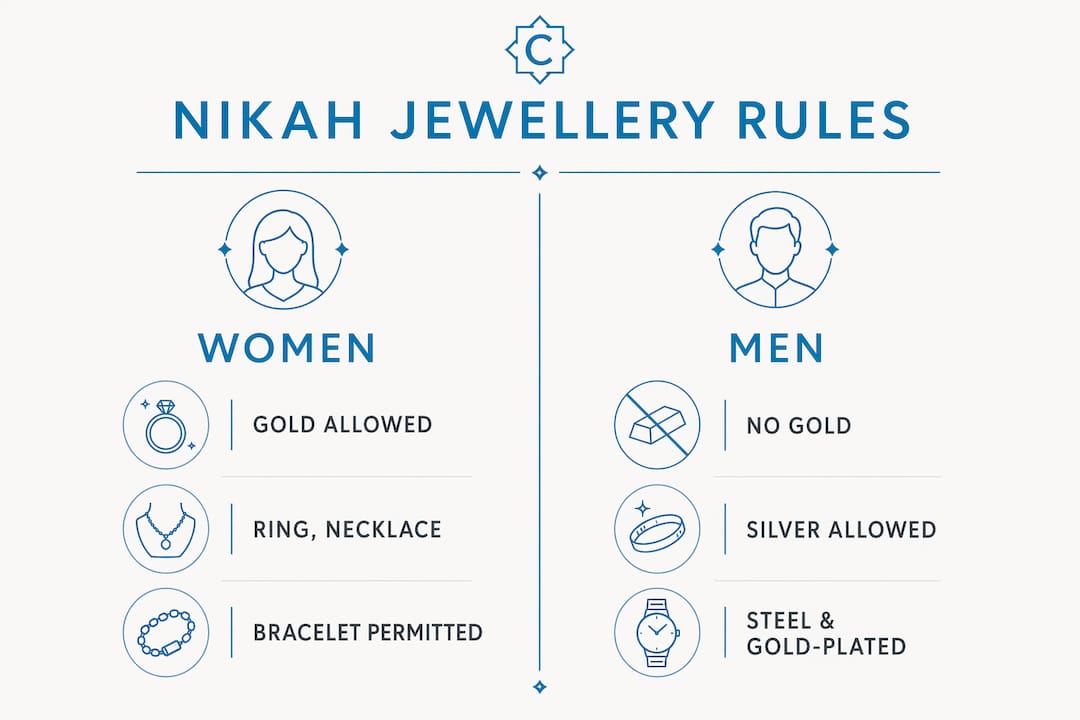
The most important ruling every couple must understand before selecting nikah ceremony gift ideas is this: gold is prohibited for Muslim men but fully permissible for Muslim women across all major Sunni schools. This ruling is not a cultural preference. It is a clear and established position in Islamic fiqh, grounded in multiple authentic hadith.
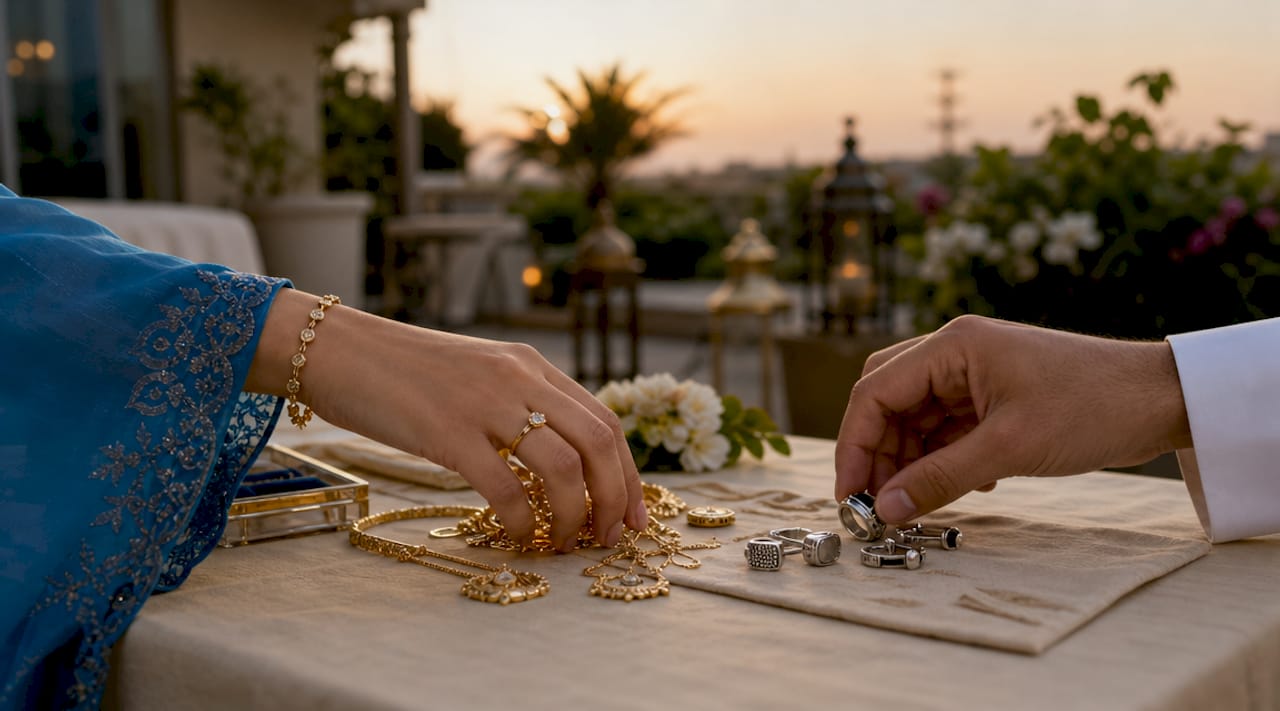
For women, gold jewellery carries no restriction. A bride may receive a gold ring, a gold necklace, or a gold bracelet as her mahr, and wearing it is entirely permissible. For men, any form of gold adornment, including gold-plated rings or bracelets, violates Sunni fiqh and should be avoided at the nikah and beyond.
This creates a practical challenge for couples who want matching jewellery sets as part of their nikah gifts. Many South Asian and Arab cultural traditions include coordinated bridal sets for both the bride and groom. When those sets include gold for the groom, they conflict directly with Islamic rulings. The solution is not to abandon the tradition of gifting the groom, but to choose permissible materials instead.
Pro Tip: For men’s nikah jewellery, choose pieces made from stainless steel, sterling silver, or gold-plated alternatives where the base metal is not gold. Cairojewellery’s stainless steel pieces with gold-plated finishes, such as the Ayatul Kursi Ring, offer the aesthetic of gold without violating Islamic rulings on men’s adornment. You can explore the full range of halal jewellery materials to make an informed choice.
How to select and document nikah gift jewellery properly
Choosing jewellery as mahr is a spiritually meaningful act, but it also carries legal weight within the nikah contract. Vague agreements lead to disputes. Clear documentation protects both spouses and honors the spirit of the obligation.
Follow these steps to select and document mahr jewellery correctly:
- Agree on the specific item. Name the jewellery type, such as a gold ring, a silver necklace, or a set of bangles. Do not leave it as “some jewellery.”
- Specify weight and purity. For gold, state the karat and gram weight. For silver, state the gram weight. This removes ambiguity about value.
- Assign a monetary value. Even if the jewellery is the agreed mahr, recording its market value at the time of the nikah protects the bride’s rights if the item is lost or damaged.
- Divide into prompt and deferred portions if needed. Mahr can be split, with part delivered immediately at the nikah and the remainder deferred to a later agreed date.
- Hand over in front of witnesses. Proper mahr handover should occur in front of the nikah witnesses and be recorded in the marriage contract.
| Step | What to specify |
|---|---|
| Jewellery type | Ring, necklace, bracelet, or set |
| Material and purity | Gold karat, silver grade, or alternative metal |
| Weight | Grams or tolas, clearly stated |
| Monetary value | Market value at time of nikah |
| Delivery terms | Prompt, deferred, or split between both |
Pro Tip: Ask your Islamic scholar or marriage officiant to review the mahr jewellery description before the nikah contract is signed. A sentence like “one gold ring” is legally weak. “One 22-karat gold ring weighing 5 grams, valued at [amount] at the time of nikah” is clear, documented, and spiritually sound.
Clear agreement on jewellery specifics prevents disputes and fulfills the contractual clarity that Islamic marriage law requires. Mahr is an act of honor toward the bride. Treating it with precision reflects that honor.
For couples considering custom pieces, resources like custom ring design guidance can help you think through durability and specification before committing to a design for the nikah contract.
What cultural practices around nikah jewellery differ from Islamic mandates?
One of the most common sources of confusion in Muslim weddings is the difference between mahr and jahez. They are not the same thing, and conflating them can create real harm.
Jahez is a cultural practice originating primarily in South Asian communities, where the bride’s family provides gifts, household items, and jewellery to the groom’s family. It is distinct from mahr in every meaningful way:
- Mahr flows from the groom to the bride. Jahez flows from the bride’s family to the groom’s household.
- Mahr is commanded in the Quran. Jahez has no basis in Islamic scripture.
- Mahr is the bride’s right and property. Jahez often becomes the property of the groom’s family.
- Mahr is agreed upon freely. Jahez is frequently demanded under social pressure.
Cultural traditions like jahez can become oppressive and contradict the simplicity and dignity that Islam intends for marriage. Scholars across the Muslim world have spoken against jahez demands that place financial burdens on the bride’s family. The Prophet ﷺ himself set a different example. His gifts to Fatimah were modest household items given out of love, not obligation. A hand mill, a water skin, and a pillow stuffed with palm fiber. These were not extravagant. They were sincere.
Mixing cultural bridal adornments with mahr obligations also creates legal and emotional ambiguity. A South Asian nath (nose ring) given as part of a bridal set, for example, may carry deep cultural meaning, but unless it is explicitly designated as mahr in the nikah contract, it does not fulfill that obligation. The intention and the documentation must align. Understanding jewellery permissibility in Islam helps couples make these distinctions with confidence.
Key takeaways
Nikah gift jewellery fulfills its Islamic purpose only when it is clearly agreed upon, properly documented as mahr, and selected according to gender-specific rulings on permissible materials.
| Point | Details |
|---|---|
| Mahr is the bride’s right | Jewellery given as mahr belongs solely to the bride and cannot be taken without her consent. |
| Documentation protects both spouses | Specify jewellery type, weight, purity, and value in the nikah contract before signing. |
| Gold is prohibited for men | Men’s nikah jewellery must use permissible materials like stainless steel or sterling silver. |
| Jahez differs from mahr | Cultural gift practices like jahez have no Quranic basis and should not be confused with the mahr obligation. |
| Intention and clarity both matter | Mahr is an act of honor. Treating it with spiritual sincerity and legal precision fulfills its purpose. |
Why I think we overcomplicate nikah jewellery when simplicity is the sunnah
I have spoken with many couples preparing for their nikah, and the same tension comes up repeatedly. The groom’s family wants something impressive. The bride’s family wants something culturally recognizable. And somewhere in the middle, the actual Islamic obligation gets buried under expectations.
What strikes me most is how the Prophet ﷺ resolved this tension without ever making it a debate. Ali’s armor. A hand mill for Fatimah. These were not symbols of poverty. They were symbols of clarity. The mahr was agreed, delivered, and documented. The gifts were given from the heart, not from social pressure.
The couples I have seen navigate this most gracefully are the ones who separate two questions clearly. First: what is the mahr, and is it properly agreed and documented? Second: what additional gifts, if any, do we want to give as expressions of love and celebration? When those two questions stay separate, the nikah becomes spiritually grounded and culturally meaningful without either one undermining the other.
My honest observation is this. The most meaningful nikah jewellery is not the most expensive piece. It is the piece that was chosen with knowledge, given with sincerity, and received as the right it truly is. A simple silver ring with Ayatul Kursi engraved on it, given as a documented mahr with full agreement, carries more barakah than a gold set given under pressure with no clear contract.
— Elias
Find jewellery that honors your nikah with faith and intention
Selecting the right piece for a nikah gift is one of the most personal decisions a couple makes. Cairojewellery is a Sweden-based Islamic jewellery brand that designs pieces rooted in Qur’anic verses, Islamic symbolism, and the kind of spiritual meaning that makes a gift worth giving. From the Ayatul Kursi Ring to the With Hardship Comes Ease Necklace, each piece is crafted in stainless steel with gold-plated or silver-plated finishes, making them permissible for both men and women. Whether you are selecting a mahr piece or a meaningful wedding gift, you can explore the full collection at Cairojewellery and find something that carries both beauty and barakah.
FAQ
What is nikah gift jewellery in Islamic tradition?
Nikah gift jewellery refers to jewellery given as mahr, the mandatory Islamic marriage gift belonging to the bride, as commanded in Surah An-Nisa 4:4. It must be agreed upon, documented in the nikah contract, and delivered to the bride as her sole property.
Can jewellery count as mahr in Islam?
Yes. Jewellery is an accepted form of mahr when its type, weight, purity, and value are clearly specified in the nikah contract. Vague descriptions like “some gold jewellery” are insufficient and can lead to disputes.
Is gold jewellery permissible for men at a nikah?
Gold is prohibited for Muslim men across all major Sunni schools of jurisprudence. Men’s nikah jewellery should use permissible materials such as stainless steel, sterling silver, or non-gold alternatives.
What is the difference between mahr and jahez?
Mahr is a Quranic obligation from the groom to the bride, belonging entirely to her. Jahez is a cultural practice where the bride’s family provides gifts to the groom’s household. Jahez has no basis in Islamic scripture and is discouraged when it involves financial pressure or coercion.
How should mahr jewellery be documented?
The nikah contract should specify the jewellery type, material, weight, purity, and monetary value at the time of the nikah. Delivery should occur in front of witnesses, and any deferred portion should include a clearly agreed timeline.