Islamic symbolism in material culture is the purposeful use of geometric patterns, arabesques, and calligraphy to communicate religious and metaphysical meanings through physical objects, not merely to decorate them. From the star-polygon compositions carved into the Hasan Sultan Tomb to the Qur’anic inscriptions pressed into Ilkhanid lusterware ceramics, every motif carries intention. This is not ornament for its own sake. It is a visual language, one that has shaped mosques, household objects, textiles, and jewelry across fourteen centuries of Islamic civilization. Understanding that language transforms how you see every piece of Islamic art you encounter.
What are the primary motifs in Islamic material culture?
Islamic ornament theory holds that ornament is never purely decorative but always communicates iconographic or symbolic meaning. Three motif families carry most of that meaning.
Geometric patterns are the most immediately recognizable element of Islamic visual culture. The interlocking star polygons found across the Alhambra in Granada and the Hasan Sultan Tomb in Anatolia function as visual codes linked to cosmological ideas. Scholars describe these compositions as expressing unity, infinity, and divine wisdom, concepts central to Islamic theology. A geometric star framing the word “Allah” over an entrance is not decoration. It is a theological statement rendered in stone.
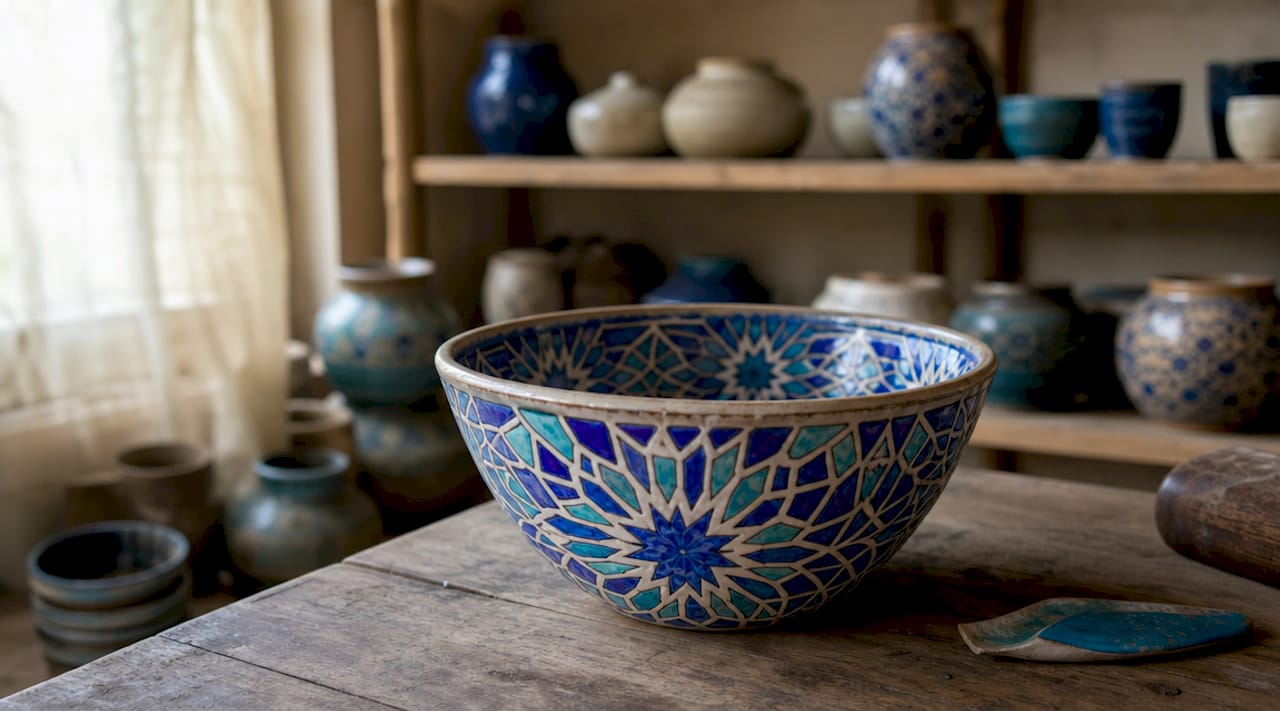
Arabesques are the flowing, plant-derived scrollwork that fills surfaces in Islamic architecture and decorative arts. They represent growth, the continuity of life, and an invitation to spiritual contemplation. The arabesque has no fixed endpoint. It spirals and branches indefinitely, which is precisely the point. That visual endlessness mirrors the Islamic understanding of divine creation as boundless.
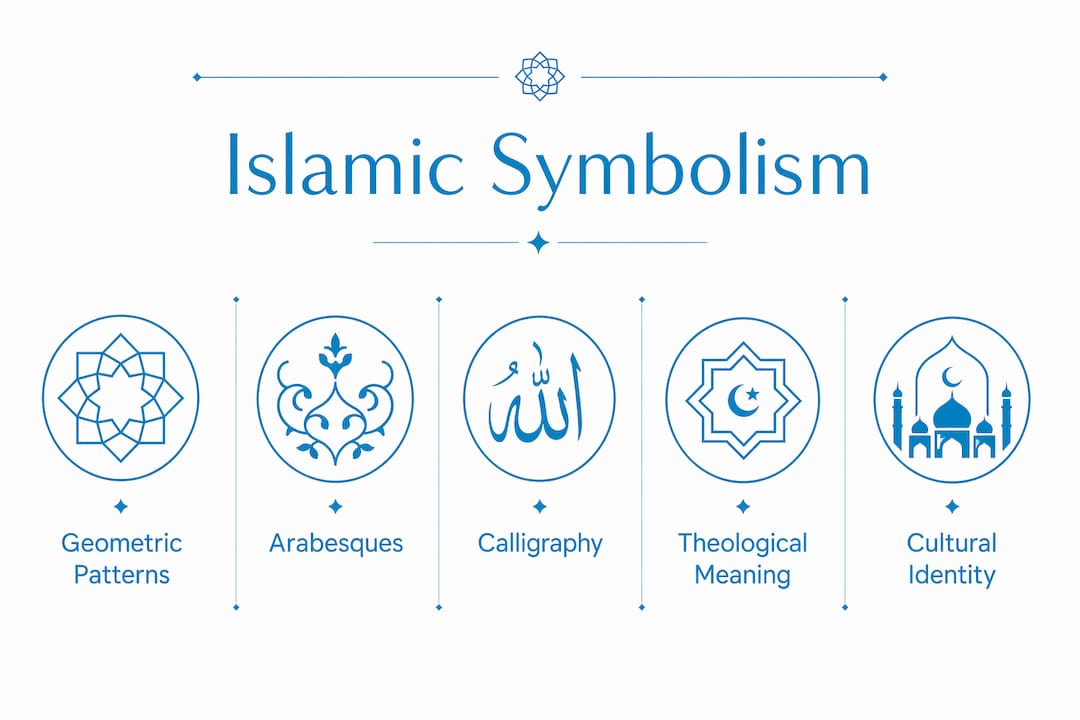
Calligraphy is the most explicitly religious of the three. Qur’anic verses, the names of Allah and the Prophet Muhammad (peace be upon him), and poetic texts appear on ceramics, metalwork, textiles, and architectural surfaces. As scholars note, calligraphy pairs with ornament to communicate complex theological and poetic content that geometric forms alone cannot carry.
These three systems rarely appear in isolation. In Seljuk tomb architecture, geometric, vegetal, and calligraphic bands work together as a multilayered symbolic language, each layer reinforcing the others. The result is an object or surface that rewards sustained attention rather than a passing glance.
“Islamic ornament functions as a passageway for meditation on life and the afterlife, not as decoration alone.” — Islamic ornament scholarship
Pro Tip: When you examine a piece of Islamic art, look for all three motif families before drawing conclusions about meaning. A geometric border paired with a Qur’anic inscription changes the reading of both elements.
How does Islamic faith shape design choices in material objects?
Religious principles are the single most decisive factor in how Islamic material culture looks. The concept of aniconism, the avoidance of representational images of living beings, particularly humans and animals, is not a stylistic preference. It reflects a theological concern about idolatry and the exclusive creative power of Allah.
The practical consequences for craftspeople were significant:
- Animal imagery was suppressed or strictly limited in most workshop traditions, meaning its absence from a given object is symbolically significant, not incidental.
- Floral and geometric motifs filled the visual space that figurative imagery occupies in other traditions, giving Islamic decorative arts their distinctive character.
- Religious messages were embedded through inscriptions and calligraphic bands, ensuring that objects communicated faith even when figurative content was absent.
- Political and dynastic symbolism occasionally appeared through specific motifs, such as the Dhu’l-Fiqar, the forked sword of Ali ibn Abi Talib, which appears on Ilkhanid ceramics as both a religious and political emblem.
Ottoman metalwork provides one of the clearest examples of this dynamic. Research confirms that religious faith drives the predominance of geometric and floral motifs in Ottoman-era metal arts, with animal imagery deliberately limited. This was not a creative limitation. It was a form of devotion expressed through craft discipline.
The Ilkhanid ceramic tradition shows how this framework could accommodate nuance. Lusterware vessels from this period feature the hoopoe bird, a creature associated with the Prophet Sulayman (Solomon) in the Qur’an, alongside mystical poetry and geometric borders. The bird’s appearance is not a violation of aniconism but a carefully chosen symbol with explicit Qur’anic authorization. Context and intention determine meaning in Islamic iconography, not rigid rules applied without thought.
Pro Tip: When you encounter animal imagery in Islamic art, look for the inscription context. A hoopoe or a phoenix in an Islamic ceramic is almost always a Qur’anic or Sufi literary reference, not a decorative accident.
How does Islamic symbolism function in everyday and diaspora life?
Islamic symbolism in everyday life operates through what researchers call sacred spatial choreography. This means that the placement and visibility of symbolic objects in a home, not just the objects themselves, creates an environment of continuous religious meaning.
Ethnographic research with migrant Muslim families documents this practice in detail. The findings show that Muslim diaspora families embed Islamic symbols in domestic spaces through deliberate arrangement, sacralizing routines and reinforcing identity. Common elements include:
- A Qur’an displayed prominently in the main living area, often elevated on a dedicated stand
- Prayer rugs positioned to indicate the direction of Mecca, even when not in active use
- Calligraphic art featuring Ayatul Kursi or the Basmala hung near entrances
- Prayer beads, tasbih, kept visible on surfaces as reminders of dhikr
- Framed du’a or Qur’anic verses in children’s rooms to establish faith from an early age
This practice of spatial choreography transforms living spaces into persistent sites of faith and identity. For diaspora communities living in non-Muslim majority countries, this function is especially significant. The home becomes a sanctuary where Islamic identity is continuously affirmed, even when the surrounding environment does not reflect it.
The same logic extends to wearable objects. A bracelet engraved with Ayatul Kursi carries the verse with you throughout the day, functioning as a portable sacred space. This is why jewelry in Muslim identity carries weight that goes beyond fashion. It is a form of material devotion, a way of keeping faith present in every context you move through.
Pro Tip: If you are setting up a home space that reflects your faith, think about placement as carefully as you think about the objects themselves. Where something sits in a room shapes how it is experienced.
How does inscription deepen the meaning of Islamic symbolic objects?
Inscription and ornament function as paired systems in Islamic material culture. Neither is fully legible without the other, and understanding this interdependence is what separates a surface reading of Islamic art from a genuinely informed one.
The evolution of inscription content across Islamic history tells its own story. Early Islamic objects often carried brief phrases: “Bismillah,” “Alhamdulillah,” or a short Qur’anic verse. As craft traditions matured, particularly in the Ilkhanid and later Timurid periods, inscriptions evolved from brief phrases to elaborate mystical poetry, with lusterware ceramics becoming vehicles for Sufi literary expression. A single bowl could carry verses from Rumi or Hafiz alongside geometric borders and figural motifs, creating an object that functioned simultaneously as tableware, devotional object, and literary artifact.
The iconographic and iconological method, developed by art historian Erwin Panofsky and applied to Islamic objects by contemporary scholars, provides a structured way to read this layered content. Applied to Seljuk tomb decorations, this approach reveals that motif analysis combined with cultural context uncovers meanings that purely stylistic readings miss entirely.
| Object type | Motif system | Inscription function |
|---|---|---|
| Seljuk stone tomb | Geometric star polygons, vegetal scrolls | Calligraphic bands naming Allah and the deceased |
| Ilkhanid lusterware | Arabesques, figural motifs, Dhu’l-Fiqar | Mystical poetry and Qur’anic verses |
| Ottoman metalwork | Floral and geometric patterns | Religious phrases, dynastic titles |
| Alhambra architecture | Interlocking geometric grids | Qur’anic verses, poetic panegyrics |
The absence of a motif carries meaning too. Research on elite Islamic architecture shows that the exclusion of acanthus motifs near mihrabs in certain palaces signals a deliberate spiritual intention, distinguishing sacred from secular space through what is left out rather than what is included. This is a sophisticated symbolic grammar, one that rewards careful attention.
“Inscription and ornament should be interpreted as paired systems; inscriptions often carry keys to understanding symbolic meaning.” — Analytical study of Ilkhanid ceramics
Key takeaways
Islamic symbolism in material culture functions as a layered visual language where geometric patterns, arabesques, calligraphy, and inscriptions work together to communicate religious, metaphysical, and cultural meaning across objects, architecture, and everyday domestic spaces.
| Point | Details |
|---|---|
| Motifs carry theological meaning | Geometric patterns, arabesques, and calligraphy each express distinct religious concepts, not decoration. |
| Aniconism shapes design | The absence of living figures in Islamic objects is a deliberate religious statement, not a stylistic limitation. |
| Inscription unlocks meaning | Calligraphic content paired with ornament reveals the full symbolic intent of any Islamic object. |
| Diaspora spaces are sacred | Muslim families use spatial placement of symbolic objects to maintain faith and identity in non-Muslim environments. |
| Absence is also symbolic | Missing motifs in elite Islamic architecture signal intentional spiritual distinctions between spaces. |
Why Islamic symbolism is a living language, not a historical artifact
By Elias
Most people approach Islamic art as something to admire from a distance, as if the geometric precision of the Alhambra or the calligraphic bands on an Ottoman bowl belong to a sealed past. I think that framing misses what makes this tradition genuinely extraordinary.
What strikes me most, after spending years reading about and engaging with Islamic material culture, is that these motifs were never meant to be museum pieces. They were designed to be lived with. A prayer rug is not a decorative object that happens to be used for prayer. It is a symbolic environment that the worshipper enters five times a day. The geometric pattern on its surface is not background. It is part of the act of worship itself.
The diaspora research confirms something I have observed personally: when Muslim families arrange their homes with Qur’anic calligraphy, prayer rugs, and symbolic objects, they are not decorating. They are constructing a continuous experience of faith in a physical space. That is a profound and underappreciated form of religious practice.
The same principle applies to what you wear. A piece of Islamic wearable art engraved with Ayatul Kursi is not jewelry that happens to have Arabic text on it. It is a portable act of remembrance. The motif is the message. When modern designers and brands treat Islamic symbols as aesthetic choices without engaging their meaning, something important is lost. When they engage that meaning honestly, something genuinely moving is created.
My honest view: the depth of Islamic symbolic tradition deserves more than surface appreciation. Learn what the motifs mean. Read the inscriptions. Ask why a particular verse appears on a particular object. The answers will change how you see everything.
— Elias
Carry the meaning with you: Islamic symbolic jewelry from Cairojewellery
Cairojewellery designs pieces that take Islamic symbolism seriously. Each item in the collection, from the Ayatul Kursi Bracelet to the Olive Branch Ring, carries a motif or verse with documented spiritual significance, not as decoration but as a daily reminder of faith. The Ayatul Kursi Necklace engraves the most protective verse in the Qur’an directly onto a piece you wear close to your heart. The With Hardship Comes Ease Necklace carries a Qur’anic promise that is worth keeping present. Whether you are choosing something for yourself or for someone you would make du’a for, explore the full jewelry collection and find a piece whose meaning speaks to you. Every order also donates meals through ShareTheMeal, so the blessing extends further than the gift itself.
FAQ
What is Islamic symbolism in material culture?
Islamic symbolism in material culture refers to the use of geometric patterns, arabesques, and calligraphy in physical objects to communicate religious, spiritual, and cultural meanings. These motifs function as a visual language rather than mere decoration.
What do geometric patterns mean in Islamic art?
Geometric patterns in Islamic art express concepts of unity, infinity, and divine order. Scholars analyzing sites like the Hasan Sultan Tomb describe these compositions as visual codes linked to cosmological and metaphysical ideas central to Islamic theology.
Why is calligraphy so prominent in Islamic objects?
Calligraphy is the most direct way to embed religious content in a physical object. Qur’anic verses and the names of Allah appear on ceramics, metalwork, and architecture because the written word of God carries inherent spiritual authority and blessing.
How do Muslim families use Islamic symbols at home?
Ethnographic research shows that Muslim families, particularly in diaspora settings, place Qur’ans, prayer rugs, and calligraphic art in deliberate positions throughout the home. This spatial arrangement sacralizes everyday routines and reinforces continuous religious identity.
What does the absence of animal imagery mean in Islamic art?
The limited use of animal imagery in Islamic material culture reflects religious compliance with aniconism, the avoidance of representational figures. Research on Ottoman metalwork confirms this absence is a deliberate devotional choice, not a stylistic accident.