Islamic wearable art explained simply means clothing, jewelry, and textiles that carry spiritual, cultural, and artistic meaning rooted in the Islamic tradition. But most people encounter this subject with a misunderstanding already in place. They see a beautifully embroidered garment or a gold-engraved bracelet and assume it is decorative fashion. It is far more than that. What you wear in the Islamic tradition can be an act of remembrance, a statement of identity, a carrier of Qur’anic protection, and a living form of art that has been refined over more than a thousand years. This guide walks you through all of it.
Table of Contents
- Key Takeaways
- Historical roots of Islamic wearable art
- Core artistic elements and their meaning
- Modern expressions of Islamic wearable art
- Islamic wearable art, faith, and mindful living
- My perspective on Islamic wearable art today
- Wear your faith with intention: explore Cairojewellery
- FAQ
Key Takeaways
| Point | Details |
|---|---|
| Deep historical roots | Islamic wearable art draws from over 1,000 years of textile, calligraphy, and geometric craftsmanship traditions. |
| Symbols carry meaning | Calligraphy, geometric patterns, and vegetal motifs each hold spiritual significance beyond visual decoration. |
| Identity and community | Wearable art serves as a public expression of faith, solidarity, and cultural belonging in everyday life. |
| Modern market is growing | Muslim fashion spending is forecast to reach $433 billion by 2028, showing how mainstream this tradition has become. |
| Mindful selection matters | Choosing pieces aligned with your values and intention is both a spiritual practice and a form of self-care. |
Historical roots of Islamic wearable art
To understand Islamic wearable art, you need to understand where it came from. The tradition did not emerge in a vacuum. It grew from a civilization that placed profound value on beauty as a reflection of the divine. From the earliest Islamic empires, textiles were among the most prized forms of artistic production. Silk weaving in Persia, cotton embroidery in Egypt, and wool craftsmanship across North Africa each fed into a shared aesthetic language.
Three principles shaped what that language looked like:
- Calligraphy: The written word of Allah is considered sacred. Embedding Qur’anic verses into cloth, jewelry, or garments transforms the object into something that carries spiritual weight. This is why you find Arabic script on everything from royal robes to modern bracelets.
- Geometric patterns: Islamic art tradition avoids figurative depiction to reflect spirituality through abstraction, repetition, and geometric harmony. These patterns are not simply decorative. They suggest the infinite nature of God through endlessly repeating forms.
- Vegetal and floral motifs: Arabesque designs, with their flowing vines and stylized plant forms, appear across ceramics, architecture, and textiles. On wearable art, they create a sense of organic beauty that complements the precision of geometric work.
The most extraordinary example of this tradition is the Kiswa, the covering of the Kaaba in Mecca. The Kiswa embroidery uses 24-carat gold-plated silver wire worked into natural black silk, inscribed with Qur’anic verses by craftspeople who have passed down this skill across generations. There is no cleaner illustration of what Islamic wearable art can be at its highest level.
Regional traditions added distinct flavors. Ottoman garments featured intricate silk brocade with tulip and carnation motifs. Central Asian robes used ikat dyeing to produce dramatic abstract patterns. Moroccan djellabas featured embroidered necklines with geometric precision that varied city by city, making a garment readable as a regional identity marker to those who knew how to look.
Pro Tip: When exploring Islamic wearable art, pay attention to regional origin. A pattern that looks similar across different traditions may carry entirely different cultural meanings depending on whether it originates from the Levant, the Maghreb, or South Asia.
Core artistic elements and their meaning
The three main visual languages of Islamic wearable art each deserve a closer look, because understanding them changes the way you see a garment or piece of jewelry.
Calligraphy on the body
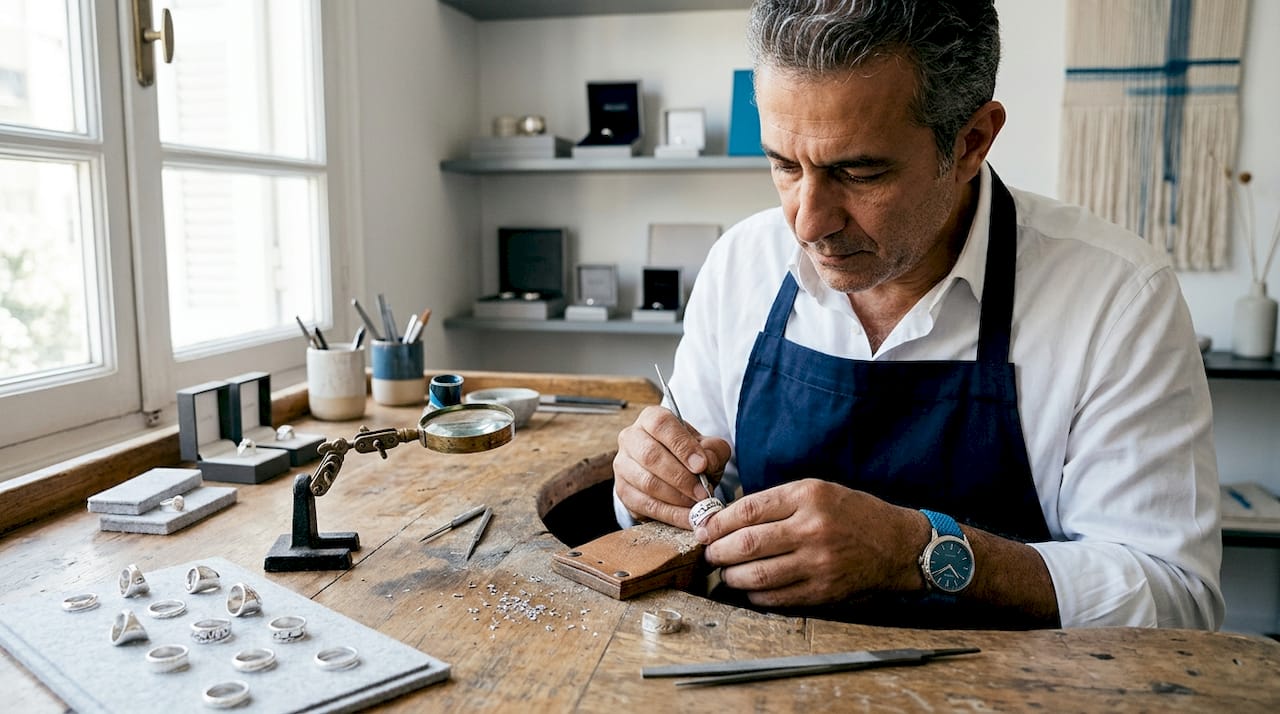
Calligraphy is the highest art form in Islamic tradition. When a Qur’anic verse is engraved on a ring, embroidered on a robe, or stamped onto a pendant, it is not decoration. It is an act of honoring the divine word by keeping it close to the body. Ayatul Kursi (Verse of the Throne from Surah Al-Baqarah 2:255) is one of the most commonly rendered verses in wearable art because it is understood to offer protection and is among the most recited in daily life.
Geometry and its spiritual logic
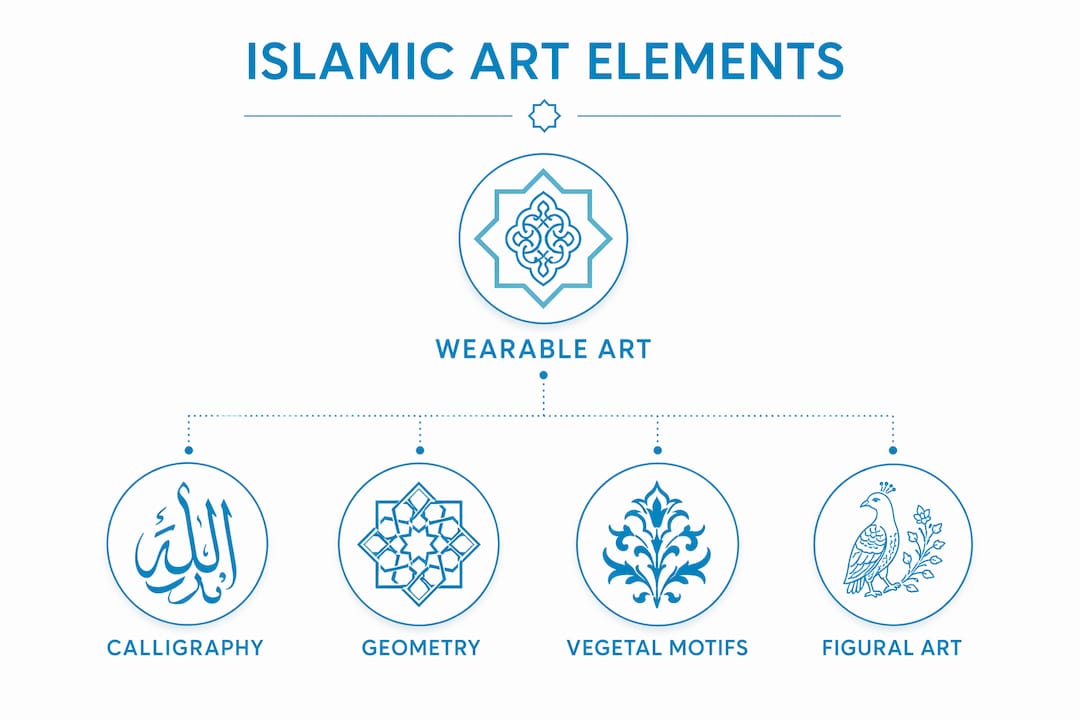
Islamic art’s four main components are calligraphy, vegetal patterns, geometric patterns, and controlled figural representation, with the latter avoided in religious contexts entirely. Geometric design on wearable art is not arbitrary. An eight-pointed star, for example, carries symbolic associations with direction, balance, and divine order. A hexagonal tile pattern worn as a brooch connects the wearer to a visual tradition stretching back to medieval mosque architecture.
Comparison of traditional and modern approaches
| Element | Traditional use | Modern interpretation |
|---|---|---|
| Qur’anic calligraphy | Hand-embroidered on ceremonial garments | Laser-engraved on stainless steel jewelry |
| Geometric patterns | Woven into silk robes and carpets | Printed on modest fashion fabrics and accessories |
| Vegetal/arabesque motifs | Carved into leather, painted on textiles | Cast into metal pendants, pressed into resin jewelry |
| Protective symbolism | Amulets and inscribed garments | Engraved bracelets and necklaces worn daily |
Pro Tip: If you are choosing a piece of Islamic wearable art for its spiritual meaning, learn the verse or symbol before you buy. Wearing something you understand creates a far deeper connection than wearing something that simply looks meaningful.
The prohibition on figurative art in religious contexts is worth dwelling on. It is not a restriction born from fear of beauty. It is a theological position that the representation of living beings risks elevating the created above the Creator. This is why non-figurative Islamic art focuses on archetypes, abstraction, and symmetry rather than portraiture or narrative scenes. On clothing and jewelry, this means the art always points beyond itself toward something transcendent.
Modern expressions of Islamic wearable art
The world has taken notice of Islamic modest fashion in a significant way. Muslim fashion spending is forecast to reach $433 billion by 2028, reflecting a global shift in how modest dressing is perceived. It has moved from a niche religious practice to a recognized lifestyle category with its own designers, media, and consumer culture.
But numbers alone do not tell you what is actually happening on the ground. Here is what modern Islamic wearable art looks like in practice:
- Identity and solidarity statements: Artists like Dina Sami understand wearable art as a conduit for identity expression and shared community narratives, carrying meaning in public spaces without needing explicit explanation. A Palestinian watermelon pin, a Qur’anic verse ring, or an olive branch pendant communicates belonging and solidarity the moment it is seen.
- Architectural precision in jewelry and textile art: Designers such as Marwa Ali Ahmed apply structural engineering principles from architecture to wearable art, blending gallery-level artistry with functional apparel. This is not craft for craft’s sake. It is the same intellectual rigor applied to a mosque’s geometry now applied to a beaded brooch.
- Technology integration: Indonesian designers developed hijab-compatible hearing aids worn as brooch pins, weighing just 12 grams and offering up to 100dB sound clarity, solving the problem of hijab fabric dampening acoustic signals. This is Islamic wearable art solving real problems.
- Modest fashion as personal expression: The islamic community fashion examples emerging from communities worldwide show how modest dressing has diversified. Wearable art now ranges from streetwear-inspired scarves with geometric print to fine jewelry engraved with Qur’anic text.
The tension worth acknowledging here is the one between commercial adoption and authentic expression. When global fashion brands incorporate Islamic aesthetics without community involvement, the result often feels hollow or misrepresented. Modest fashion’s global expansion requires authentic community collaboration to prevent cultural detachment. The most resonant Islamic wearable art still comes from those who carry the tradition from the inside.
Islamic wearable art, faith, and mindful living
What you choose to wear is, in the Islamic framework, an act of intention. This is not a metaphor. It is a practical application of niyyah, the Islamic concept of conscious intention that shapes the spiritual value of any action. Choosing a garment or piece of jewelry with awareness of what it represents changes the relationship you have with it.
Islamic psychology connects dressing with emotional regulation, inner balance, and reducing identity-related social friction. For Muslims living in multicultural contexts, this is particularly meaningful. The role of jewelry in Muslim identity extends beyond aesthetics to a form of grounding. Wearing a piece engraved with Ayatul Kursi is a reminder, not just an accessory. It is there when you need it.
Here is a practical framework for building a wardrobe that reflects Islamic values and supports mindful living:
- Start with intention. Before buying any piece, ask what it means and why you want it. A piece chosen with purpose will carry more value than one chosen purely for appearance.
- Learn the symbolism. Whether it is a Qur’anic verse, a geometric motif, or a cultural pattern, know what you are wearing. This connects you to the tradition behind it.
- Prioritize quality over quantity. Modest dressing reflects autonomy and self-respect. A smaller collection of meaningful, well-made pieces honors that intention better than a large wardrobe of hollow acquisitions.
- Check for alignment with Islamic values. Consider whether the piece respects the principles of modesty, avoids imagery prohibited in religious contexts, and comes from a source you trust.
- Consider gifting as an act of care. Giving someone a piece of Islamic wearable art, particularly something engraved with a protective verse, is a form of dua made tangible. This is the kind of gift that means something beyond the wrapping.
Pro Tip: When curating a faith-aligned wardrobe, think in terms of what you want to carry with you throughout the day, literally and spiritually. A verse on your wrist during a difficult meeting is not just jewelry. It is a reminder of who you are and what you believe.
My perspective on Islamic wearable art today
I have followed the evolution of Islamic wearable art for years, and what strikes me most is not the growth in market size or the emergence of new designers. It is the shift in how Muslims themselves relate to the objects they wear.
In my experience, the most powerful Islamic wearable art is never the loudest. It is the engraved bracelet a mother gives her son before he travels. It is the geometric brooch a young woman wears to her first day at a new job. The meaning is quiet and deeply personal. I think we lose something important when Islamic wearable art is framed primarily as a market category rather than as a spiritual practice.
What I find consistently true is that the tradition holds its own when people engage with it seriously. The geometric principles that informed mosque architecture 800 years ago still produce visually compelling, spiritually resonant objects today. You do not need to update what already works. You need to understand it.
The challenge I see going forward is maintaining authentic community voices at the center of Islamic fashion narratives as global commercial interest increases. The designers and artisans who carry this knowledge deserve to lead the conversation. When they do, the results are extraordinary.
— Elias
Wear your faith with intention: explore Cairojewellery
If this guide has deepened your appreciation for Islamic wearable art, Cairojewellery offers a thoughtful place to take that understanding further.
Cairojewellery is a Sweden-based Islamic jewelry brand that designs pieces around Qur’anic verses, Islamic symbolism, and the kind of meaning that makes a gift worth giving. From Ayatul Kursi bracelets engraved in gold-plated stainless steel to the Olive Branch Ring and Palestine Watermelon Necklace, each piece is designed to be worn with awareness. Every order also contributes to the ShareTheMeal program, helping provide meals to those in need. If you are looking to support Islamic wearable art and community initiatives, Cairojewellery connects your purchase to something larger than fashion.
FAQ
What is Islamic wearable art?
Islamic wearable art refers to clothing, jewelry, and textiles that incorporate spiritual, cultural, and artistic elements rooted in Islamic tradition, including Qur’anic calligraphy, geometric patterns, and vegetal motifs with symbolic meaning.
What are the main types of Islamic art found in wearable form?
The four core visual elements are calligraphy, geometric patterns, vegetal motifs, and controlled figural work, with the last category avoided entirely in religious contexts. All four appear across textiles, embroidery, and jewelry.
How does Islamic wearable art connect to faith and identity?
Islamic psychology links clothing with emotional regulation and identity stability. Wearing pieces engraved with Qur’anic verses or meaningful symbols serves as both a spiritual reminder and a public expression of faith and belonging.
How do I know if a piece of Islamic wearable art aligns with my values?
Check whether the design avoids prohibited imagery, incorporates authentic symbolism you understand, and comes from a trustworthy source. Intention matters as much as the object itself in Islamic tradition.
Why is the modest fashion market growing so rapidly?
Muslim fashion spending is forecast to reach $433 billion by 2028 because modest dressing increasingly reflects personal autonomy, cultural identity, and aesthetic choice rather than solely religious obligation, drawing a broader and more diverse audience.