Jewellery with spiritual protection beliefs is defined as wearable objects designed to create energetic boundaries that shield the wearer from harm, negative energy, and spiritual attack. These pieces combine ancient symbolism, cultural memory, and personal intention into a single object you carry with you at all times. From the Evil Eye bead worn across the Mediterranean to the Ayatul Kursi engraved on a bracelet, protection jewelry reflects collective human belief that the right symbol, worn with the right intention, can guard the spirit. This guide covers the symbols, materials, traditions, and practical methods that make spiritual protection jewellery meaningful in 2026.
What are jewellery spiritual protection beliefs and why do they matter?
Spiritual protection jewellery functions as both a psychological tool and a symbolic shield. Wearing these pieces acts as a physical reminder of personal boundaries, helping calm the nervous system and reinforce the wearer’s sense of safety. The Evil Eye symbol alone is recognized across dozens of cultures, from Turkey and Greece to Morocco and Mexico, which demonstrates that the desire for protection through objects is a universal human instinct.
The practice is not rooted in superstition alone. Symbols like the Hamsa hand, the Saint Benedict medal, and Qur’anic verses carry centuries of collective intention behind them. That accumulated meaning is precisely what gives them weight. When you wear a piece tied to a living tradition, you are connecting to every person who has worn that symbol before you with the same hope.
Modern wellness culture has absorbed these beliefs without replacing their original depth. People who do not identify with any formal religion still wear black tourmaline bracelets or Evil Eye pendants because the symbolic power derives from collective intention and historical use, not from the price of the material. That accessibility is one reason spiritual protection jewellery continues to grow in relevance.
What are the most common spiritual protection symbols and their meanings?
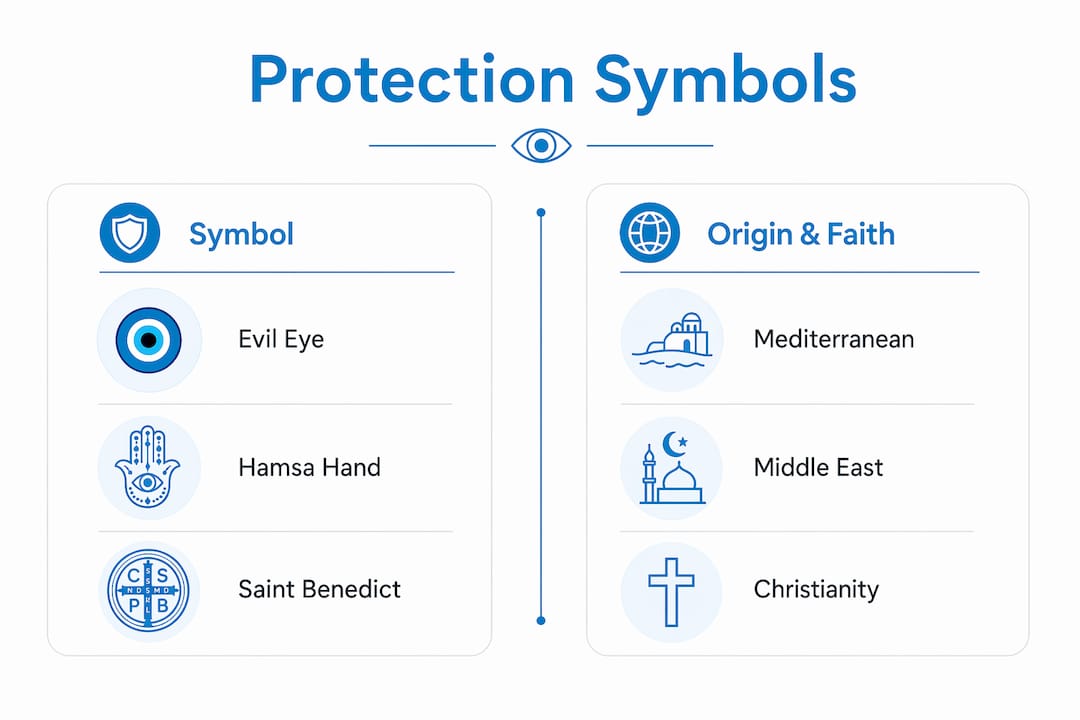
Protection symbols in jewellery span nearly every major civilization. Each carries a distinct origin and protective function, though many overlap in meaning across cultures.
- Evil Eye (Nazar): Reflects negative energy back to its source. Widely used in Turkish, Greek, Jewish, and Arab traditions. The blue glass bead form is the most recognized version globally.
- Hamsa hand: A palm-shaped amulet used in both Islamic and Jewish traditions. Amulets and talismans serve different functions: the Hamsa acts as a passive shield when fingers point down and as an active attractor of blessings when fingers point up.
- Saint Benedict medal: A Catholic protection symbol bearing the initials of a Latin exorcism prayer. It is believed to guard against spiritual attacks and intercede against evil.
- Om symbol: Rooted in Hinduism and Buddhism, representing the primordial sound of the universe. Wearing it is understood to align the wearer with divine vibration.
- Ankh: An ancient Egyptian symbol of eternal life, used in modern spiritual jewellery to invoke protection through connection to life force.
- Tree of Life: Found across Celtic, Norse, and Islamic traditions. It represents rootedness, strength, and the interconnection of all living things.
The table below compares four of the most widely worn protection symbols by origin, function, and faith context.
| Symbol | Origin | Primary function | Faith context |
|---|---|---|---|
| Evil Eye (Nazar) | Mediterranean, Middle East | Deflects negative energy | Multi-faith, secular |
| Hamsa hand | Middle East, North Africa | Shields and attracts blessings | Islam, Judaism |
| Saint Benedict medal | Catholic Christianity | Intercession, spiritual defense | Christianity |
| Tibetan Dzi bead | Tibet, East Asia | Accumulates merit, offers protection | Buddhism |
The distinction between these symbols matters when choosing a piece. A Saint Benedict medal carries the weight of Catholic intercessory prayer, while a Dzi bead is understood in Tibetan Buddhism to accumulate merit and offer protection through karmic alignment. Knowing the origin of a symbol helps you wear it with genuine respect.
Which gemstones and materials are believed to offer spiritual protection?
Protective crystals in jewellery are selected based on their attributed energetic properties, which are often connected to their formation conditions, color, and cultural history.
- Black tourmaline: Considered the strongest protective stone. It is believed to absorb electromagnetic stress and repel negative energy. Black crystals formed under intense geological pressure are understood to carry grounding protective energy, making them ideal for heavy protection needs.
- Obsidian: A volcanic glass that is said to create a shield against psychic attack and reveal hidden truths. Often used in protective amulets for spiritual protection.
- Hematite: An iron-rich stone associated with grounding and strength. Worn to stabilize emotions and reinforce personal boundaries.
- Tiger’s eye: Combines earth and sun energy. Believed to protect against ill will and support clear decision-making under pressure.
- Amethyst: Used for emotional balance and spiritual clarity rather than direct shielding. It is often paired with stronger protective stones.
- Rose quartz: Provides emotional protection by reinforcing self-worth and compassion, creating an internal buffer against negativity.
Metals carry their own significance. Silver is traditionally linked to intuition and lunar energy, making it a common choice for pieces meant to heighten spiritual awareness. Gold is associated with solar vitality and divine connection. Copper is believed to conduct and amplify the energy of stones it holds.
Pro Tip: The symbolic power of protection jewelry comes from collective intention and historical use more than expensive materials. A stainless steel piece engraved with Ayatul Kursi carries the full weight of that verse regardless of its price point.
How do cultural and religious traditions shape protection jewellery?
Every major faith tradition has developed its own form of protective jewellery, and the differences reveal how each tradition understands the relationship between the physical and spiritual worlds.
- Islam: Qur’anic verses, particularly Ayatul Kursi (2:255), are engraved on rings, bracelets, and necklaces as a form of dhikr (remembrance) and protection. The verse is understood to invoke Allah’s guardianship directly. Cairojewellery’s Ayatul Kursi collection is built entirely around this tradition, placing the verse where it is always present on the body.
- Christianity: The Saint Benedict medal and Saint Michael pendants function as intercessory objects invoking spiritual forces for protection. Wearing them is understood as an act of faith, not magic.
- Buddhism: Tibetan Dzi beads and mala beads are worn after ritual consecration by a lama. The blessing ceremony is what activates the piece’s protective function, not the object alone.
- Hinduism: Rudraksha malas, made from seeds of the Elaeocarpus ganitrus tree, are worn for protection and spiritual merit. Each bead type corresponds to a different deity and protective function.
- East Asian traditions: Tai Sui charms are worn to harmonize energy and protect against zodiac clashes in years of astrological conflict. In 2026, the Year of the Horse, these charms carry specific protective significance for those born in conflicting zodiac years.
- Indigenous and folk traditions: Protective amulets made from bone, shell, and stone are worn as direct connections to ancestral spirits and land-based protection.
The common thread across all these traditions is intention and consecration. A piece becomes protective not simply by existing but by being worn with awareness of what it represents. The true meaning of spiritual jewelry in Islam illustrates this clearly: the verse itself is the protection, and the jewellery is the vessel that keeps it close.
How to choose, activate, and maintain spiritual protection jewellery
Selecting and activating protection jewellery is a deliberate process. The piece you choose should resonate with your specific need, whether that is shielding from external negativity, strengthening faith, or reinforcing emotional boundaries.
Step 1: Define your intention. Ask yourself what you need protection from. Emotional drain, spiritual attack, anxiety, and grief each call for different symbols and stones. Effective jewellery becomes a ritual object supporting inner life and mindfulness when personalized intent is applied.
Step 2: Choose the right symbol or stone. Match the symbol to your tradition or the tradition you are drawing from respectfully. If you are Muslim, Qur’anic verse pieces carry the deepest resonance. If you are drawn to crystal work, black tourmaline or obsidian suits heavy protection needs.
Step 3: Cleanse the piece before wearing. New jewellery carries the energy of everyone who handled it before you. Cleansing methods include passing the piece through sage smoke, placing it in moonlight overnight, or rinsing it with clean water while holding a clear intention.
Step 4: Set your intention consciously. Hold the piece in both hands. Verbalize or silently state what you are asking it to support. Activation rituals include holding the piece with intention, verbalizing protection goals, and visualizing protective light surrounding both the jewellery and yourself.
Step 5: Wear it consistently. A piece worn daily builds a conditioned association between the object and your sense of protection. Charging it through prayer or meditation creates a tactile trigger that turns the piece into a mindfulness anchor you can return to throughout the day.
The table below summarizes placement traditions across different cultural contexts.
| Placement | Tradition | Protective purpose |
|---|---|---|
| Left wrist | Crystal healing | Receives energy, absorbs protection |
| Right wrist | Islamic tradition | Active giving and remembrance |
| Around the neck | Multi-faith | Keeps symbol close to the heart |
| Ring finger | Various | Channels intention through touch |
Pro Tip: Avoid wearing multiple protection pieces from conflicting traditions without understanding their origins. Layering Muslim jewellery works best when each piece shares a coherent symbolic language.
How does spiritual protection jewellery connect to modern wellness?
Spiritual protection jewellery has moved well beyond religious practice into mainstream wellness culture, and the reasons are grounded in psychology as much as tradition.
Jewellery functions as a physical and psychological anchor. When you touch a piece during a stressful moment, the tactile sensation interrupts the stress response and redirects attention. Holding mala beads or crystals during meditation can calm the nervous system and bring attention back to the present moment. This is the same mechanism behind worry stones and prayer beads used across cultures for centuries.
Protection jewellery also supports boundary setting in difficult environments. Wearing a piece associated with strength or shielding before entering a challenging situation creates a conditioned psychological state. The object becomes a cue, not unlike a pre-performance ritual for athletes.
“Many view spiritual protection jewellery as a tool for anyone seeking emotional clarity, regardless of formal spiritual practice.”
The democratization of these beliefs is one of the defining shifts in how jewelry enhances spirituality today. You do not need to belong to a specific faith to benefit from the psychological grounding that a meaningful piece provides. What matters is that the piece carries genuine significance for you personally, because personal resonance rather than trendiness determines the most effective protection jewellery.
Key takeaways
Spiritual protection jewellery works through the combination of meaningful symbols, intentional activation, and consistent wear rooted in cultural or personal belief.
| Point | Details |
|---|---|
| Symbols carry collective weight | Evil Eye, Hamsa, and Qur’anic verses draw power from centuries of shared protective intention. |
| Activation is required | Cleansing, intention setting, and visualization bond the wearer’s energy to the piece for effective protection. |
| Amulets and talismans differ | Amulets repel negativity passively; talismans actively attract desired energy like blessing or strength. |
| Material matters less than meaning | Stainless steel engraved with Ayatul Kursi carries the same protective significance as gold. |
| Consistency builds effectiveness | Daily wear and mindful interaction turn a piece into a conditioned psychological and spiritual anchor. |
Why I think most people approach protection jewellery backwards
Most people buy a protection piece because it looks meaningful, then wonder why it does not feel meaningful. The object is not the source of protection. It is a vessel for intention, and a vessel only works when you fill it.
What I have observed, both personally and through years of writing about faith and material culture, is that the most powerful pieces are the ones worn with full awareness of what they represent. An Ayatul Kursi bracelet worn by someone who recites the verse and understands its meaning is a completely different object from the same bracelet worn as a fashion accessory. Both are valid choices. Only one is protection jewellery.
The other mistake I see constantly is chasing the most expensive or exotic piece. The symbolic power of protection jewelry comes from collective intention and historical use, not from the material. A €35 stainless steel bracelet engraved with a Qur’anic verse carries the full weight of that verse. A €500 crystal pendant with no personal resonance carries almost nothing.
My honest recommendation: start with one piece from your own tradition or the tradition you feel most drawn to. Wear it every day for thirty days with conscious intention. Notice what changes. That is how you learn whether protection jewellery works for you, not by reading about it, but by practicing it.
— Elias
Explore meaningful protection jewellery from Cairojewellery
Cairojewellery designs each piece around the belief that jewellery should carry real meaning, not just aesthetic appeal. The Ayatul Kursi collection includes bracelets, necklaces, and rings engraved with one of the most powerful protective verses in the Qur’an, crafted in stainless steel with gold and silver plating for lasting wear. Every order also contributes meals through the ShareTheMeal collaboration, so your purchase extends its blessing beyond yourself. Whether you are buying for yourself or for someone you would make dua for, these pieces are designed to be worn with intention and given with love. Browse the full collection and find the piece that speaks to what you need most right now.
FAQ
What is spiritual protection jewellery?
Spiritual protection jewellery refers to pieces designed to shield the wearer from negative energy, spiritual harm, or emotional drain through symbols, sacred texts, or protective stones. The protection comes from the combination of the symbol’s cultural meaning, the material’s attributed properties, and the wearer’s intention.
What are the best amulets for spiritual protection?
The Evil Eye bead, Hamsa hand, Saint Benedict medal, and Qur’anic verse pieces like the Ayatul Kursi are among the most widely recognized amulets for spiritual protection across different faiths. Each functions differently depending on the tradition it comes from.
Do protective crystals in jewellery actually work?
Protective crystals work through a combination of symbolic belief, tactile anchoring, and conditioned psychological response. Black tourmaline, obsidian, and hematite are the most commonly used stones for shielding, and their effectiveness is tied to the wearer’s consistent intention and engagement with the piece.
How do you activate spiritual protection jewellery?
Activation involves cleansing the piece, holding it with a clear stated intention, and visualizing protective energy surrounding both the jewellery and yourself. For faith-based pieces like Qur’anic verse jewellery, reciting the relevant verse while wearing it reinforces the connection between the object and its spiritual purpose.
What is the difference between an amulet and a talisman?
An amulet passively repels negativity and acts as a shield, while a talisman actively attracts a desired outcome such as luck, health, or blessing. Many pieces, including the Hamsa hand, function as both depending on how they are oriented and worn.