There is a common assumption that when Muslims buy faith jewelry, they are seeking magical protection from a physical object. That assumption misses something much deeper. The real reasons why Muslims buy faith jewelry range from daily spiritual mindfulness to cultural pride, identity affirmation, and the desire to carry a visible reminder of Allah through every moment of an ordinary day. Whether you are a Muslim exploring this practice or a non-Muslim trying to understand it, this article walks through the spiritual, historical, and deeply personal motivations behind Islamic faith-based accessories.
Table of Contents
- Key takeaways
- Why Muslims buy faith jewelry: spiritual intention at the center
- Historical and cultural roots of Islamic jewelry
- Faith jewelry as Muslim identity and belonging
- Choosing the right materials and design
- How faith jewelry fits into modern Muslim daily life
- My honest take on what faith jewelry actually does
- Explore faith jewelry designed with sincerity
- FAQ
Key takeaways
| Point | Details |
|---|---|
| Intention drives meaning | Jewelry holds no inherent power; spiritual benefit comes entirely from the wearer’s conscious intention (niyyah). |
| Tactile reminders support dhikr | Touching or seeing a faith piece can redirect attention toward gratitude and remembrance of Allah during a busy day. |
| Cultural identity matters | Faith jewelry signals belonging and pride, especially for Muslims living in diverse or challenging social environments. |
| Materials and respect are connected | Quranic verse pieces require respectful care, such as removing them before entering a restroom. |
| Gifting carries deep meaning | Faith jewelry is among the most emotionally significant gifts for Ramadan, Eid, weddings, and other milestones. |
Why Muslims buy faith jewelry: spiritual intention at the center
The most misunderstood aspect of Islamic faith-based accessories is what they actually do. They do not protect through any power of their own. The spiritual benefit comes from niyyah, the Arabic word for conscious intention. A piece engraved with Ayatul Kursi or the 4 Qul chapters serves as a visual cue, not a substitute for prayer or a source of independent power. The object is a prompt. The faith belongs entirely to the person wearing it.
This distinction matters enormously for understanding Muslim jewelry buying reasons. When someone puts on an Allah pendant or a necklace inscribed with a Quranic verse, the act itself can become a moment of remembrance. The physical sensation of a bracelet on the wrist, the glimpse of an engraving during a stressful meeting, the weight of a ring during a moment of anxiety. These are the micro-moments where tactile cues redirect attention toward gratitude and remembrance of Allah.
This practice is connected to the Islamic tradition of dhikr, which means the remembrance of God through repeated phrases, reflection, or focused thought. Jewelry that supports dhikr functions as a frictionless spiritual anchor. It does not require setting aside dedicated time. It works in the middle of the workday, in a crowded space, or during a difficult conversation.
Pro Tip: When choosing a faith piece, look for designs where the symbol or verse is positioned to catch your eye naturally throughout the day, not hidden under a collar or facing inward. The spiritual reminder only works when you actually see or feel it.
Key reasons Muslims choose faith jewelry for spiritual mindfulness:
- Quranic verse pieces like Ayatul Kursi serve as shielding chapter reminders, keeping protective supplications close during distracted moments
- Engravings and textures allow the hands and mind to reconnect with intention without disrupting daily activity
- Wearing a symbol of faith openly creates an internal accountability to embody that faith throughout the day
- Pieces tied to specific verses encourage the wearer to reflect on the meaning of those verses regularly
Historical and cultural roots of Islamic jewelry
The practice of wearing faith-based accessories in Muslim communities is not modern. It has roots across centuries and regions, each with its own symbolic language and material traditions.
In Shia Muslim communities, the concept of the hirz amulet has long held spiritual significance. These sterling silver hirz pieces connect wearers to the legacy and lineage of the Prophet, serving as a focal point for supplication and connection to sacred history. The use of 925 sterling silver in Islamic jewelry carries both practical and symbolic weight. Silver is referenced favorably in Islamic tradition, and its spiritual significance in Islam has made it the material of choice for faith pieces across cultures and centuries.
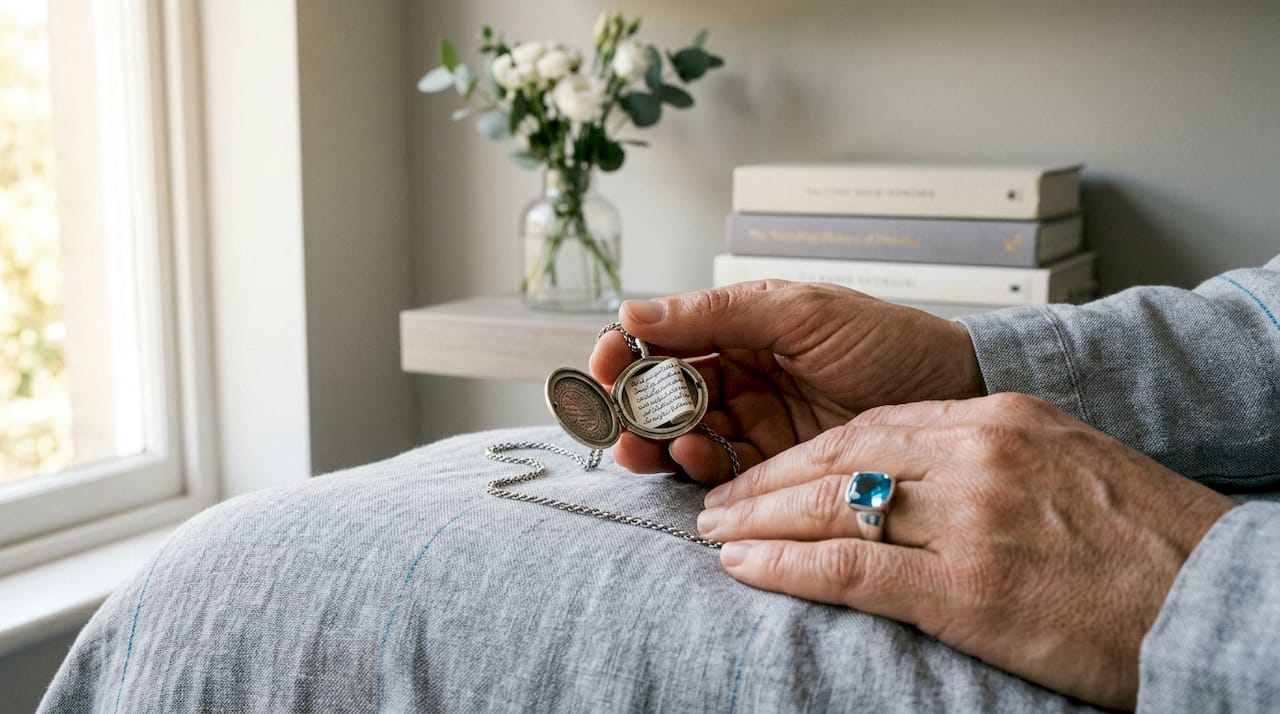
The visual vocabulary of Islamic jewelry is extraordinarily diverse. Ottoman filigree work, North African enamel designs, Arabic calligraphy pendants, and geometric tessellations rooted in classical Islamic art all represent distinct regional expressions of the same spiritual impulse. This table captures some of the key traditions:
| Tradition | Region | Characteristic |
|---|---|---|
| Hirz amulets | Iran, Iraq, Lebanon | Sterling silver, Quranic inscriptions, connected to prophetic lineage |
| Filigree metalwork | Turkey, Balkans | Intricate wirework in gold and silver, often featuring geometric patterns |
| Calligraphy pendants | Pan-Islamic, global diaspora | Names of Allah, Quranic phrases in stylized Arabic script |
| Enamel and beadwork | North Africa (Morocco, Tunisia) | Bold colors, geometric motifs, protective symbolism |
| Geometric tessellation | Central Asia, Persia | Mathematical patterning reflecting divine order |
What ties these traditions together is cultural continuity. For many Muslim families, a specific style of faith jewelry carries the memory of a grandmother’s home country, a wedding gift passed between generations, or a tradition carried through migration. Layering different pieces allows wearers to tell the story of who they are, where their family came from, and what they believe, all without saying a word.
The important distinction here is between talismanic thinking and authentic remembrance practice. Islamic theology is clear: protection comes from Allah alone. Jewelry serves only as a focal point for intention, not as an object with independent power.
Faith jewelry as Muslim identity and belonging
For many Muslims, particularly those living as minorities in secular or multi-faith societies, faith jewelry carries a social dimension that goes beyond personal spirituality. It is a quiet but deliberate statement. A choice to be visible.
Calligraphy pendants signal belonging and cultural pride in environments where Muslim identity sometimes feels under pressure. This is especially true in contexts where more visible markers of faith, like the hijab, may attract unwanted attention. A delicate bracelet or ring with an Islamic inscription can express the same conviction with a subtler presence.
“Faith jewelry allows Muslims to carry their identity with dignity, regardless of what the world around them looks like on any given day.”
This sense of identity is not only a response to external pressure. It is also a genuine celebration of who you are. The role of jewelry in Muslim identity reflects a desire to honor cultural heritage and spiritual conviction simultaneously, in a form that feels personal rather than performative.
Common symbols chosen for their identity and solidarity significance include:
- The name of Allah in Arabic calligraphy, a direct and dignified declaration of faith
- Ayatul Kursi, the Throne Verse from Surah Al-Baqarah, recognized across Muslim traditions as one of the most profound verses in the Quran
- The crescent and star, widely recognized as a symbol of Islamic heritage
- The olive branch, connected to peace, Palestine solidarity, and the deep symbolism of olive trees in Islamic and Abrahamic tradition
- Phrases like “Inna ma’al usri yusra” (With hardship comes ease), which function as both spiritual reminders and emotional support
Choosing the right materials and design
Understanding the significance of faith jewelry is one part of the picture. Choosing the right piece requires some practical knowledge too.
-
Opt for quality base metals. 925 sterling silver and stainless steel with 18K gold plating are the most popular choices in Islamic jewelry. Both offer durability, resist tarnishing with basic care, and align with the modest aesthetics many Muslim wearers prefer.
-
Check for halal-friendly materials. Durable and ethically sourced pieces reduce waste, reflect spiritual respect, and align with the broader Islamic value of stewardship. Avoid pieces that incorporate animal-derived materials, such as bone or certain adhesives, if halal compliance matters to you.
-
Consider how the design will wear over time. A thick gold plating over stainless steel will hold much better than a thin coating over a base alloy. Ask about plating thickness before purchasing if longevity is a priority.
-
Respect the sacred nature of Quranic text. Removing verse-inscribed pieces before entering a restroom is widely recommended by Islamic scholars. Many wearers choose adjustable or easy-clasp designs that make this respectful practice simple and habitual.
-
Match the piece to the occasion and wardrobe. Subtle, unisex designs tend to work best for daily wear and gifting. Layering a Quranic verse necklace with a plain chain, or stacking a faith ring with a simple band, allows personal expression without overwhelming an outfit.
Pro Tip: If you are buying faith jewelry as a gift, choose a piece whose verse or phrase speaks directly to what you would say in a dua for that person. A piece that carries “With hardship comes ease” for a friend going through difficulty means more than a generic pendant.
How faith jewelry fits into modern Muslim daily life
The meaning behind faith jewelry becomes most visible in how Muslims actually use it day to day. It is not reserved for Fridays or formal occasions. It lives in ordinary moments.
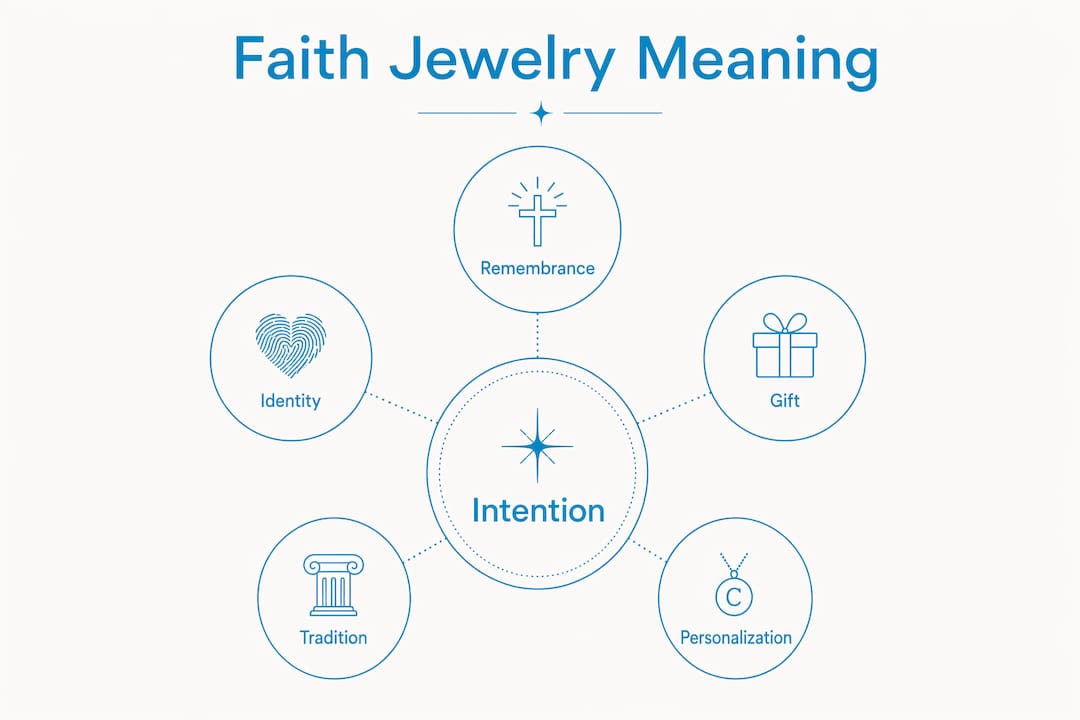
During a work commute, a glance at an engraved bracelet can redirect a stressed mind toward a short dhikr. At a social gathering, a necklace bearing an Islamic phrase can spark a meaningful conversation or simply give the wearer a quiet sense of grounding. In contexts where removing your shoes at a mosque or pausing for prayer is not possible, a faith piece keeps a thread of spiritual connection alive.
The gifting dimension of Islamic jewelry is equally significant. Jewelry as a spiritual gift for Ramadan, Eid, weddings, and graduations carries emotional weight that typical gifts do not. It says: I made dua for you, and I want you to carry something that reminds you of that. That is a different category of gift entirely.
Modern faith jewelry also reflects the work of artisan and small-batch makers who design with genuine cultural awareness rather than generic religious branding. Their pieces tend to feel sincere because they are made by people who understand the spiritual language they are working in.
The trend toward layering and personalization has made faith jewelry more accessible to younger generations as well. A person might wear an Ayatul Kursi bracelet alongside a plain minimalist band, or a calligraphy pendant layered with a delicate chain. These combinations allow intentional accessorizing that honors both faith and personal style without feeling like one cancels out the other.
My honest take on what faith jewelry actually does
I have spent years working alongside Muslim communities and artisans who create these pieces, and the thing conventional discussion almost always gets wrong is the talismanic framing. People outside the tradition often assume faith jewelry is a protective object in the superstitious sense. People inside the tradition sometimes slip into that thinking too, if they are not careful. Both miss the point.
What I have found is that faith jewelry works because of what the wearer brings to it, not what the object contains. The moment a person puts on a piece with conscious intention, they have already done something spiritually meaningful. The jewelry then serves as a recurring invitation to return to that intention throughout the day.
I have also seen how much the identity dimension matters, especially for Muslims navigating spaces where their faith is invisible to others or quietly unwelcome. Wearing a piece that carries a Quranic verse is not aggression or performance. It is dignity. And that distinction is worth understanding clearly.
The practical wisdom I would offer: choose a piece whose symbolism you actually know and connect with. A necklace with a verse you have never read is just decoration. A necklace with a verse that has carried you through something real is a companion.
— Elias
Explore faith jewelry designed with sincerity
If this article has clarified what you are looking for, the next step is finding a piece made with the same care and intention described here. Cairojewellery is a Sweden-based Islamic jewelry brand that creates pieces centered on Quranic verses, Islamic symbolism, and meaningful gifting. From the Ayatul Kursi Bracelet to the With Hardship Comes Ease Necklace, each design is made to serve as a genuine reminder, not just an accessory. Every order also contributes meals through a ShareTheMeal collaboration, connecting your purchase to real humanitarian impact. Explore the full faith jewelry collection and find a piece worth giving, or worth keeping for yourself.
FAQ
Why do Muslims wear Islamic jewelry with Quranic verses?
Muslims wear necklaces with Quranic symbolism as daily reminders to maintain spiritual focus and connection to Allah. The piece itself holds no power; the benefit comes from the wearer’s intention and conscious remembrance.
Is it permissible to wear faith jewelry in Islam?
Wearing Islamic jewelry is generally considered permissible, provided the wearer does not attribute independent protective power to the object. Scholars emphasize that pieces bearing Quranic text should be treated with respect, including removing them in restrooms.
What is the most common type of Muslim faith jewelry?
Ayatul Kursi pieces, Allah pendants, and 4 Qul necklaces are among the most widely worn. These are chosen for their deep Quranic significance and their function as spiritual focus pieces during daily life.
Why is faith jewelry a meaningful gift in Muslim culture?
Faith jewelry marks spiritual milestones and strengthens bonds by conveying something deeply personal. Gifting a piece for Eid or Ramadan communicates care, prayer, and the desire for the recipient to feel spiritually supported.
Can non-Muslims wear Islamic faith jewelry?
Non-Muslims can wear Islamic jewelry respectfully if they do so with genuine appreciation for its meaning rather than as a trend or costume. Understanding what the verse or symbol represents is the most important starting point.