Many Muslims have worn a necklace engraved with Quranic verses and felt a quiet sense of peace doing so. Others have been told that the same piece could border on shirk. So what does necklace symbolize in Islam, exactly? The answer is not a simple yes or no. It sits at the intersection of religious ruling, cultural tradition, intention, and material. This article breaks down each of those dimensions clearly, so you can wear your faith with knowledge and confidence, whether you are choosing a piece for yourself or giving it to someone you love.
Table of Contents
- Key Takeaways
- Religious rulings on wearing necklaces in Islam
- Islamic necklace symbolism and what pendants mean
- The controversy around Quranic verses as amulets
- Practical guidance for choosing and wearing Islamic necklaces
- Key symbolism and rulings at a glance
- My perspective on wearing Islamic necklaces
- Faith-centered Islamic jewelry from Cairojewellery
- FAQ
Key Takeaways
| Point | Details |
|---|---|
| Gender determines material | Gold necklaces are forbidden for men; women may wear gold, silver, and other adornments freely. |
| Intention shapes permissibility | A necklace worn as a reminder of faith differs significantly from one worn as a protective amulet. |
| Amulets carry serious risk | Scholars widely consider ta’wiz worn for protection to be shirk, regardless of whether they contain Quranic verses. |
| Culture adds rich symbolism | Specific pendants like the Zulfiqar sword carry deep cultural meaning within Muslim communities. |
| Ruqyah over reliance on objects | Scholars recommend recitation and supplication over wearing physical Quranic inscriptions for protection. |
Religious rulings on wearing necklaces in Islam
The foundation of any conversation about what a necklace symbolizes in Islam begins with what Islamic law actually says about wearing one. The rulings are more specific than most people realize, and they hinge primarily on two things: the material of the necklace and the gender of the person wearing it.
Gold jewelry is forbidden for Muslim men but fully permissible for women as adornment. This is not a matter of scholarly debate. It is established through prophetic tradition and upheld by the consensus of major scholars across all four schools of Islamic jurisprudence. For men, the ruling applies regardless of the design or purpose of the necklace.
Silver, on the other hand, occupies different ground. Men may wear silver jewelry with conditions, including that it not be worn in imitation of women’s adornment and that it not be excessive in quantity or weight. A simple silver necklace with a meaningful Islamic motif falls within what many scholars permit for men.
For women, the importance of jewelry in Islam is well established. Necklaces are explicitly permitted for women as a form of adornment, with scholars including al-Nawawi and al-Bayhaqi affirming this. Women may wear necklaces in gold, silver, or other materials as long as the pieces do not involve forbidden symbols or serve as superstitious amulets.
Here is a quick summary of the rulings by material and gender:
- Gold necklaces: Permitted for women; forbidden for men.
- Silver necklaces: Generally permitted for both women and men, with conditions for men.
- Stainless steel or other metals: Permissible for both, provided they do not cause harm or contain forbidden imagery.
- Necklaces as adornment: Permitted when worn without superstitious belief or amulet intent.
- Necklaces as amulets (ta’wiz): Problematic and often forbidden, regardless of gender or material.
Pro Tip: If you are a man looking to wear an Islamic necklace, choose silver or stainless steel designs featuring Quranic calligraphy or geometric motifs rather than gold, and wear it with the clear intention of faith expression, not as a talisman.
The distinction between adornment and amulet use is where many people get confused. Adornment is a legitimate Islamic category. The Prophet, peace be upon him, said that Allah is beautiful and loves beauty. Wearing a necklace to express elegance or Islamic identity sits comfortably within that framework. Wearing a necklace to ward off the evil eye or bring good luck does not.
Islamic necklace symbolism and what pendants mean
Beyond rulings, the richer question is what necklaces actually represent in Islamic culture. The answer spans spiritual identity, Quranic connection, and centuries of tradition that vary across Muslim communities worldwide.
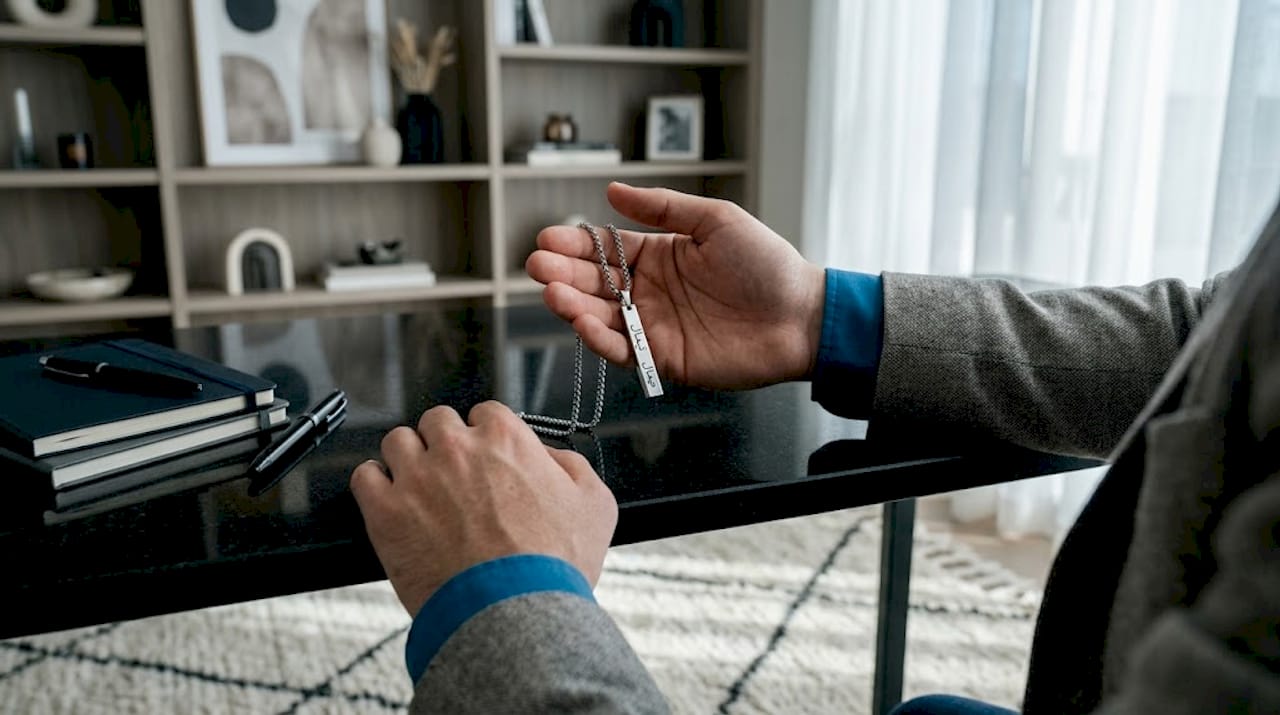
Quranic inscriptions are the most common form of Islamic jewelry symbolism on necklaces. A pendant engraved with Ayatul Kursi or the name of Allah serves as a wearable reminder of one’s relationship with the Creator. For many Muslims, wearing such a piece is like carrying a dhikr with you throughout the day. The visual and tactile presence of the verse can prompt remembrance, reflection, and gratitude.
Specific pendant designs carry distinct cultural meanings. Here is how the most widely recognized symbols are understood across Muslim communities:
- Ayatul Kursi pendant: Represents the sovereignty and power of Allah. Ayatul Kursi (Quran 2:255) is widely regarded as the greatest verse of the Quran. Wearing it as a reminder carries deep spiritual significance.
- Name of Allah calligraphy: A direct expression of tawhid, the belief in the oneness of Allah. It functions as a declaration of faith worn close to the heart.
- Zulfiqar sword pendant: In Shia Islamic culture, the Zulfiqar symbolizes justice and courage, tied to the legacy of Imam Ali ibn Abi Talib. The pendant is an emblem of virtues that many Muslims across backgrounds admire, even if its roots lie in Shia heritage.
- Crescent and star pendant: Carries a cultural association with Muslim identity, though it does not originate from Quranic text. It is more of a civilizational symbol than a strictly religious one.
- Olive branch or geometric motifs: Often reflect Islamic artistic heritage and can symbolize peace, hope, or the beauty of Allah’s creation.
| Symbol | Primary meaning | Cultural origin |
|---|---|---|
| Ayatul Kursi | Allah’s sovereignty and omnipotence | Broad Islamic tradition |
| Zulfiqar sword | Justice, courage, allegiance to Imam Ali | Shia Islamic culture |
| Name of Allah | Declaration of tawhid | Pan-Islamic |
| Crescent and star | Muslim identity | Ottoman and broader culture |
| Olive branch | Peace, hope, divine creation | Islamic and regional culture |
The distinction between a spiritual reminder and a forbidden amulet is one of the most misunderstood areas within the significance of ornaments in Islam. A reminder points your heart toward Allah. An amulet asks the object itself to protect you. One is worship in its widest sense. The other is a form of reliance that scholars unanimously warn against.
The controversy around Quranic verses as amulets
This is where many sincere Muslims feel uncertain, and rightly so. The question of whether wearing a necklace with Quranic verses is allowed touches on one of the most serious concerns in Islamic theology: shirk, the association of partners with Allah.
“Whoever wears an amulet has committed shirk.” (Reported by Ahmad, with a sound chain according to many scholars of hadith.)
Wearing ta’wiz around the neck is considered shirk by a significant number of scholars when the wearer believes the object itself provides protection. The logic is precise. If you place your trust in the physical piece rather than in Allah, you have replaced reliance on the Creator with reliance on a created thing. The fact that the object contains Quranic verses does not automatically make it permissible.
There is no authentic hadith from the Prophet, peace be upon him, or his companions supporting the wearing of Quranic verses physically around the neck for protection. This is a critical point that many are unaware of. The practice is culturally widespread but lacks prophetic precedent.
Some scholars do draw a distinction based on intention and function. A person who wears a necklace engraved with Ayatul Kursi purely as a reminder of Allah’s words, not as a protective charm, occupies a different position in the scholarly debate than someone wearing the same piece to ward off jinn. The majority opinion still leans toward caution, but this nuance matters for understanding the full picture.
What scholars universally recommend instead is ruqyah. Recitation with sincere intention is the prophetically supported means of seeking protection. Reading Ayatul Kursi before sleeping, reciting the three Quls, or making sincere dua places your reliance directly where it belongs: with Allah alone.
Pro Tip: Wear Quranic inscriptions on necklaces as a reminder of the words of Allah, not as a ward against harm. Pair the piece with the actual recitation of those verses daily. The necklace points you toward the practice; it does not replace it.
Practical guidance for choosing and wearing Islamic necklaces
Understanding the rulings and symbolism is the first step. Applying them when you actually shop for or wear a necklace is the next. Here is how to choose pieces that honor both your faith and your intention.
- Check the material. Men should avoid gold. Silver or stainless steel with appropriate Islamic designs is a sound choice. Women have broader flexibility, but quality and durability matter too, since these are pieces often worn daily.
- Examine the design. Avoid symbols that originate from non-Islamic traditions or that carry associations with superstition, luck, or forbidden beliefs. Look for Quranic calligraphy, geometric Islamic art, or motifs with clear, documented meaning.
- Know your intention. Before putting on a necklace, be honest with yourself. Are you wearing it to feel spiritually grounded and remind yourself of Allah? That is beautiful and permissible. Are you wearing it because you believe it will protect your home, bring money, or keep away illness? That is where caution is absolutely necessary.
- Learn about halal jewelry materials before buying. Not every metal sold as “Islamic” meets the standards of permissibility. Understanding which materials are acceptable helps you shop with confidence.
- Avoid necklaces designed explicitly as ta’wiz. If a necklace is marketed as something that will protect you or bring you blessings through the object itself, that is a warning sign.
Key symbolism and rulings at a glance
The conversation around necklace meaning in Islam is not monolithic. It reflects the diversity of Muslim communities, schools of thought, and cultural traditions that have developed across fourteen centuries. Here is a concise view of the major perspectives:
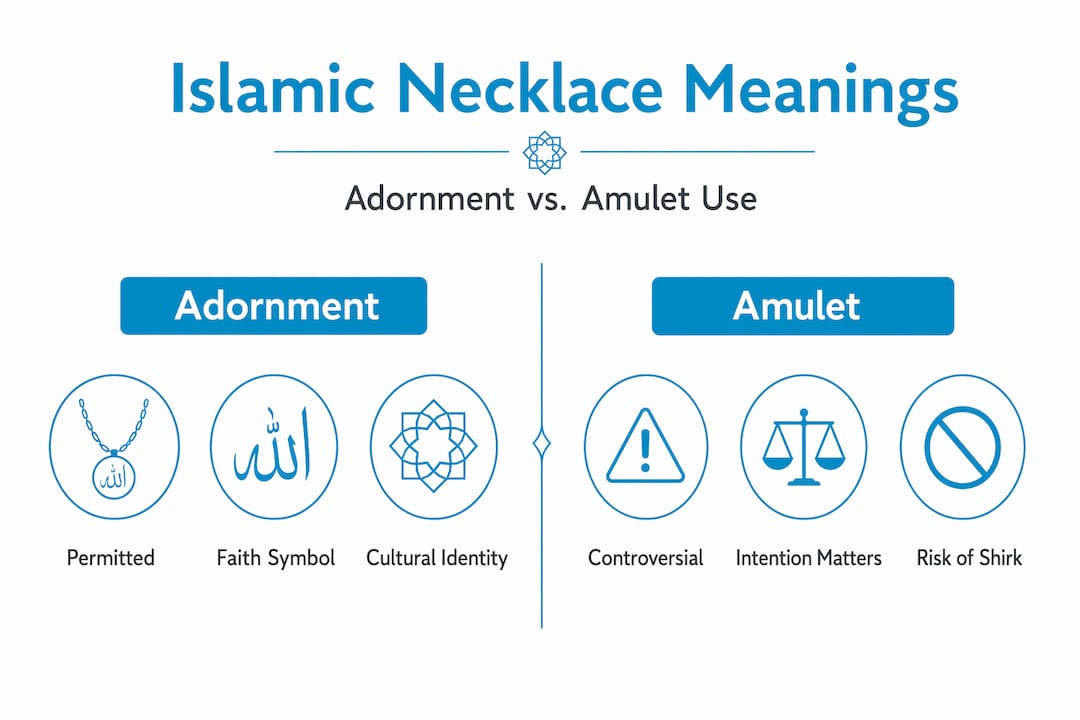
| Dimension | Ruling or meaning |
|---|---|
| Materials for women | Gold, silver, and other metals are permitted as adornment |
| Materials for men | Gold is forbidden; silver and stainless steel are generally permitted |
| Amulet use | Widely considered shirk by scholars across madhabs |
| Quranic inscriptions as reminders | Debated but less objectionable when intention is pure remembrance |
| Cultural pendants (e.g., Zulfiqar) | Carry significant cultural meaning; permissible as symbolic adornment |
| Recommended protection | Recitation of Quranic verses and sincere dua, not physical amulets |
Respecting this diversity means neither dismissing cultural traditions as ignorant nor accepting practices uncritically simply because they are widespread. The most grounded position is one built on knowledge, intention, and continuous learning.
My perspective on wearing Islamic necklaces
I have spent years observing how Muslims relate to their jewelry, and what I have found is that most of the confusion comes not from bad faith but from incomplete knowledge. Someone wearing a necklace with Ayatul Kursi engraved on it is almost certainly doing so out of love for the Quran and closeness to Allah. That impulse is beautiful and should be honored, not dismissed.
What I have learned is that the conversation should not start with “is this shirk?” It should start with “what does this piece mean to you and why are you wearing it?” In my experience, when someone genuinely understands the distinction between reliance on Allah and reliance on an object, they naturally recalibrate how they think about their jewelry.
I have also seen how cultural tradition can be mistaken for religious obligation. The Zulfiqar pendant is a profound symbol of virtue and sacrifice in many Muslim communities. Wearing it as a cultural expression of those values is entirely different from wearing it as a protective charm. Context and community knowledge matter enormously.
My honest take: wear what connects you to Allah, wear what reminds you to recite, wear what honors your identity as a Muslim. Just know why you are wearing it. That knowledge is itself a form of worship.
— Elias
Faith-centered Islamic jewelry from Cairojewellery
If you are looking for necklaces that honor both Islamic principles and genuine craftsmanship, Cairojewellery offers a carefully curated range designed with exactly this in mind. The Ayatul Kursi Necklace carries one of the most beloved verses of the Quran in an elegant, wearable form, crafted in gold-plated or silver-plated stainless steel. Every piece from Cairojewellery is designed as a reminder, not a talisman. It points you toward the words of Allah, not away from Him. For those who want to give something truly meaningful, this is the kind of gift you give to someone you would make dua for. Cairojewellery also supports the ShareTheMeal donation program with every purchase, meaning your gift carries blessing beyond the person receiving it.
FAQ
What does a necklace symbolize in Islam?
A necklace in Islam can symbolize faith, identity, and connection to Allah when worn as adornment or a spiritual reminder. Its meaning depends largely on the design, material, and the intention of the wearer.
Is it permissible for Muslim men to wear necklaces?
Muslim men may wear silver or stainless steel necklaces but must avoid gold, which is forbidden based on prophetic tradition. The necklace should not be worn as an amulet or in imitation of women’s adornment.
Are Quranic verse necklaces considered shirk?
Wearing a Quranic verse necklace as a protective amulet carries a high risk of shirk according to many scholars. When worn purely as a reminder of Allah’s words without placing protective trust in the object, the ruling is more debated but still treated with caution by most scholars.
What is the difference between a reminder necklace and a ta’wiz?
A reminder necklace bears Quranic text to prompt remembrance and reflection. A ta’wiz is worn with the belief that the physical object itself provides protection, which scholars widely consider a form of shirk.
What do Islamic pendant symbols like the Zulfiqar mean?
The Zulfiqar sword pendant symbolizes justice, courage, and devotion to Imam Ali within Shia Islamic culture. More broadly, it is recognized across Muslim communities as an emblem of moral strength and righteous leadership.