When most people look at an illuminated Qur’anic manuscript or a mosque wall covered in flowing letters, they assume the Arabic script is decorative. It is not. Understanding the true arabic script meaning in islamic art requires recognizing that each letter, each spacing decision, and each stylistic tradition carries spiritual weight alongside aesthetic beauty. Arabic calligraphy, the proper scholarly term for this practice, is not an ornament placed over sacred content. It is the sacred content, given visual form. This article explores why that distinction matters, tracing the script’s origins, spiritual logic, material expressions, and living cultural relevance.
Table of Contents
- Key Takeaways
- Historical origins of Arabic script in Islamic art
- Spiritual and ethical meaning behind Arabic calligraphy
- Arabic script across architecture, textiles, metalwork, and manuscripts
- Technical rules and manuscript structure
- Cultural and modern relevance of Arabic script today
- Why “just decoration” is a misreading worth correcting
- Carry the meaning with you
- FAQ
Key Takeaways
| Point | Details |
|---|---|
| Script as sacred text | Arabic calligraphy is not decoration; it functions as the visual manifestation of divine speech. |
| Spiritual discipline | Purity of script was understood to reflect purity of the soul, linking craft to ethics. |
| Multi-art integration | Arabic script appears across architecture, textiles, metalwork, and manuscripts with layered meanings. |
| Technical rules matter | Qur’anic orthographic conventions govern spacing, form, and layout in authentic calligraphy. |
| Living tradition | Script continues to shape Muslim identity in jewelry, fashion, and contemporary art today. |
Historical origins of Arabic script in Islamic art
Arabic script existed before Islam. Its early uses were largely functional: trade records, treaties, and poetry inscribed on stone or animal skins. The letters were utilitarian, without the visual sophistication that would come later. That changed decisively with the rise of Islam in the seventh century and the divine command to preserve the Qur’an in written form.
The task of transcribing the word of Allah transformed Arabic script from a practical tool into a sacred responsibility. Scribes understood they were not simply copying text. They were preserving the exact divine utterance revealed to the Prophet Muhammad, peace be upon him. That understanding gave rise to an entire visual language.
The historical significance of Arabic script accelerated through several distinct calligraphic styles, each with its own spiritual and functional context:
- Kufic: The earliest formal script, characterized by angular, geometric letterforms. It dominated early Qur’anic manuscripts and mosque inscriptions from the seventh through tenth centuries.
- Naskh: A rounder, more legible style that became the standard for Qur’anic copying by the tenth century. Most printed Qur’ans today still use a descendant of Naskh.
- Thuluth: A large, ornate style frequently used in architectural inscriptions and headings, known for its sweeping vertical strokes.
- Nastaliq: Predominantly used in Persian manuscripts, recognizable by its diagonal flow and expressive line quality.
Calligraphic design is omnipresent in Islamic art and serves as the central vehicle for transcribing the Qur’an across diverse objects and architectural surfaces. You find it on coins, tiles, metalwork, and buildings, not because it looked appealing, but because the word of Allah was meant to permeate every sphere of material life.
Spiritual and ethical meaning behind Arabic calligraphy
The most significant insight about Arabic calligraphy in Islamic tradition is this: the quality of the script was understood to reflect the spiritual condition of the one who wrote it. This was not metaphorical language. It was a guiding principle of the craft.
Purity of writing symbolizes purity of soul, and calligraphers along with Sufis trace their spiritual lineage to Ali ibn Abi Talib, the cousin and son-in-law of the Prophet. This lineage is not merely historical. It signals that the transmission of the calligraphic tradition carries spiritual authority, not just technical skill.
“Purity of writing is purity of soul.” This medieval principle shaped every aspect of how calligraphers understood their work, from the preparation of ink to the control of breath while writing.
This is where Arabic script in culture diverges sharply from Western artistic traditions. In many Western frameworks, great art reflects the unique personality of the artist. In Arabic calligraphy, the goal is precisely the opposite. Calligraphers traditionally emphasize self-effacement to serve the divine word rather than assert personal expression. The meanings of Arabic symbols and their forms belong to God. The calligrapher is the instrument.
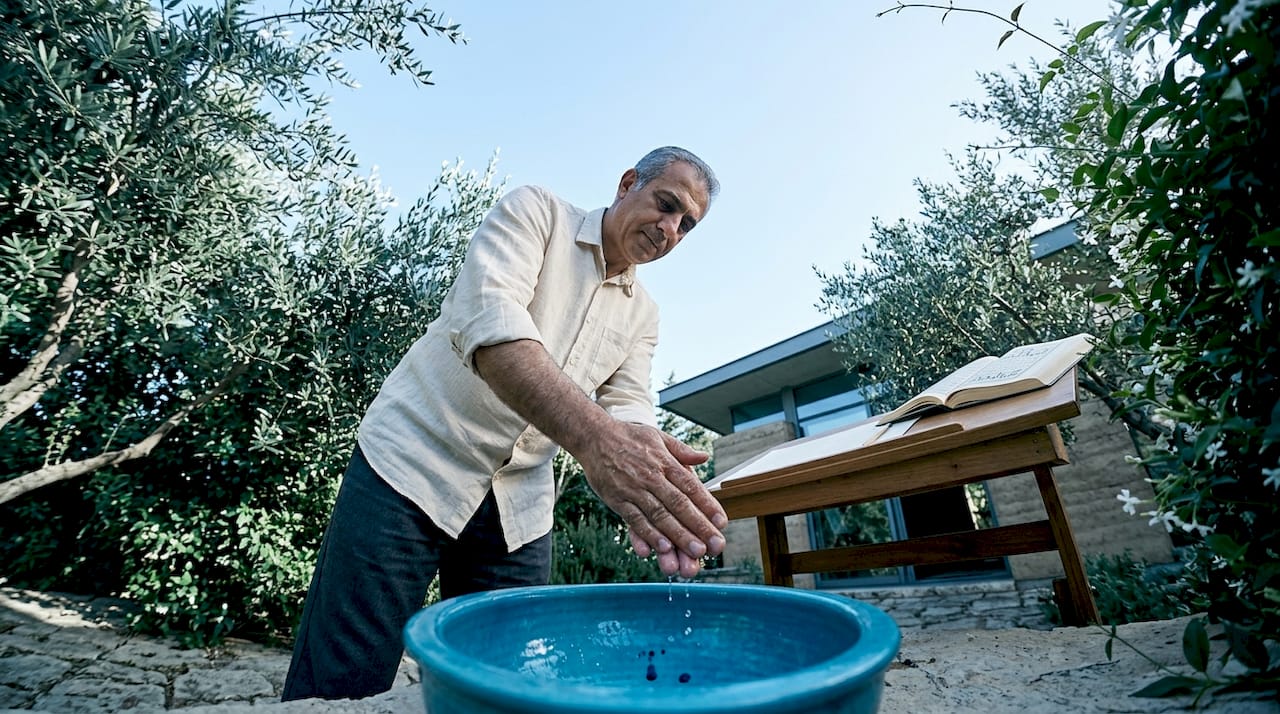
This ethical orientation extended to daily practice. A master would not simply begin writing. Preparation included ritual purification, a state of mental stillness, and sometimes specific prayers before touching the reed pen to paper. Every completed line was an act of devotion.
Pro Tip: If you are studying Arabic calligraphy for the first time, pay attention to what a master calligrapher does before writing, not just what they produce. The ritual preparation reveals as much about the art’s spiritual logic as the finished script does.
The role of calligraphy in Islam cannot be understood apart from this ethical framework. The art was never purely about beauty. It was about submission, discipline, and the embodiment of reverence through form.
Arabic script across architecture, textiles, metalwork, and manuscripts
One of the most striking qualities of Arabic calligraphy in art is how completely it permeates different material traditions. The same Qur’anic verse can appear on a stone portal, a bronze lamp, a woven textile, and a hand-painted manuscript page. Each medium adds its own layer of meaning to the script it carries.
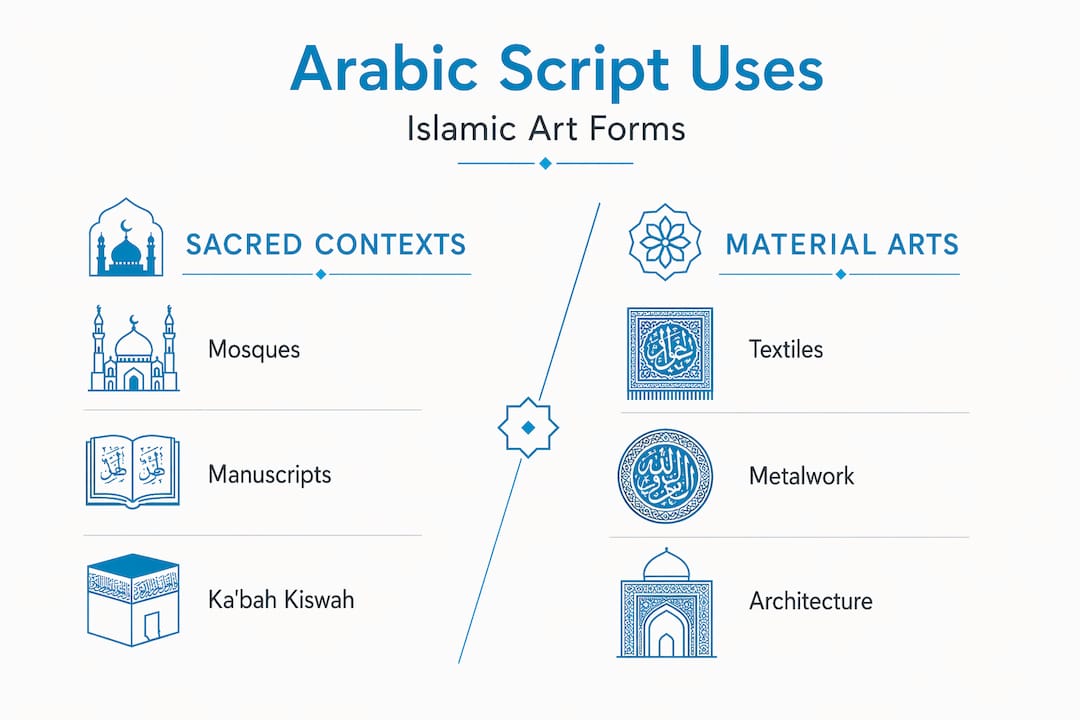
| Art Form | Example | Significance |
|---|---|---|
| Architecture | Mosque interiors, domes, portal inscriptions | Script claims sacred space and orients worshippers toward divine presence |
| Textiles | Ka’bah’s kiswah with embroidered Qur’anic verses | Labor and precious materials make the devotional act physically tangible |
| Metalwork | Coins, lamps, ewers bearing Qur’anic phrases | Script confers blessing and legitimacy on functional objects |
| Manuscripts | Illuminated Qur’ans with gilded borders | Calligraphy and ornamentation work together as a unified devotional art |
The Ka’bah’s kiswah offers perhaps the most extraordinary example of script as devotional material art. Silver wires coated with 24-karat gold are hand-embroidered into the black silk following precise linework and ornamental design. The verses you see on the kiswah are not printed or applied mechanically. They are built up through multi-step embroidery with precious metals, a process in which the labor itself becomes part of the offering. The meaning of the scripture is amplified, not just displayed.
Islamic art and lettering in architectural contexts work similarly. Walk into the great mosque of Córdoba or the Süleymaniye Mosque in Istanbul, and you will find Qur’anic verses inscribed at every meaningful threshold: the entryway, the mihrab, the dome. Script marks where the sacred begins. It tells the body where to direct its attention before the mind has decided.
Manuscript production brought all of these elements together. The art of producing authentic Islamic manuscripts requires integrated knowledge of page structure, calligraphy, ornamentation, gilding, and bookmaking. A skilled manuscript artist was not a specialist in one area. They understood how each element served the whole. The layout of the page, the proportion of text to margin, the coloring of chapter headings: all of these decisions carried meaning.
Pro Tip: When examining an Islamic manuscript, look at the relationship between the text block and the decorative border. In high-quality manuscripts, the border is never an afterthought. It frames the divine word the way a sanctuary frames prayer.
You can learn more about how precious metals in Islamic tradition carry their own symbolic weight alongside the script they bear.
Technical rules and manuscript structure
Authentic Arabic calligraphy is governed by rules that go far beyond aesthetics. For Qur’anic calligraphy specifically, orthographic conventions govern spacing and permitted letter forms, and violating them is not an artistic choice. It is a theological error.
Contemporary training programs reflect how seriously this technical precision is taken. Here is how a rigorous Qur’anic calligraphy education unfolds:
- Script fundamentals: Students master the proportional system of the chosen style, learning how each letter’s height, width, and angle relate to a base unit derived from the pen’s nib size.
- Orthographic rules: Qur’anic spelling differs from standard Arabic in several ways, preserving archaic forms. Students learn which letter forms are permitted, which are prohibited, and why those distinctions exist.
- Layout and page structure: Manuscript arts programs integrate calligraphy with understanding of manuscript structure combined with hands-on training, teaching how text is distributed across a page to honor both readability and visual balance.
- Ornamentation and gilding: Students learn how decorative elements interact with script, ensuring that visual embellishment draws attention toward the text rather than away from it.
- Independent composition: Only after mastering all prior elements does a student attempt original compositions, applying the rules with personal craft expression within established boundaries.
This structure explains why the Arabic typography and art of Qur’anic manuscripts looks disciplined without feeling rigid. The rules create a framework within which real artistry operates. Mastery is not about breaking conventions. It is about understanding them so thoroughly that your work carries their authority.
Cultural and modern relevance of Arabic script today
The tradition of Arabic script as spiritual art did not remain sealed in the past. It continues to shape Muslim identity in the twenty-first century, from mosque architecture to personal adornment and contemporary design.
Today, the importance of Arabic script is visible across several modern expressions:
- Contemporary calligraphy art: Artists like Hassan Massoudy and Etel Adnan have extended traditional forms into gallery spaces, creating large-scale works that honor calligraphic convention while speaking to modern audiences.
- Fashion and streetwear: Arabic lettering appears on garments as a declaration of faith and cultural pride, particularly among younger Muslims navigating identity in Western contexts.
- Jewelry and personal objects: Qur’anic verses and phrases like “inna ma’al usri yusra” (With hardship comes ease) are worn on the body as daily reminders and protection. The cultural meaning of Arabic jewelry reflects the same logic as manuscript ornamentation: the word, given material form, stays close.
- Architectural revival: New mosques and Islamic centers worldwide continue commissioning hand-calligraphed inscriptions, maintaining the tradition of script as sacred space-marker.
- Gifting culture: Meaningful gifts featuring Arabic script have become a significant expression of care within Muslim communities, particularly for occasions like Eid, graduations, and marriages.
The artistic expressions found in Islamic script today draw on the same spiritual logic the tradition always carried. When someone wears an Ayatul Kursi necklace or frames a piece of calligraphic art in their home, they are participating in a practice of keeping the divine word present, physically and constantly, in everyday life. Whether you find that in a thousand-year-old manuscript or on a modern piece of jewelry, the intention is the same.
If you are exploring these connections across decorative arts, the guide to Islamic geometric design offers important context on how calligraphy and pattern work together in the same visual tradition.
Why “just decoration” is a misreading worth correcting
I have spent years studying Islamic art, and the single most persistent misconception I encounter is the idea that Arabic script in mosques or on objects is primarily ornamental. Even well-intentioned visitors to great museums look at a Qur’anic inscription and say, “Beautiful pattern,” without pausing to read or ask what the words say.
That response is understandable. The visual impact of Arabic script is immediate and powerful. But misreading calligraphy as mere decoration genuinely obscures its multi-dimensional role in Islamic art. It reduces an act of devotion to an aesthetic effect.
What changed my own understanding was watching a calligrapher at work. Not the finished product, but the process before a single mark was made. The stillness, the measured breath, the deliberate posture. That preparation revealed something no museum label could. The script was not being created. It was being received and transmitted, with the calligrapher as a disciplined conduit.
I think art enthusiasts and scholars both benefit from sitting with the discomfort of that reorientation. It asks you to evaluate art by criteria that are spiritual and ethical before they are aesthetic. For those trained in Western art history, that is a real cognitive shift. But it is the only way to meet this tradition honestly.
The meanings of Arabic symbols and their arrangement are never arbitrary. Every letter placement is either correct or incorrect relative to a divine original. That is a very different relationship to artistic choice than most Western traditions offer, and it is worth taking seriously.
— Elias
Carry the meaning with you
At Cairojewellery, the belief behind every piece is that Arabic script carries its meaning wherever it goes. The Qur’anic verses and Islamic phrases on their jewelry are not decorative motifs. They are words of protection, remembrance, and faith, made wearable. Whether you are drawn to the Ayatul Kursi collection or a piece engraved with “With hardship comes ease,” each one reflects the same tradition explored throughout this article: the divine word, given material form, kept close. For those looking to give something that carries this kind of depth as a gift, Cairojewellery’s pieces also make for genuinely meaningful gifts for any occasion tied to faith and remembrance.
FAQ
What does Arabic script symbolize in Islamic art?
Arabic script in Islamic art functions as the visual form of divine speech, carrying both textual and spiritual meaning. Calligraphy serves a dual role as sacred text and aesthetic art, making its meaning both semantic and sacramental.
Why is calligraphy considered a spiritual practice in Islam?
The tradition holds that purity of writing reflects purity of soul, connecting the physical act of writing to inner discipline and ethical conduct. Calligraphers and Sufis trace their lineage to Ali ibn Abi Talib, giving the practice a recognized spiritual authority.
What are the main styles of Arabic calligraphy?
The primary styles include Kufic, Naskh, Thuluth, and Nastaliq, each with distinct visual characteristics and contexts of use. Naskh became the standard for Qur’anic manuscripts, while Thuluth is most common in architectural inscriptions.
How does Qur’anic calligraphy differ from regular Arabic script?
Qur’anic calligraphy follows strict orthographic rules on spacing and permitted letter forms that preserve archaic spelling conventions, making it distinct from standard written Arabic. Deviating from these rules is a theological error, not simply a stylistic one.
How is Arabic script used in modern Islamic culture?
Arabic script continues to appear in architecture, fashion, art, and personal jewelry as an expression of faith and identity. Phrases from the Qur’an are worn and displayed as daily reminders of protection and spiritual connection.