Gold has fascinated humanity for millennia, but understanding what does gold mean in Islamic culture requires looking well beyond its obvious material value. In Islam, gold occupies a uniquely layered position: it is celebrated in the Quran as one of the adornments of this life, yet repeatedly framed as a spiritual test. It is given as a symbol of love and commitment in marriage, yet forbidden as personal adornment for men. This article walks through the religious texts, prophetic teachings, social customs, and even dream traditions that together shape how gold is understood, honored, and approached across the Muslim world.
Table of Contents
- Key takeaways
- What does gold mean in Islamic culture: Quranic roots and prophetic teachings
- Gold in Islamic marriage and social life
- Gold symbolism in Islamic dream traditions
- Gold as a modern Shariah-compliant investment
- My take on gold’s true meaning in Islam
- Meaningful gold-inspired pieces from Cairojewellery
- FAQ
Key takeaways
| Point | Details |
|---|---|
| Gold as a spiritual test | The Quran acknowledges gold’s beauty but warns against attachment to worldly wealth over faith. |
| Gendered rules on adornment | Men are prohibited from wearing gold jewelry; women may wear it under Islamic jurisprudence. |
| Gold in Islamic marriage | Gold serves as mahr (dowry) in Islamic weddings, symbolizing commitment and financial security. |
| Dual meaning in dreams | Gold in dreams can signal blessing or spiritual warning depending on context and the dreamer’s state. |
| Modern investment relevance | Gold remains a key Shariah-compliant asset in a global Islamic finance market projected to reach $7.5 trillion by 2028. |
What does gold mean in Islamic culture: Quranic roots and prophetic teachings
The significance of gold in Islam begins in the Quran itself. Gold is mentioned repeatedly, not as a neutral material, but as something carrying both beauty and danger. Quranic verses like 3:14 list gold among the adornments of worldly life that can distract the soul from what truly matters. The verse does not condemn gold outright. It identifies it as something beautiful, something people naturally desire, while gently reminding the believer that what Allah has prepared in the Hereafter is far greater.
This framing matters. Gold in Islamic teachings is not cast as sinful by nature. The sin lies in placing it above faith, using it as a measure of human worth, or hoarding it at the expense of others. The Quran speaks of those who accumulate gold and silver without spending in the way of Allah, warning of a severe accounting. That warning is addressed to everyone, not to gold itself.
Prophet Muhammad (peace be upon him) added specificity to these principles through the Hadith. Among the most well-known rulings:
- Men are prohibited from wearing gold as adornment, with silk similarly restricted, as a guard against vanity and arrogance.
- Women are permitted to wear gold jewelry under Islamic jurisprudence, recognizing the legitimate human desire for beauty within boundaries.
- Gold and silver were recognized as foundational monetary metals, with the Prophet emphasizing fair and immediate exchange. Tangible money like gold was explicitly preferred over abstract or debt-based financial promises.
- Hoarding gold without fulfilling zakat (the obligatory alms) was described as a grave spiritual failure, tying wealth directly to social responsibility.
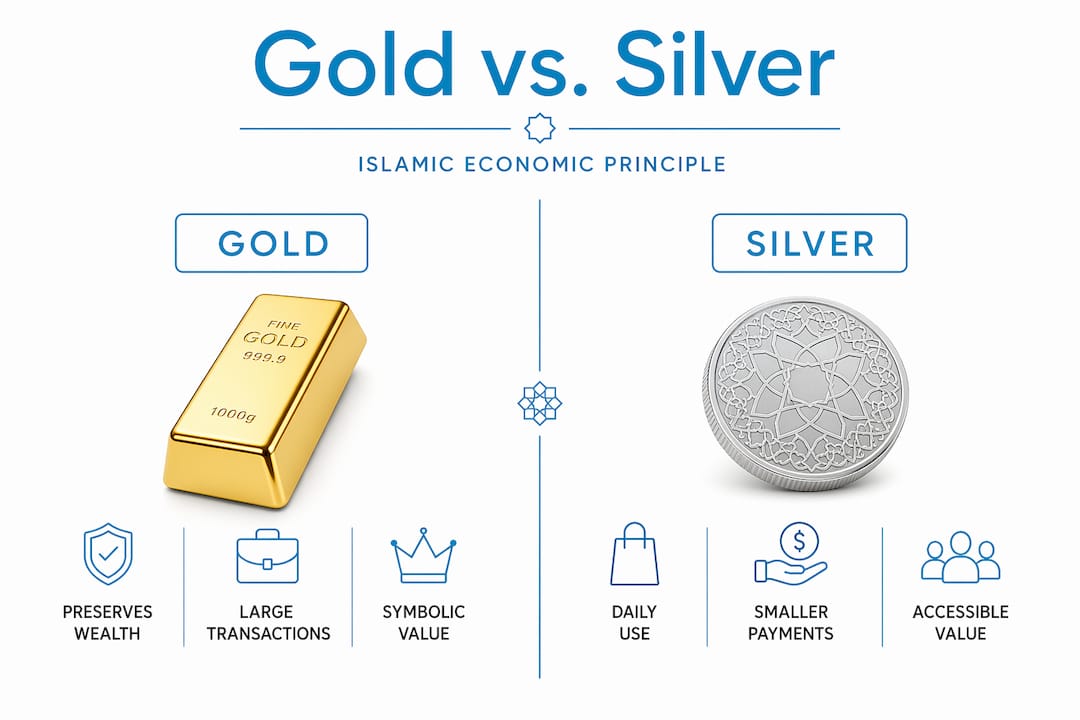
The economic principle is equally significant. Gold was reserved for large transactions and wealth preservation, while silver functioned as everyday currency, reflecting an advanced and intentional dual monetary system. The Prophet’s guidance was not against wealth itself. It was against wealth that separates the owner from God and community. To understand more about how silver fits alongside gold, the Cairojewellery guide on silver in Islam is worth reading.
Pro Tip: When reading Quranic verses about gold, pay attention to what comes directly before and after them. The surrounding context almost always shifts the meaning from condemnation to cautionary wisdom, which is a significant interpretive difference.
Gold in Islamic marriage and social life
Beyond scripture, the cultural meaning of gold in Islam is perhaps most visible in the rituals surrounding marriage. In Islamic tradition, the mahr (often translated as dowry or bridal gift) is a mandatory gift from the groom to the bride. Gold is by far the most common form this gift takes across Muslim-majority cultures. It is not merely symbolic. High-purity 22K gold is preferred precisely because it functions as tangible financial security for the woman, an asset she fully owns and can call upon at any time.
The social dimensions of gold in Islamic communities follow a recognizable pattern, though they vary by region. Here is how gold typically functions across different life contexts:
- Weddings. Gold jewelry gifted as mahr or presented by family members carries layered meanings: love, security, status, and blessing all at once.
- Birth celebrations. In many Muslim cultures, gold is given to a newborn or new mother as a gift of protection and prosperity.
- Eid and religious holidays. Gold purchases spike during Eid seasons. Gifting gold to children or spouses is common, often linked to celebration traditions in Islamic communities.
- Inheritance and wealth transfer. Gold jewelry is often passed down through generations, carrying both monetary value and family memory.
A comparison of gold and silver across these contexts shows clear distinctions:
| Context | Gold | Silver |
|---|---|---|
| Marriage gift (mahr) | Strongly preferred | Less common |
| Daily adornment | Women only, under Islamic law | Permitted for both men and women |
| Large-scale savings | Primary store of value | Secondary role |
| Everyday currency | Less practical | Historically used for daily trade |
| Spiritual symbolism | Worldly beauty, divine test | Prophetic preference, purity |
What stands out in this picture is that gold in Islamic social life is not simply a status symbol. Gold jewelry serves as a financial asset that gives women real economic independence within their families. That practical dimension reflects Islamic values around justice, security, and dignity.

Gold symbolism in Islamic dream traditions
Islamic dream interpretation (ta’bir al-ru’ya) has a long and respected history, and gold features prominently in its literature. The symbolism here is more nuanced than most people expect. Gold in dreams carries dual meaning, simultaneously representing potential blessing and potential spiritual warning. The same object, seen in two different contexts, can signal opposite realities.
Several key scenarios shape how gold in dreams is read:
- Wearing a gold ring as a man. This is generally read as a troubling sign, reflecting the waking-world prohibition and suggesting an inclination toward something forbidden or a coming trial.
- Wearing gold jewelry as a woman. Often interpreted positively as a sign of joy, honor, and blessing from Allah.
- Receiving gold as a gift. Frequently seen as a sign of incoming good news or spiritual reward, though the identity of the giver matters.
- Finding gold. This can mean unexpected prosperity, but Islamic dream scholars often read it as a prompt for gratitude and ethical care with the blessing.
- Losing or melting gold. Melting gold in a dream is often interpreted as a sign of public embarrassment or loss of reputation, a warning to examine one’s character and conduct.
Islamic scholars who interpret dreams always emphasize context. The dreamer’s spiritual and moral state at the time of the dream, the emotions felt during it, and the surrounding symbols all influence the meaning. A dream of gold should never be read in isolation.
Pro Tip: If you receive a dream involving gold and feel uncertain about its meaning, Islamic tradition recommends consulting a knowledgeable scholar rather than relying on generalized dream dictionaries. The personal context of your life always shapes the interpretation.
The broader spiritual lesson embedded in gold dream symbolism aligns with Islam’s waking-world teachings. Gold is not inherently good or bad. It reflects back the condition of your heart and your relationship with the material world.
Gold as a modern Shariah-compliant investment
The importance of gold in Islamic tradition has not faded with modernity. If anything, the growing global Islamic finance sector has renewed gold’s relevance in compelling ways. The global Islamic finance market was valued at $5.5 trillion in 2025 and is projected to reach $7.5 trillion by 2028, with gold playing a recognized role within it.
Why does gold fit so naturally into Shariah-compliant investing? Several reasons:
- Gold is a tangible, physical asset, meaning it avoids the prohibition of riba (interest) that disqualifies many conventional investment vehicles.
- It cannot be replicated or manufactured infinitely, giving it an inherent fairness that aligns with Islamic principles of equitable exchange.
- Scholars recognize it as a commodity money with intrinsic value, consistent with prophetic teachings that favored real assets over speculative promises.
The ethical dimension goes further. The Hadith describing the Euphrates one day revealing a mountain of gold is increasingly read by contemporary scholars as a metaphor for resource conflicts and environmental harm. The Hadith warns that 99 out of 100 people will die fighting over this gold, a sobering image of what happens when wealth is pursued without wisdom or restraint.
This prophetic warning feels remarkably current. From mining’s environmental costs to geopolitical conflicts over natural resources, the Hadith’s message about material obsession and its consequences speaks across centuries. Muslim investors and consumers increasingly factor this into how they think about gold: not just as an asset to acquire, but as a responsibility to steward with care and intention.
My take on gold’s true meaning in Islam
What I find most striking about the Islamic view on gold is how consistently it refuses easy answers. Most religious or cultural frameworks do one of two things: they either glorify gold as divine, or they condemn it as corrupt. Islam does neither. It holds the tension open.
In my understanding, that tension is the point. Gold in Islamic culture is treated as a mirror. It shows you something true about your priorities. If a man feels compelled to wear gold despite the prohibition, that impulse is worth examining. If a family uses gold as mahr to genuinely protect a bride’s financial dignity, that is the tradition working as it should. If a believer hoards gold while ignoring zakat, the gold has become a spiritual problem. If another person invests in gold to build halal wealth for their family, they are following prophetic wisdom.
I have also come to appreciate the connection between the Euphrates Hadith and modern environmental concerns. When I read contemporary analyses of that hadith in light of oil fields and mineral extraction conflicts, I see a tradition that was never purely about coin and currency. It was about how human beings relate to the earth’s gifts.
Gold, in the end, is not the issue. The heart behind gold is. That is the interpretation of gold in Islam that I return to again and again, because it is the one that asks something real of the believer.
— Elias
Meaningful gold-inspired pieces from Cairojewellery
If exploring the spiritual and cultural significance of gold has you thinking about how that meaning can be carried close to you, Cairojewellery offers a thoughtful range of pieces designed with exactly that intention in mind.

The brand’s gold-plated Islamic jewelry pieces, including the Ayatul Kursi Bracelet and necklaces engraved with Quranic verses, are crafted to carry meaning that goes beyond aesthetics. Whether you are looking for a gift for someone you make dua for, or a personal reminder of faith, each piece is designed with Islamic symbolism at its center. Before purchasing, the Cairojewellery guide on halal jewellery materials gives you the knowledge to choose with confidence and care.
FAQ
What does gold symbolize in Islam?
Gold symbolizes worldly beauty, prosperity, and divine blessing, but also carries a spiritual caution against material attachment. The Quran frames it as a test of faith rather than a straightforward reward.
Can Muslim men wear gold jewelry?
No. Prophetic teachings explicitly prohibit men from wearing gold as adornment, viewing it as incompatible with Islamic values of modesty and humility. Women are permitted to wear gold under Islamic jurisprudence.
What does seeing gold in a dream mean in Islam?
Gold in Islamic dream interpretation carries dual meaning. It can represent blessing, joy, and prosperity, or it can signal a spiritual warning, depending on the context of the dream and the dreamer’s life circumstances.
Why is gold important in Islamic weddings?
Gold is commonly given as mahr, the obligatory bridal gift in Islamic marriage. High-purity 22K gold is preferred because it serves as tangible financial security that belongs entirely to the bride.
Is gold a Shariah-compliant investment?
Yes. Gold is widely recognized as a Shariah-compliant asset because it is tangible, avoids interest-based structures (riba), and aligns with prophetic guidance favoring physical metals over speculative or debt-based financial instruments.