An amulet in Islamic tradition is defined as a physical object, typically inscribed with Quranic verses, divine names, or religious symbols, worn or hung on the body for protection, healing, or spiritual benefit. The Arabic terms most commonly used are taweez (also spelled ta’wiz) and tamimah, and understanding the difference between these objects and other Islamic practices like ruqyah is central to grasping what amulets mean in the Islamic context. This question sits at the intersection of theology, culture, and personal faith, and the answer is more layered than a simple yes or no.
What does amulet mean in Islamic context?
Amulets in Islamic discourse are objects hung or worn for protection or healing, often inscribed with words, Quranic verses, or divine names. They contrast directly with ruqyah, which is a recitation or supplication made without reliance on any physical object. This distinction is not minor. It shapes the entire theological debate around whether carrying or wearing such objects is spiritually sound.
The word tamimah historically referred to beads or shells worn by pre-Islamic Arabs as charms. After the arrival of Islam, the term expanded to include any object worn with the belief that it could independently ward off harm. Taweez, by contrast, became associated specifically with written inscriptions, often folded into cloth or leather pouches and worn around the neck or arm. Both terms appear in Islamic legal discussions, though scholars treat them with varying degrees of concern depending on what they contain and why they are used.
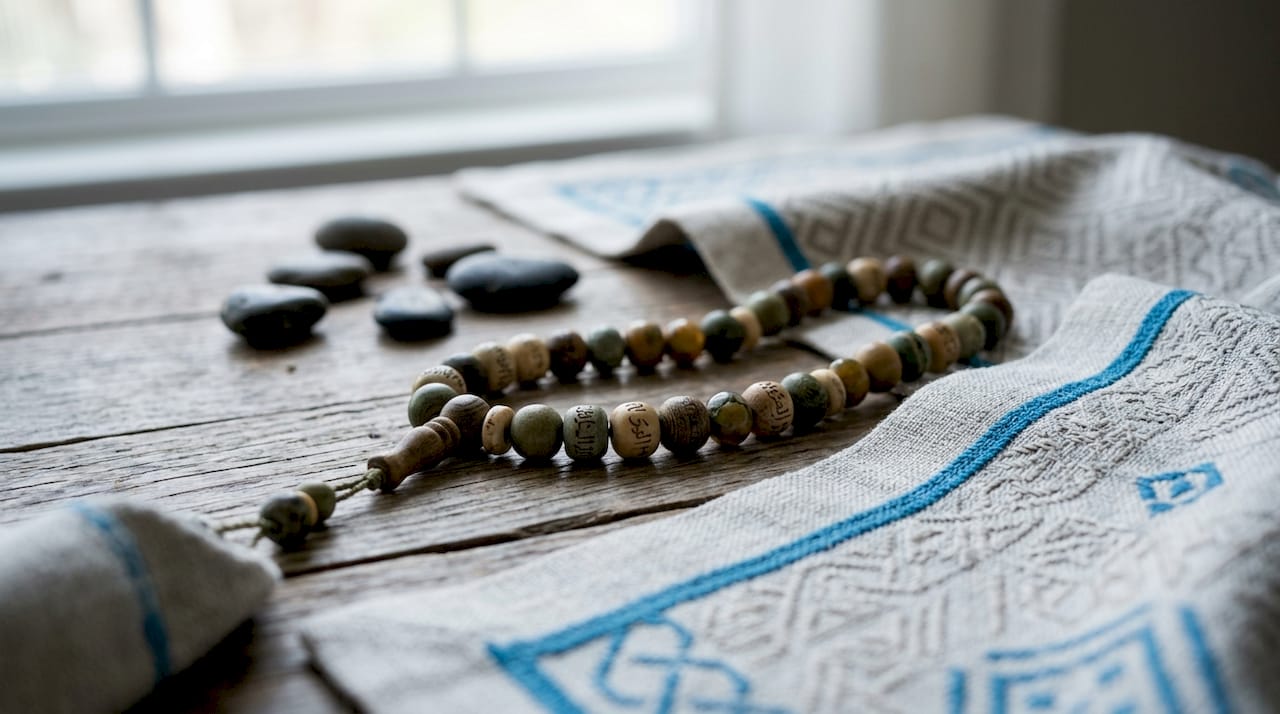
The cultural significance of amulets in Islam cannot be separated from their theological status. Across South Asia, the Middle East, North Africa, and West Africa, taweez are deeply embedded in local Muslim practice. Families pass them down across generations. Scholars write them for the sick, the grieving, and the fearful. Yet the same tradition that produced this culture also produced serious scholarly warnings against it.
What are the traditional types and uses of amulets in Islam?
Islamic amulet traditions take several recognizable forms across Muslim communities worldwide:
- Written taweez: A piece of paper or cloth inscribed with Quranic verses, divine names, or prayers, folded and placed inside a small pouch worn around the neck or arm.
- Engraved pendants: Metal or stone pieces bearing Quranic text, such as Ayatul Kursi (Quran 2:255), worn as necklaces or bracelets.
- Hanging charms: Objects placed in homes, vehicles, or above doorways for household protection.
- Herbal or symbolic bundles: Less common in mainstream Sunni practice but present in some regional traditions, combining written text with natural materials.
The stated purposes behind these objects are consistent: protection from the evil eye (ayn), healing from illness, warding off harm, and attracting blessings. These are sincere motivations rooted in real fear and real love for one’s family.
Ruqyah, by contrast, involves reciting specific Quranic verses or supplications directly over a person or into water they will drink. Lawful ruqyah requires Arabic or intelligible words and the firm belief that Allah alone creates the healing effect. The recitation is the act of worship. No object carries the benefit independently.
Pro Tip: When you encounter an amulet in a Muslim cultural context, the most important question to ask is not “what does it look like?” but “what does the person using it believe it does?” Intent and belief are the theological core of this entire discussion.
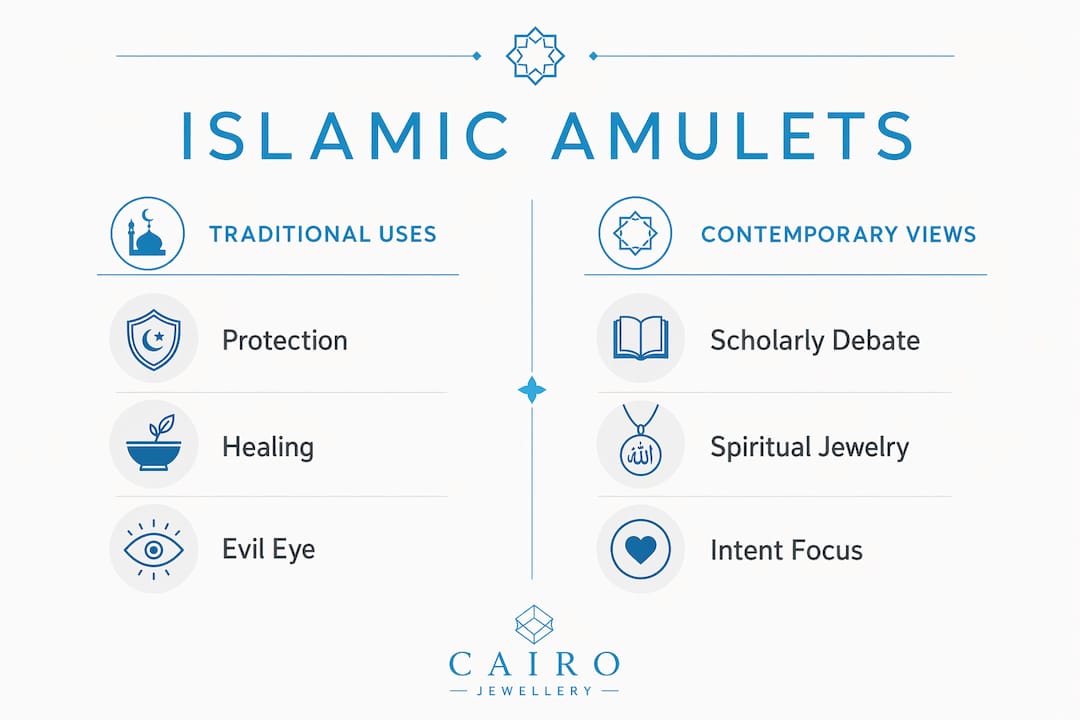
What are the Islamic scholarly opinions on the permissibility of amulets?
Scholarly opinion on amulets in Islam is not uniform. It divides broadly into three positions:
-
Complete prohibition: A significant group of scholars, including companions of the Prophet such as Ibn Mas’ud, opposed all amulets without exception, whether they contained Quranic text or not. Their reasoning is that the Prophet Muhammad (peace be upon him) did not practice or authorize wearing inscriptions as physical objects, and no documented precedent exists among the companions for doing so.
-
Conditional permissibility for Quranic amulets: A second group of scholars permits taweez that contain only Quranic verses and the names of Allah, provided the wearer believes the benefit comes solely from Allah and not from the object itself. Some scholars align these Quranic taweez with the spirit of ruqyah, treating them as a written form of supplication.
-
Categorical prohibition of non-Quranic content: All mainstream scholars agree that amulets containing unknown symbols, non-Islamic formulas, or polytheistic invocations are forbidden without qualification. These fall clearly into the category of shirk (associating partners with Allah).
The historical disagreement between scholars like Ibn Mas’ud (who prohibited all taweez) and others who permitted Quranic ones reflects a tension that has never been fully resolved in Islamic jurisprudence. No precedent from the Prophet or his companions for wearing Quranic inscriptions as physical amulets is documented, which is the strongest argument used by those who prohibit the practice entirely.
The majority position among contemporary scholars, particularly those in the Salafi and Hanbali traditions, leans toward prohibition of all taweez. Scholars from the Hanafi tradition, dominant across South Asia and Turkey, are more likely to permit Quranic taweez under strict conditions. This is why you will find sincere, knowledgeable Muslims on both sides of this question.
How do amulets relate to shirk and reliance on Allah?
Shirk is defined in Islam as attributing divine power, authority, or independence to anything other than Allah. It is the one sin the Quran explicitly states will not be forgiven if a person dies without repenting from it. This is why the amulet question carries such theological weight.
The hadith states that whoever wears an amulet has committed shirk. This is a direct prophetic statement, and scholars who prohibit taweez cite it as decisive. The concern is not merely about what is written on the object. The concern is about what the wearer believes the object does.
Here is where the distinction between taweez and ruqyah becomes theologically critical. The portability of a taweez creates a risk that the object itself is treated as having independent power. A person who recites Ayatul Kursi as a supplication is directing their heart toward Allah. A person who wears a pouch containing Ayatul Kursi may, over time, begin to trust the pouch rather than the verse’s Author. That psychological drift is the core danger scholars identify.
The scholarly framework for evaluating any specific amulet practice uses three criteria: content (what is inscribed), intent (what the wearer believes), and means (how the object was obtained and used). All three must align with Islamic monotheism for the practice to be considered permissible by those scholars who allow it at all.
- Content: Only Quranic verses and names of Allah are potentially permissible. Unknown symbols or non-Islamic text are forbidden.
- Intent: The wearer must believe that Allah alone is the source of any benefit. The object is a reminder, not a source of power.
- Means: The object must not be obtained through practitioners who use forbidden knowledge or claim independent spiritual authority.
Pro Tip: If you are uncertain whether a specific practice crosses into shirk, prioritize direct supplication. Du’a costs nothing, requires no object, and carries no theological risk. It is the purest form of asking Allah for protection.
What are practical Islamic recommendations for protection?
Orthodox Islamic guidance consistently prioritizes three practices for spiritual protection:
- Du’a (supplication): Direct prayer to Allah for protection, health, and safety. Specific du’as from the Sunnah, such as Bismillah before entering the home or Ayatul Kursi before sleep, are documented and encouraged.
- Ruqyah: Recitation of Quranic verses over oneself, one’s children, or water. Contemporary educators emphasize du’a, ruqyah, and adhkar over physical objects for protection, warning that physical charms often introduce confusion and innovation away from authentic practice.
- Adhkar (remembrance): Daily remembrance of Allah through morning and evening supplications, which the Sunnah presents as a comprehensive shield against harm.
The guidance for families is especially clear. Families seeking protection from the evil eye are advised to emphasize du’a, ruqyah, and adhkar over physical relics or charms to maintain sound Islamic practice. Teaching children to recite protective verses is considered far more beneficial than hanging charms above their beds.
Distinguishing honored cultural practice from forbidden innovation requires honest self-examination. A grandmother who ties a blue bead on her grandchild’s wrist out of love and cultural habit is not the same as a person who believes the bead has divine power. But the practice still carries risk if it gradually replaces direct reliance on Allah. The respectful approach is to honor the love behind the tradition while redirecting the practice toward what is theologically sound.
How do amulets feature in Islamic cultural symbolism and jewelry today?
The line between amulet and spiritual jewelry is one of the most discussed questions in contemporary Muslim fashion. Many Muslims wear pieces engraved with Quranic verses not as taweez but as reminders of their faith. The intent is devotional, not magical. Understanding spiritual jewelry meanings in this context requires separating the symbolism of the object from the theological question of amulets.
| Practice | Description | Scholarly status |
|---|---|---|
| Wearing Quranic verse jewelry as a reminder | Engraved pieces worn for reflection and identity | Generally permissible |
| Taweez with Quranic text | Written inscriptions worn for protection | Disputed among scholars |
| Taweez with unknown symbols | Non-Islamic formulas or symbols | Prohibited by consensus |
| Ruqyah recitation | Quranic verses recited over a person | Permissible and encouraged |
| Hanging charms for protection | Objects placed in homes or vehicles | Discouraged or prohibited |
Modern Muslim artisans and brands approach this distinction carefully. Pieces engraved with Ayatul Kursi, for example, are designed to carry meaning as a spiritual reminder rather than as a protective charm with independent power. The wearer recites the verse. The jewelry holds the memory of that recitation close. This is a meaningful distinction, and it reflects how contemporary Muslim communities navigate the space between cultural symbolism and religious permissibility. You can explore how necklaces carry meaning in Islamic tradition to understand this more fully.
Key takeaways
Amulets in Islam are defined by content, intent, and means, and the permissibility of any specific practice depends on all three factors evaluated together.
| Point | Details |
|---|---|
| Definition of taweez | Amulets are physical objects inscribed with text, worn for protection or healing in Muslim communities. |
| Ruqyah vs. taweez | Ruqyah is a recited supplication; taweez is a portable object, and this difference shapes the entire theological debate. |
| Scholarly disagreement | Scholars divide between prohibiting all amulets and permitting those containing only Quranic text under strict conditions. |
| Shirk risk | Attributing independent power to any object, including a Quranic taweez, constitutes shirk and is forbidden. |
| Practical guidance | Du’a, ruqyah, and adhkar are the orthodox alternatives that carry no theological risk and are fully documented in the Sunnah. |
Why intent matters more than the object itself
I have spent a long time thinking about this question, and the conclusion I keep returning to is this: the amulet debate in Islam is really a debate about the human heart. Scholars are not primarily concerned with cloth pouches or engraved pendants. They are concerned with where a person’s trust actually lives.
The most common mistake I see is treating this as a binary question, either amulets are fine or they are forbidden, when the reality is that Islamic scholarship has always been more interested in the condition of the believer than in the object itself. A person who wears an Ayatul Kursi necklace and recites the verse daily, understanding that Allah alone protects, is in a very different spiritual position from someone who grips a taweez in a moment of fear without any supplication at all.
What concerns me more than the object is the gradual replacement of direct reliance on Allah with reliance on a thing you can touch. That drift is subtle. It does not happen all at once. It happens when the pouch becomes a comfort and the du’a becomes an afterthought. The scholars who prohibited all taweez, including Quranic ones, understood this human tendency better than most.
My honest recommendation is to let the Quran live in your voice and your heart before you let it live on your wrist. Recite Ayatul Kursi before you sleep. Make du’a for your children by name. Then, if you choose to wear a piece of jewelry engraved with a verse you love, wear it as a reminder of what you already believe, not as a substitute for believing it.
— Elias
Carry your faith with meaning, not just metal
At Cairojewellery, every piece is designed around a simple idea: your faith deserves to be close to you, not stored away. The Ayatul Kursi Bracelet, Ayatul Kursi Necklace, and Ayatul Kursi Ring are not taweez. They are reminders, crafted in stainless steel and gold-plated with care, meant to keep the most powerful verse in the Quran present in your daily life. Pair any piece with the supplication pairing guide to understand how to honor the verse you wear. Every order also contributes to real-world good through the Cairojewellery Donations and Support System, because faith expressed outwardly should also move you to act.
FAQ
What is the difference between taweez and ruqyah?
Taweez is a physical object inscribed with text and worn or hung for protection, while ruqyah is a recited supplication directed to Allah without reliance on any object. Ruqyah is permissible by scholarly consensus; taweez is disputed.
Are amulets allowed in Islam?
Scholarly opinion is divided. Amulets containing non-Quranic or unknown content are forbidden by consensus. Amulets containing only Quranic verses are permitted by some scholars and prohibited by others, with the majority of contemporary scholars leaning toward caution or prohibition.
Does wearing an amulet count as shirk?
Wearing an amulet with the belief that the object itself has independent power to protect or harm is considered shirk. If the wearer believes Allah alone is the source of benefit and the object is only a reminder, some scholars permit it under strict conditions.
What should Muslims use instead of amulets for protection?
Orthodox Islamic guidance recommends du’a, ruqyah, and adhkar as the primary means of seeking protection. These practices are fully documented in the Sunnah and carry no theological risk.
Can Quranic verse jewelry be worn without it being a taweez?
Yes. Jewelry engraved with Quranic verses worn as a spiritual reminder of faith, rather than as a charm believed to have protective power, is generally considered permissible. The distinction lies in the wearer’s belief and intent.