The silver ruling in Islam defines the nisab threshold based on silver weight, determining when zakat becomes obligatory for Muslims who hold qualifying wealth for a full lunar year. In Islamic jurisprudence, this standard is known as the nisab al-fidda and sits at the center of zakat eligibility for hundreds of millions of Muslims worldwide. Understanding what the silver ruling means in Islam is not a matter of academic interest alone. It directly shapes how much you owe, who qualifies, and how wealth purification functions in your daily financial life. The silver nisab is the lower of the two classical thresholds, making it the more inclusive standard for zakat obligation.
What does silver ruling mean in Islam and how is it defined?
The silver ruling in Islam refers to the use of approximately 595g to 612.36g of pure silver as the minimum wealth threshold that triggers zakat obligation. This weight derives from the classical standard of 200 dirhams, the silver coin used in early Islamic trade and governance. The two gram figures reflect different scholarly translations of the dirham weight, and both remain in active use across institutions and madhhabs today.
Once your total zakatable wealth equals or exceeds the monetary value of this silver weight and has been held continuously for one full lunar year, known as the hawl, zakat becomes obligatory. The obligation is not triggered by owning silver itself. It is triggered by owning wealth whose total value meets or exceeds the silver nisab. This distinction matters enormously in practice, because most Muslims today hold their wealth in cash, investments, and receivables rather than precious metals.

How to convert silver nisab to a current monetary value
The silver nisab changes in monetary terms every day because it tracks the live market price of silver. To find today’s threshold, you multiply the nisab weight (595g or 612.36g, depending on which scholarly standard your institution follows) by the current price of silver per gram in your local currency. If silver trades at $0.90 per gram, a 595g nisab equals approximately $535. That figure is your eligibility floor for zakat on combined wealth.
Pro Tip: Check the silver spot price on a recognized commodities platform such as Kitco or the London Bullion Market Association before your annual zakat calculation. Using an outdated price can shift your eligibility by a meaningful margin.
| Silver nisab weight | Basis | Approximate value at $0.90/g |
|---|---|---|
| 595g | Widely used scholarly standard | ~$535 |
| 612.36g | Alternative classical measurement | ~$551 |
| Gold nisab (85g) | Comparative reference | ~$7,650 at $90/g gold |
Practitioners stress the importance of transparent calculation methods that clearly state which silver nisab weight standard is used, to avoid confusion among payers. Choosing between 595g and 612.36g is a legitimate scholarly difference, not an error. What matters is consistency and clarity in your annual practice.
How does silver nisab compare to gold nisab?
The gold nisab is set at 85 grams of pure gold, which at current market prices is roughly 12 to 15 times higher in monetary value than the silver nisab. This gap has widened dramatically over the past century as gold prices have risen far faster than silver prices. In the early centuries of Islam, the two nisabs were much closer in value, which is why both were considered valid standards.
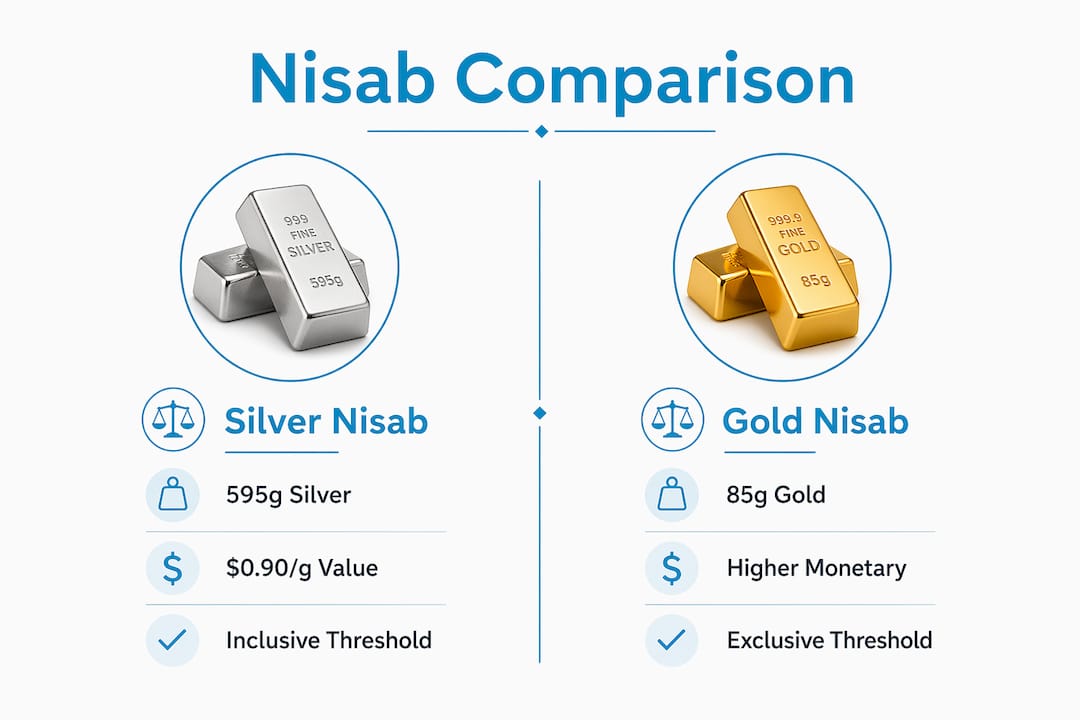
The practical consequence of this divergence is significant. A Muslim with $3,000 in savings would be obligated to pay zakat under the silver nisab but would fall well below the gold nisab threshold. The choice of standard is therefore not merely academic. It determines whether millions of borderline-wealth Muslims are included in or excluded from the zakat obligation.
How different madhhabs approach the silver and gold nisab
The four major Sunni madhhabs apply these thresholds with notable differences:
- Hanafi madhhab: Uses the silver nisab for zakat on cash and combined wealth, making it the predominant standard in South Asia, Turkey, and Central Asia. This produces a lower eligibility threshold and broader zakat participation.
- Maliki and Shafi’i madhhabs: Generally apply the gold nisab for monetary wealth, resulting in a higher threshold before zakat becomes obligatory.
- Hanbali madhhab: Permits either standard, with scholars often advising the silver nisab for caution.
- Contemporary fatwa bodies: Many modern institutions, including Islamic Relief and the American Muslim Community Foundation, recommend the silver nisab as the more cautious and socially beneficial choice.
The silver nisab’s more inclusive threshold reflects the social justice element of zakat, encouraging broader participation in wealth distribution to those in need. Choosing the silver standard is not a compromise of rigor. It is a deliberate act of caution and generosity that aligns with the spirit of zakat as a pillar of communal welfare.
How to calculate zakat using the silver ruling
Calculating zakat under the silver ruling follows a clear sequence. Accounting for all zakatable assets including receivables, investments, and immediate debts is complex but essential for accuracy. Follow these steps:
- Compile all zakatable assets. Include cash in hand and bank accounts, gold and silver holdings, business inventory held for trade, investments and stocks, money owed to you that you expect to receive, and savings in any currency.
- Subtract immediately due debts. Deduct only debts that are due within the current lunar year. Long-term liabilities such as mortgages are generally not fully deductible under most scholarly opinions.
- Check against the silver nisab. If your net zakatable wealth equals or exceeds the current monetary value of 595g (or 612.36g) of silver, you meet the nisab condition.
- Confirm the hawl. Your wealth must have remained at or above the nisab for a full lunar year. The zakat obligation requires continuous holding above nisab throughout the year, not just at one point in time.
- Apply the 2.5% rate. Once nisab and hawl conditions are met, zakat is fixed at 2.5% of your total net zakatable wealth.
Pro Tip: Set a recurring reminder on the same Islamic calendar date each year to reassess your nisab eligibility. Consistency in your hawl start date prevents calculation errors and missed obligations.
A common and serious mistake is checking nisab only once at the year’s end. If your wealth dipped below the silver nisab at any point during the year and then recovered, the hawl resets from the point it returned above the threshold. This is not a technicality to overlook. It is a foundational condition of the obligation.
What are the scholarly views on the silver ruling in Islam?
The silver ruling carries significant jurisprudential weight beyond its numerical function. Modern circulated currencies are treated as legally equivalent to gold and silver for zakat and riba purposes, as affirmed by Shaikh Ibn Baz and other major contemporary scholars. This ruling means that cash savings, digital balances, and investment accounts all fall under the same nisab framework as physical silver and gold.
A persistent misconception is that the “silver ruling” refers to a general superiority of silver as a material or a special status for silver jewelry. The silver ruling is specifically a nisab concept. Silver itself is zakatable whether owned as jewelry, coins, or bullion, but the silver ruling governs the threshold for all combined wealth, not a separate category for silver owners. The two concepts are related but distinct.
Scholarly opinions on the silver ruling also address the question of silver jewelry worn for adornment. Some schools, particularly the Hanafi madhhab, hold that silver jewelry worn in normal amounts by women is exempt from zakat. Other schools require zakat on all silver regardless of use. The zakatability of silver jewelry depends on the fiqh position followed and any applicable local fatwas. This is an area where consulting a qualified scholar familiar with your madhhab is strongly advised.
The broader scholarly consensus favors using the silver nisab for caution to support the needy more widely. This recommendation reflects the principle of ihtiyat, or precaution, in Islamic legal reasoning. When two valid scholarly positions exist and one results in greater benefit for the poor, choosing the more inclusive option is considered the more virtuous path.
Key takeaways
The silver ruling in Islam defines the nisab threshold at approximately 595g to 612.36g of silver, and once net zakatable wealth meets this value and is held for a full lunar year, zakat at 2.5% becomes obligatory.
| Point | Details |
|---|---|
| Silver nisab definition | Approximately 595g to 612.36g of pure silver sets the minimum wealth threshold for zakat. |
| Silver vs. gold nisab | Silver nisab is 12 to 15 times lower in value than gold nisab, making zakat more inclusive. |
| Hawl requirement | Wealth must remain above the silver nisab continuously for one full lunar year before zakat is due. |
| Madhhab variation | Hanafi scholars use silver nisab for cash wealth; Maliki and Shafi’i schools often apply gold nisab. |
| 2.5% zakat rate | After meeting nisab and hawl, apply 2.5% to total net zakatable assets minus immediately due debts. |
Why the silver ruling deserves more attention than it gets
I have spent years reading through zakat guides, attending Islamic finance seminars, and speaking with Muslims at various levels of scholarship. The silver ruling is consistently either oversimplified or ignored entirely in popular zakat education. Most people learn “pay 2.5%” and stop there. The nisab question, and specifically the choice between silver and gold, is treated as a footnote when it should be the starting point.
The gap between the two nisabs is not a minor technical detail. At current prices, it is the difference between a threshold of roughly $535 and one of roughly $7,650. That gap determines whether a working-class Muslim with modest savings is included in the zakat system at all. The silver ruling, when applied with awareness, brings far more people into the circle of givers and strengthens the redistributive power of zakat as a pillar of Islam.
My honest observation is that many Muslims who follow the gold nisab do so not out of scholarly conviction but out of convenience. It is a higher bar, and clearing it means no obligation. That reasoning inverts the spirit of the ruling. The silver nisab exists precisely because the Prophet, peace be upon him, set a threshold that was accessible and meaningful for the community of his time. Honoring that spirit today means choosing the standard that keeps zakat alive as a genuine act of purification and solidarity.
If you are uncertain which standard to follow, speak to a scholar from your madhhab. But if you are choosing between two equally valid positions, the silver ruling is the one that serves your community more fully.
— Elias
Halal silver jewelry and Islamic guidance from Cairojewellery

Cairojewellery is built on the belief that what you wear can carry meaning far beyond its material. For Muslims who want to understand the spiritual significance of silver in Islam, from its symbolic role in Islamic tradition to its place in wealth and worship, the Cairojewellery blog offers grounded, respectful guidance. If you are exploring halal jewelry materials for yourself or as a gift for someone you would make dua for, Cairojewellery’s collection of Qur’anic pieces, including the Ayatul Kursi Bracelet and Olive Branch Ring, reflects both faith and intention. Every piece is designed in Sweden and ships worldwide, so the reminder of your deen is always close.
FAQ
What does silver ruling mean in Islam?
The silver ruling in Islam refers to the nisab threshold based on approximately 595g to 612.36g of pure silver, which determines when zakat becomes obligatory on a Muslim’s total zakatable wealth held for one full lunar year.
Is the silver nisab or gold nisab better to use for zakat?
Most contemporary scholars recommend the silver nisab for caution, as its lower monetary value includes more Muslims in the zakat obligation and strengthens wealth distribution to those in need.
Does the silver ruling apply to silver jewelry?
The silver ruling primarily governs the nisab threshold for all combined wealth. Silver jewelry’s zakatability depends on your madhhab, with some schools exempting jewelry worn for adornment and others requiring zakat on all silver holdings.
How often does the silver nisab value change?
The silver nisab changes daily because it is calculated by multiplying the nisab weight (595g or 612.36g) by the current live market price of silver per gram in your local currency.
What is the zakat rate once the silver nisab is met?
Once your net zakatable wealth meets the silver nisab and has been held for a full lunar year, the zakat rate is fixed at 2.5% of your total net zakatable assets after subtracting immediately due debts.