Gold is defined in Islamic law as a ribawi commodity, meaning its exchange carries specific Shariah obligations that govern everything from the jewelry you wear to the investments you hold. The role of gold in Islamic rulings spans adornment, trade, zakat, and modern finance, and each domain carries clear, scholarly-established principles. Understanding these rulings is not just an academic exercise. It shapes daily decisions for millions of Muslims worldwide, from the ring on your finger to the ETF in your portfolio. This guide covers every major ruling with the clarity and depth you deserve.
What are the Islamic rulings on wearing gold?
The prohibition on gold adornment for men is one of the most widely established rulings in Islamic jurisprudence. Men are forbidden from wearing gold jewelry, including rings, chains, and bracelets, based on multiple authentic hadiths and the consensus of the four major Sunni schools: Hanafi, Maliki, Shafi’i, and Hanbali. This ruling applies regardless of the occasion or cultural context.
Women, by contrast, are permitted to wear gold freely. The Quran and Sunnah both affirm that gold adornment is lawful for women, and scholars across all four schools agree on this point without reservation. This distinction is not arbitrary. It reflects a broader Shariah principle that certain adornments are specific to one gender as a matter of fitrah, or natural disposition.

A nuanced point that many Muslims overlook: gold-plated jewelry is also generally forbidden for men, since the outer layer still constitutes gold adornment. The exception applies only when the plating is so negligible in thickness that it cannot be considered meaningful gold coverage. This matters practically, because much of the fashion jewelry market today is gold-plated rather than solid gold.
Medical necessity creates a recognized exception. If a man requires a gold dental crown, filling, or implant because no suitable alternative material exists, scholars permit this use. The principle of necessity (darurah) overrides the general prohibition when genuine medical need is established.
Key rulings on gold adornment at a glance:
- Men: gold jewelry of all types is prohibited, including rings, chains, and bracelets
- Men: gold-plated items are also prohibited unless plating is negligible
- Men: medical use of gold (dental crowns, implants) is permitted under necessity
- Women: gold jewelry is fully permissible with no restrictions on type or quantity
- All Muslims: gold used in household items or decoration does not carry the same ruling as personal adornment
Pro Tip: If you are a man seeking to wear meaningful Islamic jewelry, stainless steel and silver are fully permissible alternatives. Cairojewellery’s pieces, including the Ayatul Kursi Bracelet and Olive Branch Ring, are crafted from stainless steel, making them a Shariah-conscious choice for men and women alike.
How does Shariah regulate gold trading and investment?
Gold trading in Islam is governed by a foundational principle: immediate spot exchange is mandatory. Both payment and delivery must occur simultaneously, with no delay permitted on either side. This is not a procedural technicality. It is a direct consequence of gold’s status as a monetary asset under Islamic law.
The effective cause, known in Arabic as the 'illah, behind this ruling is gold’s monetary function. Because gold has historically served as currency, deferred gold exchanges are treated as a form of riba al-nasi’ah, which is the prohibited increase arising from delay. This distinguishes gold from ordinary commodities like wheat or cotton, where deferred payment is generally permitted. The same strict rule applies to silver, which shares gold’s monetary character under Shariah.
Permissible and impermissible gold investment structures
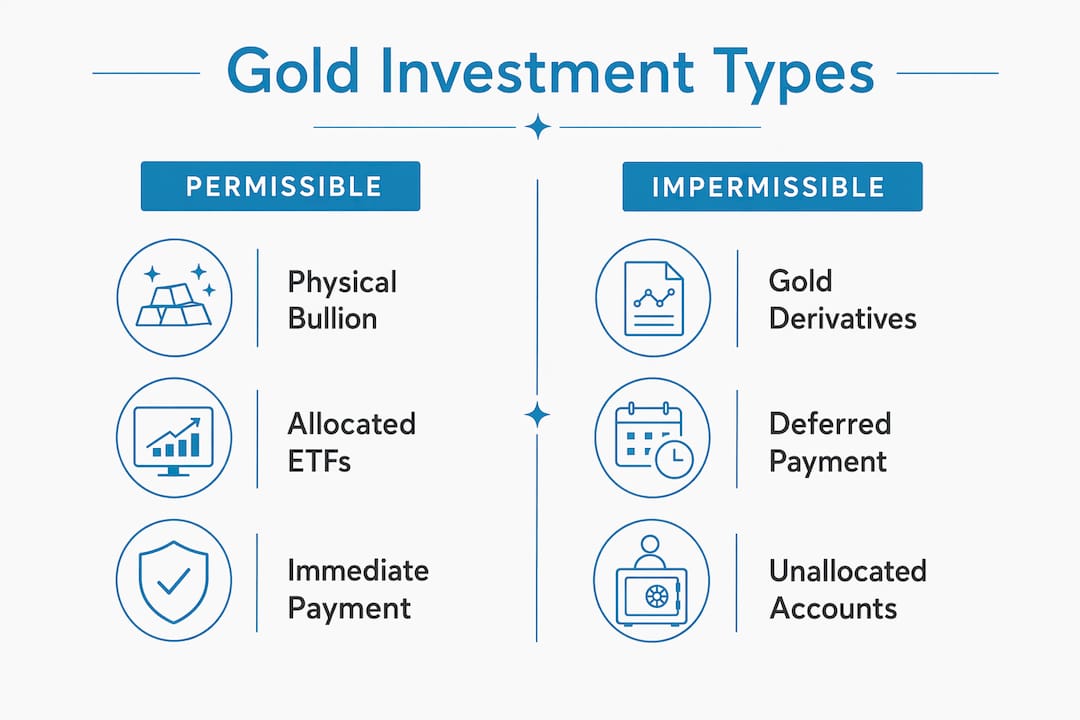
Understanding what is and is not allowed in modern gold investing requires looking at the structure of each product, not just its name.
Permissible:
- Physical gold bullion purchased with immediate payment and delivery
- Gold coins bought on a spot basis with clear ownership transfer
- Allocated gold ETFs where each unit corresponds to a specific, physically held quantity of gold with immediate settlement
Generally impermissible:
- Gold futures contracts, because delivery and payment are deferred
- Gold options, because they introduce gharar (uncertainty) and deferred obligation
- Unallocated gold accounts, where you hold a claim on gold rather than actual gold
- Installment-based gold purchases, because payment is deferred
Physical bullion and allocated ETFs with immediate payment are halal, while gold derivatives are generally prohibited. This distinction matters enormously for Muslim investors navigating platforms like the London Bullion Market Association or products offered by major asset managers.
| Investment Type | Shariah Status | Key Condition |
|---|---|---|
| Physical gold bullion | Permissible | Immediate payment and delivery |
| Allocated gold ETF | Permissible | Spot settlement, clear ownership |
| Unallocated gold account | Impermissible | No specific gold allocated to buyer |
| Gold futures | Impermissible | Deferred delivery and payment |
| Gold options | Impermissible | Gharar and deferred obligation |
Pro Tip: Before purchasing any gold investment product, ask the provider two questions: Is my gold physically allocated to me? And does settlement occur immediately? If the answer to either is no, seek a Shariah-compliant alternative.
What is the role of gold in zakat obligations?
Gold is one of the primary benchmarks for zakat, the obligatory annual wealth purification that every eligible Muslim must fulfill. The nisab threshold for gold is 87.48 grams of pure gold. If your total zakatable gold wealth meets or exceeds this threshold and has been held for a complete lunar year (hawl), you owe zakat on it.
The zakat rate on gold is 2.5%, calculated on the total value of your gold holdings at the time zakat becomes due. This applies whether you hold physical gold, gold jewelry held as an investment, or gold-backed financial assets. The underlying principle is the circulation and purification of wealth. Gold sitting idle for a year without fulfilling its social function is precisely what zakat is designed to address.
Modern gold investments complicate the calculation, but the principles remain clear:
- Physical gold bullion: Calculate 2.5% of the current market value if holdings exceed 87.48 grams after one lunar year
- Gold jewelry worn regularly: Scholars differ on this. The Hanafi school applies zakat to all gold jewelry above nisab; the Shafi’i and Hanbali schools generally exempt jewelry in active personal use
- Gold ETFs: Zakat on gold ETFs requires estimating the zakatable portion. If the ETF holds non-gold assets alongside physical gold, you calculate zakat only on the gold-backed portion
- Mixed-asset funds: Classify holdings by type — bullion, stocks, ETFs — and calculate zakat on each category according to its specific rules
The spiritual dimension of zakat on gold is worth reflecting on. Allah has made gold a means of testing stewardship. Paying zakat on your gold is an act of gratitude and trust, acknowledging that wealth belongs ultimately to Allah and that your community has a right in it.
How do modern Shariah standards shape gold-related financial products?
The Accounting and Auditing Organization for Islamic Financial Institutions, known as AAOIFI, sets the most widely recognized standards for gold transactions in Islamic finance. AAOIFI standards require physical or constructive ownership with immediate transfer for any halal gold transaction. This means that even digital gold products must meet the same “take and give” standard that classical scholars applied to physical exchange.
The distinction between gold as currency and gold as a commodity is central to how these standards are applied. When gold functions as a currency, the rules of sarf (currency exchange) apply, demanding equal weight and immediate exchange. When gold is treated as a commodity or investment asset, different but still strict conditions govern its trade. AAOIFI and bodies like the Islamic Financial Services Board (IFSB) have worked to clarify this distinction for modern financial institutions.
Emerging gold-based products in Islamic finance include:
- Gold-backed sukuk (Islamic bonds) where the underlying asset is physically held gold
- Shariah-compliant digital gold platforms that allocate specific gold to each account holder with immediate settlement
- Profit-and-loss sharing (musharakah) structures using gold as collateral, provided ownership and valuation are transparent
- Islamic gold savings accounts offered by institutions like Maybank Islamic and Kuwait Finance House, structured to meet spot settlement requirements
“Not all gold investments are automatically halal or haram. Structure, ownership clarity, and spot settlement define permissibility.” — Islamic Finance Guru
The future of gold in Islamic finance points toward greater standardization and digital integration. As Muslim investors increasingly access global markets, the demand for clearly certified, Shariah-compliant gold products will only grow. The key for any Muslim investor is to look beyond the marketing label and examine the actual contract structure, settlement terms, and ownership allocation before committing funds.
Key takeaways
Gold’s role in Islamic rulings is defined by its monetary status, which creates specific obligations around adornment, trade, zakat, and investment that every Muslim should understand and apply.
| Point | Details |
|---|---|
| Adornment rulings | Men are prohibited from wearing gold; women may wear it freely; medical exceptions apply. |
| Trade obligation | Gold must be exchanged immediately, with no deferred payment or delivery permitted. |
| Zakat threshold | Zakat of 2.5% applies when gold holdings exceed 87.48 grams after one full lunar year. |
| Investment structure | Physical bullion and allocated ETFs are permissible; futures, options, and unallocated accounts are not. |
| Modern standards | AAOIFI requires immediate ownership transfer and physical allocation for all halal gold products. |
Why gold rulings deserve more than surface-level attention
By Elias
Most Muslims I speak with know the basics: men cannot wear gold, and zakat applies to it. But the depth of these rulings, and the reasoning behind them, often goes unexplored. That gap creates real risk, not just spiritual, but financial.
The prohibition on deferred gold exchange is a perfect example. Many Muslims invest in gold products without realizing that an unallocated account or a futures-linked fund violates the same principle that classical scholars identified centuries ago. The 'illah has not changed. Gold’s monetary character still triggers the prohibition on delay, whether the transaction happens in a 7th-century marketplace or on a modern trading platform.
What I find most meaningful about the importance of gold in Islam is how the rulings connect the spiritual and the practical. Zakat on gold is not just a financial obligation. It is a reminder that wealth is a trust. Wearing silver or stainless steel instead of gold, as a man, is not a sacrifice. It is an expression of submission to Allah’s wisdom, even when that wisdom is not immediately obvious to us.
My honest advice: do not rely on a product’s marketing to determine its halal status. Read the contract. Ask about settlement terms. Consult a qualified scholar or a certified Islamic finance advisor before investing. And when it comes to adornment, explore the spiritual meaning of Islamic jewelry beyond the material. The most meaningful pieces are not always made of gold.
— Elias
Shariah-conscious jewelry rooted in faith

If you are looking for jewelry that honors Islamic values without compromising on meaning or beauty, Cairojewellery offers a thoughtfully designed collection built for Muslim men and women. Every piece, from the Ayatul Kursi Bracelet to the Olive Branch Ring, is crafted from stainless steel and designed around Qur’anic verses and Islamic symbolism. For men, this means wearing something spiritually significant without any concern about gold adornment rulings. For women, the gold-plated options offer beauty that aligns with Shariah. Every order also contributes meals through the ShareTheMeal collaboration, so your purchase carries a sadaqah dimension too. Explore the full collection at Cairojewellery.
FAQ
Is gold haram for Muslim men to wear?
Yes. Men are prohibited from wearing gold jewelry based on authentic hadiths and the consensus of all four major Sunni schools. Medical use of gold, such as dental crowns, is permitted under necessity.
What is the nisab for zakat on gold?
The nisab threshold for gold is 87.48 grams of pure gold. If your gold holdings meet or exceed this amount after one full lunar year, you owe 2.5% zakat on the total value.
Can Muslims invest in gold ETFs?
Allocated gold ETFs with immediate settlement and clear physical ownership are generally permissible. Unallocated accounts and futures-linked products are not, because they violate the spot exchange requirement for gold under Shariah.
Why is deferred payment for gold prohibited in Islam?
Deferred payment for gold constitutes riba al-nasi’ah because gold functions as a monetary asset under Islamic law. The prohibition on delayed exchange applies specifically to gold and silver due to their currency function, distinguishing them from ordinary commodities.
Are gold-plated items permissible for Muslim men?
Scholars generally rule that gold-plated jewelry is also prohibited for men, since the outer layer constitutes gold adornment. The exception applies only when the plating is so thin it carries no meaningful gold content.