Unisex Muslim bracelets are defined as Islamic jewelry pieces designed to be worn by any gender, combining Qur’anic calligraphy, spiritual symbolism, and durable materials into a single accessory that serves both faith and fashion. The most popular unisex Muslim bracelet types feature engraved verses like Ayatul Kursi or phrases such as “Hasbi Allah” on 316L stainless steel and 925 sterling silver, with mid-range prices typically falling between $30 and $60. Whether you are buying for yourself or someone you love, these pieces carry meaning that goes far beyond aesthetics. They are reminders of faith, worn on the wrist so that protection and remembrance are always close.
1. Ayatul Kursi engraved open cuff bracelets
The Ayatul Kursi open cuff bracelet is the most recognized type among unisex Muslim bracelet types, featuring the “Throne Verse” from Surah Al-Baqarah (2:255) engraved directly onto the metal band. This verse is widely understood in Islamic tradition as a source of protection, making it one of the most requested engravings across all Islamic jewelry categories. The open cuff design fits most wrist sizes without requiring adjustment, which makes it genuinely unisex in practice.
Most Ayatul Kursi cuffs are produced in 316L stainless steel, gold-plated brass, or 925 sterling silver. Stainless steel versions are hypoallergenic and rust-resistant, making them suitable for daily wear without the maintenance demands of plated pieces. Cairojewellery’s Ayatul Kursi Bracelet uses a stainless steel base with gold or silver plating, sitting in the affordable mid-range at around €35.
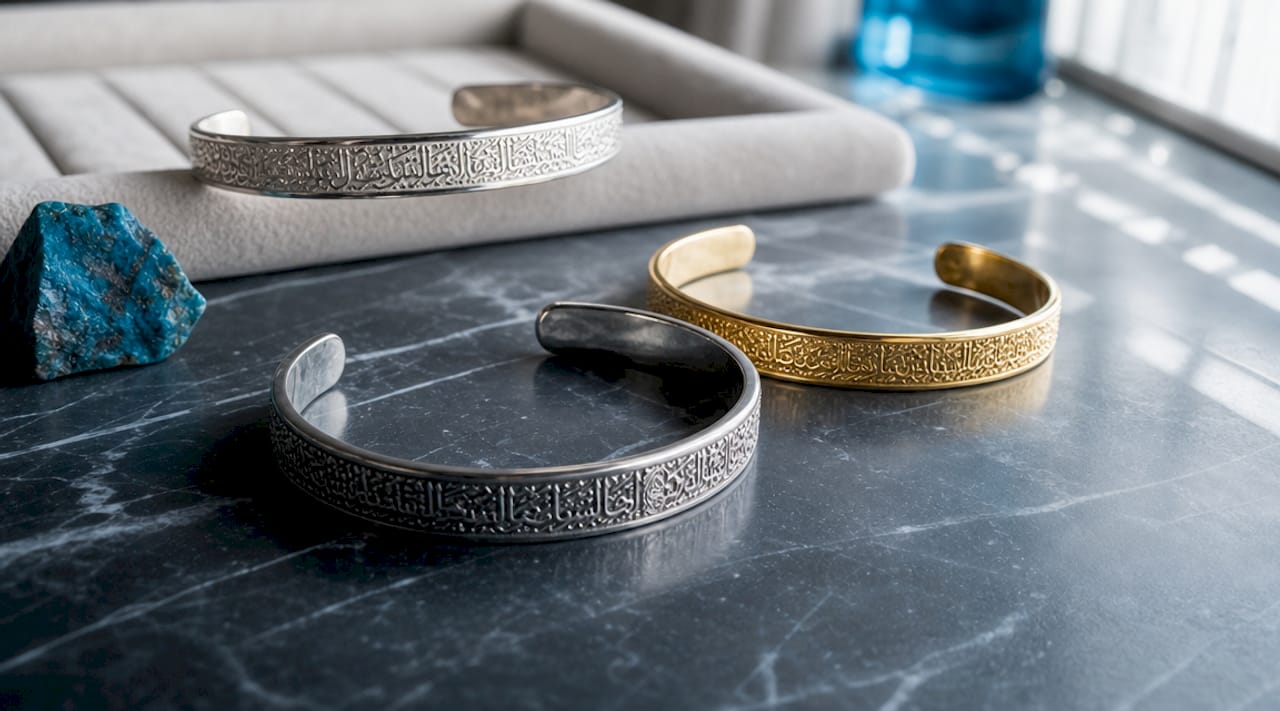
Pro Tip: If you plan to wear your Ayatul Kursi bracelet daily, choose a stainless steel base over brass-plated options. Stainless steel resists sweat and moisture far better, preserving the engraving clarity for years.
2. Kalma calligraphy bracelets
Kalma bracelets carry the Shahada, the Islamic declaration of faith, engraved or hand-set in calligraphic form. These pieces function beyond decoration. They act as visible, continual faith affirmations that are personally meaningful and socially recognizable to other Muslims. That dual role makes them one of the most spiritually significant types of Islamic bracelets available.
Kalma bracelets are commonly handcrafted on gold-polished brass with hand-set zircon stones and adjustable sizing to fit multiple wrist sizes. The combination of calligraphy and gemstone inlay gives them a ceremonial quality that suits both everyday wear and special occasions like Eid or a wedding. Because the Shahada is the foundation of Islamic belief, wearing it on your wrist carries a weight that most other inscriptions do not.
3. Tasbih prayer bead bracelets
Tasbih bracelets consist of 33 or 99 beads traditionally used to count dhikr (remembrance of Allah), but they are increasingly worn as wrist accessories with spiritual intent. The bead count corresponds to the 99 names of Allah or the three phrases repeated 33 times each after prayer: SubhanAllah, Alhamdulillah, and Allahu Akbar. Wearing a tasbih bracelet keeps that practice physically present throughout the day.
Materials range from natural gemstones like onyx, turquoise, and lapis lazuli to wood, resin, and sterling silver. Onyx is particularly popular in unisex prayer bracelets because of its neutral color and its association with strength in Islamic tradition. Tasbih bracelets also stack well with cuff-style pieces, which has made layered bracelet styling a growing trend in Muslim fashion.
4. Arabic-style gold bracelets
Arabic-style Islamic bracelets are defined by their use of high gold purity, typically 18k or 21k, and bold, weighty designs that reflect traditional Gulf and Levantine aesthetics. These pieces are preferred for their investment value as much as their beauty. When you buy an Arabic-style gold bracelet, you are acquiring something that holds monetary worth alongside spiritual meaning.
The designs tend toward geometric patterns, bold chain links, and minimal but precise calligraphy. They are less likely to feature colorful stone inlays and more likely to showcase the purity of the metal itself. Arabic bracelets align with Islamic traditions for weddings and significant life events, where the gift of gold carries both cultural and religious weight.
5. Turkish-style Ottoman artistry bracelets
Turkish-style bracelets draw from Ottoman-era craftsmanship, featuring intricate filigree patterns, zircon stone embellishments, and lightweight gold-plated construction. They are favored for daily wear precisely because they are lighter and more affordable than solid Arabic gold pieces, while still carrying strong visual and cultural identity. Turkish bracelets are popular gifts for weddings, Eid, and Hajj due to their artistic design and accessible price points.
The Ottoman influence shows in the layered geometric motifs and the use of colored stones, particularly deep blues and greens, that echo the tilework of historic mosques. These bracelets feel ceremonial without being impractical. A Turkish-style bracelet with zircon inlays is the kind of piece that photographs beautifully and wears comfortably, which is why it has become one of the most gifted types of Islamic bracelets in recent years.
Pro Tip: Turkish bracelets with zircon inlays require storage away from moisture and perfumes to preserve the stones and plating. Keep them in a dry pouch or box when not in use.
6. Handmade sterling silver kada bracelets
The kada is a solid bangle-style bracelet with roots in South Asian Muslim tradition, worn as a symbol of faith and identity. Handmade versions like the Watwaan Kada use 925 sterling silver and require precise sizing between 6.5 and 9.5 inches, with weights ranging from 33g to 60g depending on design. Unlike adjustable cuffs, a handmade kada is a fixed structure, and forcing it onto the wrong wrist size will damage the piece permanently.
The kada’s simplicity is its strength. A plain or lightly engraved silver bangle communicates faith and cultural identity without requiring explanation. For men especially, the kada offers a way to wear Islamic jewelry that feels grounded in tradition rather than trend. It is one of the few bracelet types where the material itself, solid silver, carries as much meaning as any inscription.
7. “Hasbi Allah” and reminder phrase bracelets
Reminder phrase bracelets carry short Arabic expressions of trust and reliance on Allah, with “Hasbi Allah” (Allah is sufficient for me) being among the most popular. Adjustable cuff bracelets with these inscriptions accommodate most wrist sizes, which simplifies gift selection considerably. The phrase functions as a daily reminder that is both personal and universally understood within Muslim communities.
These bracelets tend toward minimalist design, letting the calligraphy carry the visual weight. They work well in stainless steel or silver-plated finishes and pair naturally with other bracelet types for a stacked look. The emotional resonance of a phrase like “Hasbi Allah” makes this category one of the most meaningful choices for gifting during difficult times or personal milestones.
8. Stacking and layered Islamic bracelet sets
Layered bracelet styling has grown significantly in Muslim fashion, with wearers combining tasbih beads, cuff bracelets, and thin chain bangles into a single wrist composition. The role of jewelry in Muslim identity has expanded to include personal expression alongside religious observance, and stacking sets reflect that shift. A well-composed stack might include an Ayatul Kursi cuff, a strand of onyx tasbih beads, and a thin gold-plated chain bangle.
The key to a cohesive stack is keeping the metal tones consistent, either all gold-toned or all silver-toned, and letting one piece carry the primary inscription while the others serve as supporting elements. Stacking sets are also practical gifts because they offer variety and allow the recipient to wear pieces individually or together depending on the occasion.
9. Enamel and geometric symbol bracelets
Not every Islamic bracelet carries calligraphy. Geometric symbol bracelets use patterns drawn from Islamic art, including the eight-pointed star, arabesque motifs, and the crescent moon, rendered in enamel or engraved metal. These designs are rooted in the Islamic artistic tradition of expressing the divine through mathematical precision and pattern rather than figurative imagery.
Enamel bracelets add color to the category, with deep navy, forest green, and white being the most common choices in Islamic-inspired designs. They are particularly popular among younger Muslim wearers who want to express faith through fashion without wearing text-based inscriptions. These pieces also tend to be the most accessible entry point for non-Muslim gift-givers who want to honor a Muslim friend or family member respectfully.
Key takeaways
The most meaningful unisex Muslim bracelets combine Qur’anic inscription, durable material, and regional craftsmanship to serve both daily faith practice and personal style.
| Point | Details |
|---|---|
| Ayatul Kursi cuffs lead the category | Stainless steel or silver-plated open cuffs with Throne Verse engraving are the most recognized and widely worn type. |
| Regional style shapes the piece’s purpose | Arabic gold bracelets prioritize investment and tradition; Turkish pieces prioritize artistry and daily wearability. |
| Material determines longevity | 316L stainless steel and 925 sterling silver outperform plated brass for daily wear and long-term durability. |
| Sizing matters for handmade pieces | Fixed designs like the sterling silver kada require accurate wrist measurement; adjustable cuffs simplify gifting. |
| Inscription carries the emotional weight | Phrases like “Hasbi Allah” or the Kalma transform a bracelet from an accessory into a personal act of faith. |
What I’ve learned from years of wearing and gifting Islamic bracelets
The conversation around Islamic jewelry has changed. When I first started paying attention to this category, the choice was essentially between a plain gold bangle and a tasbih strand. Now, the range of unisex Muslim bracelet types reflects a genuine maturation of Muslim fashion, where faith and personal style are understood as compatible rather than competing.
What I find most interesting is how the material choice reveals the wearer’s relationship with the piece. Someone who chooses a solid 925 sterling silver kada is making a statement about permanence and tradition. Someone who layers a stainless steel Ayatul Kursi cuff with onyx beads is expressing something more personal, a faith practice that is also a visual identity. Neither approach is more correct. Both are honest.
My strongest recommendation for anyone gifting an Islamic bracelet is to choose the inscription before the material. The phrase or verse you select communicates your intention more clearly than the metal ever will. An Ayatul Kursi bracelet says “I want protection for you.” A Kalma bracelet says “I see your faith and I honor it.” A “Hasbi Allah” piece says “I know you are going through something, and I am making dua for you.” That specificity is what makes Islamic jewelry meaningful rather than merely decorative.
One practical note: if you are buying for someone whose wrist size you do not know, always choose an adjustable cuff or a tasbih-style bracelet. Handmade fixed pieces like the kada are beautiful, but an ill-fitting bracelet, no matter how meaningful the inscription, will sit in a drawer.
— Elias
Explore meaningful unisex Muslim bracelets at Cairojewellery
Cairojewellery is a Sweden-based Islamic jewelry brand that designs unisex pieces built around Qur’anic verses, spiritual reminders, and the kind of craftsmanship that holds up to daily wear. The Ayatul Kursi Bracelet uses a stainless steel base with gold or silver plating, adjustable to fit most wrists, and priced at around €35. Every order through Cairojewellery also contributes to the ShareTheMeal program, donating meals to those in need. Whether you are choosing a piece for yourself or someone you would make dua for, the collection is worth exploring. Worldwide shipping is available, and the designs are created with both faith and modern style in mind.
FAQ
What are the most popular unisex Muslim bracelet types?
The most popular types include Ayatul Kursi engraved open cuff bracelets, Kalma calligraphy bracelets, tasbih prayer bead bracelets, and reminder phrase pieces like “Hasbi Allah.” These styles work across genders because of their adjustable sizing and spiritually universal inscriptions.
What material is best for a Muslim bracelet worn daily?
316L stainless steel is the most practical material for daily wear because it is hypoallergenic, rust-resistant, and holds engraving detail well over time. Sterling silver (925) is a strong second choice, though it requires occasional polishing to maintain its finish.
Are Muslim bracelets appropriate gifts for Eid or weddings?
Yes. Turkish-style bracelets with zircon embellishments and Kalma calligraphy pieces are among the most gifted Islamic bracelets for Eid, weddings, and Hajj. Adjustable cuff bracelets with Qur’anic inscriptions are particularly practical gifts because they fit most wrist sizes without requiring measurement.
What is the difference between Arabic and Turkish Islamic bracelet styles?
Arabic-style bracelets use high-purity gold (18k or 21k) and bold designs suited for investment and ceremonial occasions. Turkish-style bracelets use lighter gold-plated construction with intricate Ottoman motifs and zircon stones, making them better suited for everyday wear and gifting.
Where can I buy unisex Muslim bracelets online?
Cairojewellery offers a range of unisex Islamic bracelets in stainless steel and gold or silver plating, designed around Qur’anic verses and shipped worldwide. When shopping online for Muslim jewelry, look for brands that clearly state their base material, plating type, and sizing details before purchasing.